The international DETECTIVE project will be developing new, data-driven methods to detect and respond to emerging and re-emerging viral threats at an earlier stage than before.
The European Commission has awarded the DETECTIVE (Data driven Excellence in Training of Epidemiological, Clinical, Technological and Innovative Virus Experts) consortium a total of 4.4 million euros in funding. This Horizon Europe Marie Sklodowska-Curie Actions (MSCA) doctoral network will train 14 doctoral researchers in an integrated programme of virology, evolutionary genomics, epidemiology, diagnostics and AI-based analytical methods, so that complex research and surveillance data can be transformed into real-time, evidence-based decision-making and direct clinical application.
“By establishing a unified, end-to-end epidemic-intelligence framework – and the expert workforce required to sustain it – DETECTIVE will strengthen European countries capacity to anticipate, detect, and respond to emerging viral threats, enhancing resilience and preparedness for future pandemics,” says Professor of Virology Heli Harvala, the DETECTIVE Consortium Lead, at the University of Turku.
Toward proactive epidemic intelligence
Emerging and re-emerging viral infections are straining healthcare systems, economies, and societies across Europe. The COVID-19 pandemic clearly highlighted the challenges associated with diagnosing, monitoring, and predicting epidemics: viral diagnostics, infection surveillance, and data analytics are fragmented, and cross-disciplinary expertise is lacking. Together, these factors limit Europe’s ability to anticipate, detect and manage new viral threats and result in a proactive approach.
DETECTIVE addresses this challenge by developing a comprehensive training and research programme that covers the entire chain from clinical diagnosis, virus detection to risk assessment and support for public health and clinical decision-making.
The project utilises, among other things, next-generation sequencing, organoid and culture models, wastewater and blood-donor surveillance, and multi-omics data. These are combined with AI-based analytics and epidemic models, which can be used to generate information that supports practical actions in rapidly changing epidemic situations.
“DETECTIVE’s mission is to train a new generation of scientists equipped to detect emerging pathogens earlier, understand who is most at risk, and translate the complex multi-source data into real-time, evidence-based decisions,” says Dr Kim Benschop, the DETECTIVE Training Lead from the Netherlands.
14 doctoral researchers in five countries – close collaboration between universities, government agencies, and industry
DETECTIVE is an interdisciplinary and intersectoral network involving 8 beneficiaries and 14 associated partners across five European countries. The network will train a total of 14 doctoral researchers in five countries: Finland (5), the Netherlands (3), Denmark (1), Spain (2), and the United Kingdom (3).
In addition to the University of Turku as the consortium coordinator, DETECTIVE members include the University of Tampere in Finland, Nordsjallands Hospital in Hilleroed and University of Copenhagen, Denmark, Amsterdam University Medical Centre and the National Institute for Public Health and the Environment in the Netherlands, University Hospital Vall d’Hebron in Barcelona, Spain, as well as the University of Glasgow and the University College London in the United Kingdom. Close collaboration with associated industrial, academic and non-academic partners will strengthen the intersectoral dimension of DETECTIVE consortium.
“DETECTIVE consortium continues to build from the European Non-Polio Enterovirus Network, ENPEN, founded 10 years by myself, Associate Professor Eeva Broberg and Professor of Virusepidemiology Thea Fischer from Denmark. This means the DETECTIVE is built on a solid foundation and I truly look forward to continuing from our long-standing collaborations further,” says Heli Harvala.
The programme will produce a new generation of virus experts who are able to bridge laboratory science, data analytics, and public health practices with skills needed for international collaborations. The goal is to develop new tools, standards, and decision-making frameworks that will strengthen Europe’s capacity to respond to new health threats quickly and in a coordinated manner.
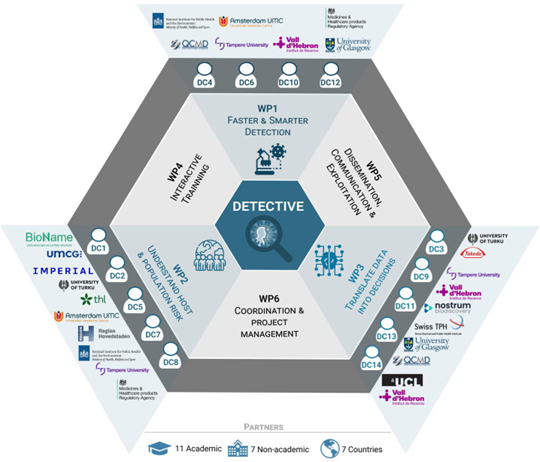
Kuva: DETECTIVE-hankkeen yhteistyökumppanit.