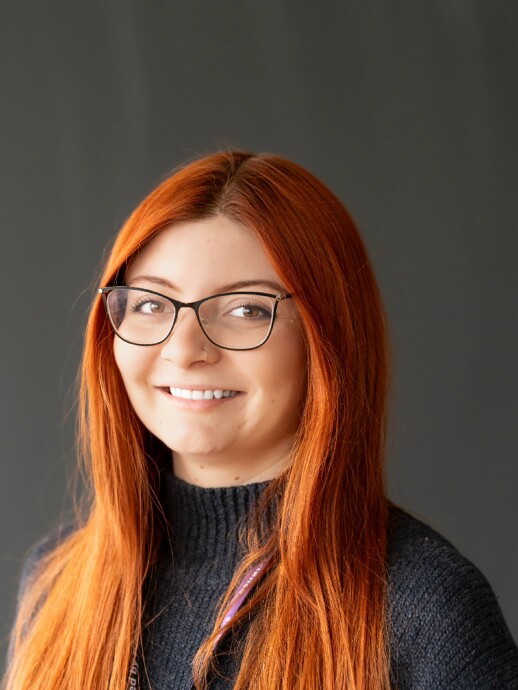
Nataly
Vidal Realpe
Contact
Links
Areas of expertise
Dissipative Particle Dynamics (DPD)
Computation of Rheological properties using Green-Kubo and Reverse Non Equilibrium Molecular Dynamics.
Soft Condensed Matter.
Nanomaterials synthesis and characterization.
Biography
I completed my bachelor’s degree in Physics Engineering at the University of Cauca, Colombia. During this time, I participated in an exchange semester at the University of Guanajuato in Mexico, where I synthesized calcium aluminate materials with thermoluminescent properties.
I then pursued a master’s degree in Materials Science and Engineering at Queen’s University Belfast, UK, where my thesis focused on the application of neural networks to clay materials. Following this, I undertook a one-year internship at the Centre for Process Innovation (CPI) in Sedgefield, UK, gaining hands-on experience in materials synthesis and characterization. In this role, I worked with nanomaterials such as dielectric inks and graphene oxide, and I also conducted molecular dynamics simulations of modified graphene oxide structures.
Currently, I am a PhD student in the Doctoral Programme in Technology at the University of Turku, under the supervision of Prof. Alberto Sacchi, where my research involves simulating HEUR polymers to investigate their linking behavior and rheological properties.
Teaching
- Teaching assistant in the course Multiscale Modelling MTEK0033 (Spring 2026)
Research
My research focuses on developing a coarse-grained molecular dynamics (CG-MD) model of hydrophobically modified ethoxylated urethane (HEUR) polymers in water and colloidal suspensions to explore their self-assembly behavior and their influence in the rheological properties of the system. Using LAMMPS simulations with Langevin dynamics, I analyze the influence of polymer concentration and transient networks in the viscosity and relaxation times of the system, aiming to optimize HEUR formulations for more stable, high-performance, and eco-friendly materials.