In March 2024, the Ministry of Education and Culture published a report (Ministry of Education and Culture Publications 2024:14) examining how the removal of the mandatory second national language—Swedish or Finnish—from the matriculation examination has affected language competence.
The report shows that, in particular, Swedish proficiency has clearly declined since the compulsory second national language requirement was removed from the matriculation examination starting with the spring 2005 exam session. The number of students choosing to write the Swedish exam has dropped dramatically: between 2017 and 2022, only about 21–26 percent of male students and 43–55 percent of female students took the Swedish matriculation exam.
Clear differences between men and women are also visible in the Swedish grades on upper secondary school diplomas. About 20 percent of male students and just over 40 percent of female students achieve a grade of eight (8), which is considered the level required to reach the upper secondary school learning target of B1 in Swedish. The majority of new graduates therefore do not reach the upper secondary Swedish learning target, which in turn is the required starting level for Swedish studies at universities and universities of applied sciences. As a result, many higher education students today face challenges in completing the Swedish studies included in their degrees, which are required by law to demonstrate competence in the second national language.
The goal of the Svenska upp project, to be implemented in the 2025–2026 academic year as a collaboration between universities and universities of applied sciences, is to create a concrete operational model for improving higher education students’ starting level in Swedish. Individual institutions do not have the resources to provide enough teaching and guidance to bridge this skills gap, but through collaboration, the project aims to find workable solutions.
The University of Turku’s Centre for Language and Communication Studies, (Kievi), is participating in the Svenska upp project, which is funded by the Ministry of Education and Culture and includes ten universities and universities of applied sciences. During the project, online teaching modules will be created (a total of 20 ECTS credits) for levels A1–A2.
Teaching Materials and Ready-Made Modules for Higher Education Institutions
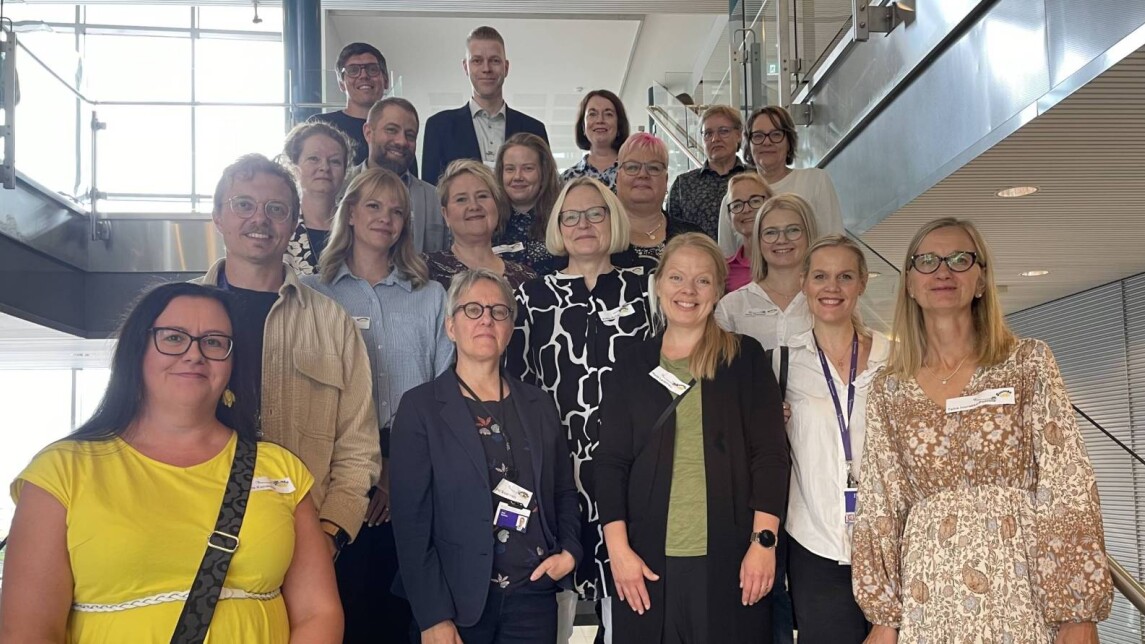
Representing Kievi in the project is university lecturer in Swedish, Miina Vaaramo, who describes the work as follows:
“The project began in August 2025 with a joint kick-off event where we started planning and brainstorming the modules and met our project partners. My partner is Susanna Kananoja from JAMK University of Applied Sciences. After that, we began developing our own modules together. Each pair produces four ECTS credits' worth of learning materials in the project. In total, there are five such four-credit units.
“The Svenska upp project website has been published, and the participants have got off to a good start in their work. The creation of pedagogical scripts for the course modules is in its final stages, and next up is building the Moodle platforms.”.

We started the work by familiarizing ourselves with the CEFR level descriptions and by creating a pedagogical script. The script outlines the broad structure of each module: objectives, content, tasks, guidance and feedback, assessment, and time allocation.
Teaching material is currently being developed in the shared Moodle environment of Tampere University and Tampere University of Applied Sciences. During autumn 2025, each pair will produce material covering two ECTS credits. The remaining two credits will be developed in spring 2026. The teaching materials will be shared through the Open Learning Materials Library for use by all higher education institutions. From there, institutions can adopt the full 20-credit package or select smaller parts of it.
The project involves a great deal of learning! Working with a partner helps in brainstorming tasks and selecting different implementation methods. The webinars and workshops organized within the project introduce new applications that encourage us to challenge old practices and create new ones. The pedagogical script and close collaboration help keep the overall project organized.
The end result will be diverse and high-quality learning material that covers levels from beginner (A1) to close to B1. This will give universities the possibility to bridge the existing skills gap or to offer Swedish studies starting from the very beginning!”
Hanna Ruska and Miina Vaaramo