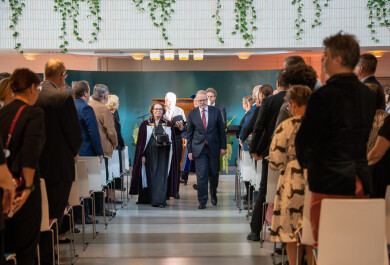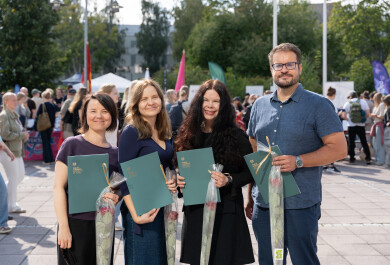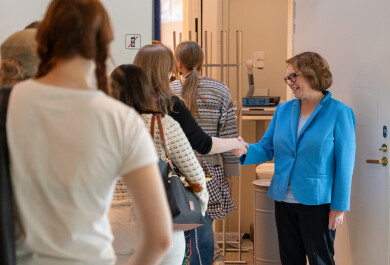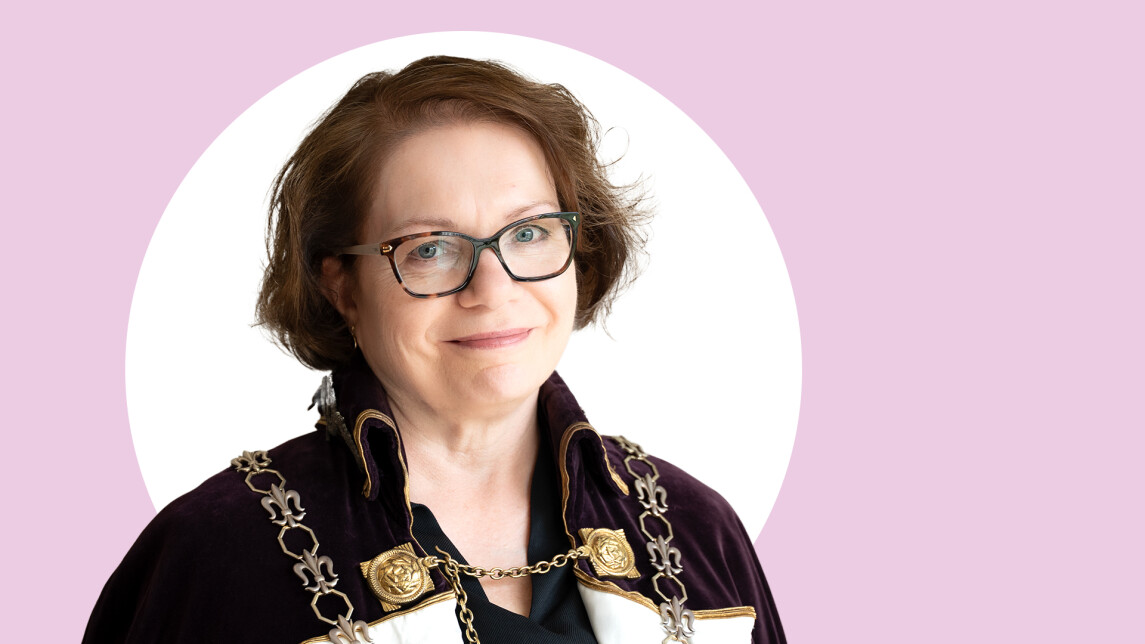
Yesterday, we opened the academic year 2026–2027, the University's 106th year in operation, together with the whole University community, in the company of our friends. During the day, we gathered for the Opening Carnival to welcome new students and to meet friends and colleagues at the start of the new academic year. While we enjoyed the Carnival, I had the opportunity to talk to the participants about our community. I said that a university is like a family. Many things take place within it, yet it remains a strong community where everyone can be themselves and feel that they belong.
The existence of our community, of the entire University, is based on science and scholarship. We cannot ignore the sentiment that is sweeping across the world: researched knowledge, science and scholarship, researchers, and universities are facing dire challenges. The University, the University community, and, more broadly, our stakeholders should pause to reflect on this serious matter.
Just under two decades ago, we believed we had achieved a rather ideal societal situation. Our postmodern world, which many of us found reasonably pleasant, seemed to be opening up and, at the very least, striving towards equal rights. Perhaps we failed to realise that we were living in a bubble, building a world in which the pursuit of self-interest seemed to be all that mattered.
In this post-postmodern era, people easily respond with a counterattack, or resort to confrontation. I have given a great deal of thought to why science and scholarship are once again targets. I think the answer is, ultimately, quite simple: research is conducted independently and is therefore not at the service of anyone, not even those in power.
We are already on a path where the understanding of research and its role is becoming blurred. Academic freedom has also been deliberately misinterpreted, and the concept of freedom is taking on increasingly negative connotations. We should rather talk about academic independence.
Independence means that research is critical, systematic, and self-correcting. Research does not yield to external pressures. It is guided by shared principles that do not change according to the interests of funders, commissioners, or political agendas.
The role of research is not to reinforce a doctrine, a world view, or arbitrary opinions. We know all too well from the past that researched knowledge is a threat to those who seek to become dictators and to totalitarian regimes. If science and scholarship do not bend to the will of a dictator, if they do not bow at the altar of dogma, they are pushed aside or, at the very least, constrained. In this respect, history seems to repeat itself with uncomfortable frequency. If only we humans had a better memory of history.
Yesterday, I told colleagues, students and our friends that, when faced with challenges, we must make a choice—we choose to trust that people in Finland still believe in research. However, we must remain vigilant, as mental landscapes are shaped in subtle ways.
We choose to trust that people in Finland still believe in research.
The research conducted at our multidisciplinary University affects people’s lives in many ways and is often so closely connected to everyday life that we may not necessarily stop to consider the day-to-day significance of research. In recent weeks, for example, we have shared information about new potential areas for drug development, ways to alleviate anxiety in children and young people, and how laser scanning in the Amazon has revealed the impact of an ancient civilisation, which can be factored into climate models. Soft robotics and bio-based electronics have also been in the spotlight.
Research is not a villain, it is an ally. Research is an ally to those who want to create innovations and economic growth, it is an ally to those who want to understand the past or the future. Research is your ally when you want to use clean energy or invest in it, research is your ally if your child gets sick.
Research is also of utmost importance for the future of Finland. Universities generate new knowledge, understanding and expertise, providing the foundation upon which democracy, security, education, a sustainable economy, and the renewal of society are built. Without this foundation, Finland will be left merely reacting to global changes, rather than being able to build the better future we seek.
Rector of the University of Turku