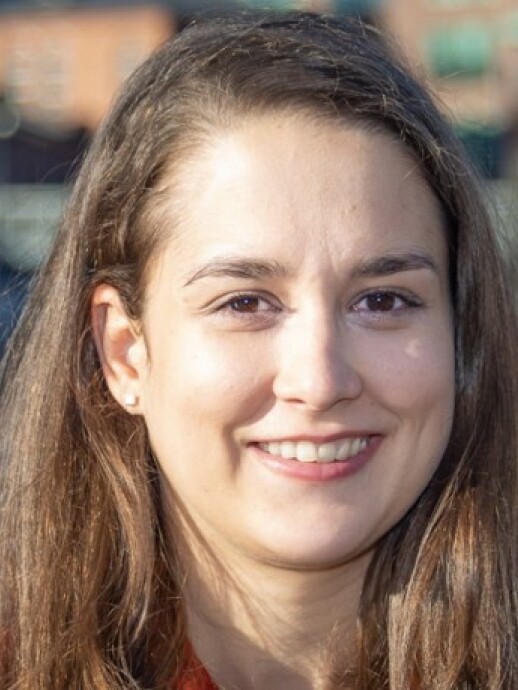
Monica
Sanchez Torres
Contact
Links
Areas of expertise
Biography
I am a sociolinguist with expertise in gender and multilingualism. My academic and professional journey across Spain, the UK, Austria, and Finland has shaped my interest in how language intersects with identity, inclusion, and social change. I hold a joint PhD from Tampere University and Universidad de Alcalá, where I examined the processing and perception of sexist and inclusive language in a second language using eye-tracking and survey methods.
I have taught a variety of courses in Spanish language and linguistics and co-designed an interdisciplinary course on gender in languages. My research and teaching are guided by inclusive, research-based pedagogy that values diversity and multilingualism. I have also contributed to international projects promoting linguistic accessibility, social inclusion, and intercultural understanding.
Teaching
Lead course instructor for Hispanic Dialectology (ESPA0019) and Spanish Pronunciation and Phonetics (ESPA0076), and co-teacher in Academic Writing Skills II (ESPA0055), Research Seminar (ESPA0065), and Academic Writing Skills III (ESPA0083).
During the 2025-2026 academic year, taught Hispanic Dialectology (ESPA0019), Spanish History and Society (20th-21st Centuries) (ESPA0053), and Advanced Spanish Grammar (ESPA0075), and served as a co-teacher in Academic Competencies (ESPA0052). Responsibilities also included the assessment and grading of Spanish Sociolinguistics and Sociology of Language (ESPA0025), Semantics and Pragmatics, Spanish (ESPA0026), and Language Policy and Planning (ESPA0031), as well as participation in the evaluation of Master's theses in Spanish linguistics.
Research
My research explores how language reflects and shapes identity, inclusion, and belonging in multilingual contexts. I investigate language attitudes, language ideologies, and linguistic change, with a particular interest in how speakers perceive and use inclusive language.
My doctoral research examined how speakers process and evaluate sexist and inclusive language, combining sociolinguistic and cognitive approaches such as eye-tracking and survey methods.
More recently, my work has expanded towards heritage language studies, multilingualism, and linguistic accessibility. I am currently developing a project on Spanish as a heritage language in Finland, focusing on language maintenance, intergenerational transmission, identity, and community engagement among Spanish-speaking families.
I am also interested in multilingual access to public information and services. My current work examines the multilingual accessibility of online information provided by maternity and child health clinics. In addition, I continue to explore multilingual education and decolonial perspectives on language and knowledge production.