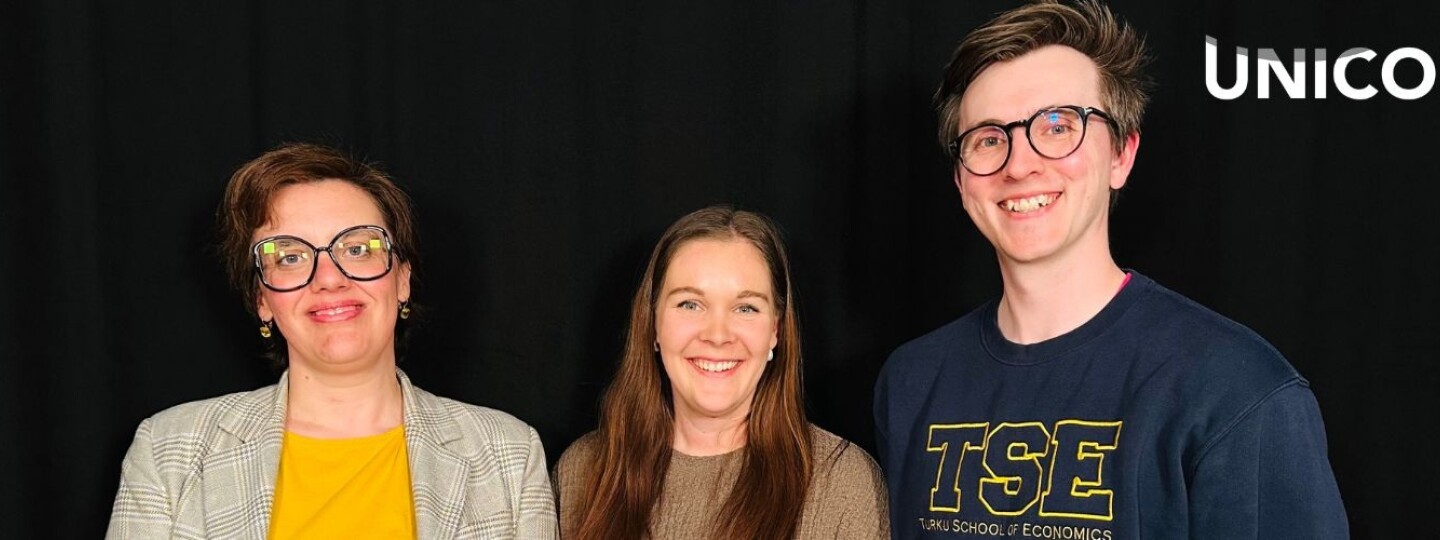
Is language a barrier to employment in Finland—or can it also be an opportunity? In this UNICOM+ podcast episode, we explore how language requirements are viewed in recruitment and how international professionals can approach job-hunting even with limited Finnish skills.
The episode is hosted by Lucia Vuillermin, International Relations Coordinator at Turku University of Applied Sciences, and Jonathon Murphy, Project Coordinator at the City of Turku. They are joined by Lotta Kaunonen, Talent Acquisition & Employer Branding Manager at Elomatic Oy, who shares an employer’s perspective on recruitment.
Topics covered:
- How employers define and evaluate language requirements
- When Finnish language skills are essential—and when they are not
- How to highlight your strengths beyond language proficiency
- Different perspectives on language as a barrier in recruitment
Find more information:
The UNICOM+ podcast series is designed to help international talents residing in Finland navigate their transition to Finland and, later on, to the Finnish job market. The podcast series is produced in collaboration with the University of Turku, Turku University of Applied Sciences, and Åbo Akademi University. UNICOM+ project (2025–2027) is co-funded by the European Union.
This episode is co-produced in collaboration with the PURJE project.
UNICOM+ podcast series is produced by Junaid Raza.
Length of the episode is 34 minutes.
You can also listen on:
Text alternative for the episode:
Lucia: Hello. Welcome again to a new UNICOM+ podcast. Today we have Jonathan, but not as a guest this topic.
Jonathon: No. Hi everyone. I'm delighted to be the co-host of this episode. A much more comfortable position to be in. My name is Jonathan Murphy. I am from the city of Turku. I'm a project coordinator and nice to be invited back.
Lucia: Thank you. Nice to have you back. And my name is Lucia Vuillermin. I work at Turku University Applied Sciences as international relation coordinator. Very fancy title.
Jonathon: Very fancy. But not just you and me today, Jonathan. No, we actually have a guest. So, welcome Lotta. Welcome to our UNICOM+ podcast. Would you like to tell a bit about yourself? What do you do? And why did you join us today? maybe.
Lotta: I was forced to be here. [laughter] Thank you very much. Yes, My name is Lotta Kaunonen and I work at Elomatic as talent acquisition and employer branding manager since last October. I've been working in HR and marketing in recruitment and talent acquisition about 10 years and finding the right talent and try to help young people also to grow as professionals. It's totally my passion I would say and I love my work trying to find and also retain and keep the right talents. So I think that's why I'm here. And yeah, I'm also quite active with universities and university partnerships we have at Elomatic. So yeah, it's great to be here with the important topic and
Jonathon: Really good to have you here because again I think many of the the people listening and watching to this maybe will be quite familiar with the services the career services at the universities or maybe they've used some services by international house but I think really you know we get a lot of requests from our students and our clients to really hear from the companies themselves. So no pressure.
Lucia: But we want to hear today about a topic that I think is the most discussing topic is the first things that always come when international students are looking for jobs in Finland is the language. Language requirement especially in recruitment. We know that Finnish is not the easiest language in the world but is doable. We can say that. But I think that that what their students ask the most. Do you agree?
Jonathon: Yeah, absolutely. And of course we work with a lot of like newcomers at international house tour and I think a lot of people have an idea of where they would like their career to go when they move to Finland or when they graduate and then I guess they hit this barrier or this was like hey all the jobs I want to go into all the adverts are in Finnish and Finnish is needed. So again we thought we'd bring you in today to to sort of dig a little deeper into this.
Lucia: HR perspective.
Jonathon: Yeah, the HR perspective.
Lotta: Sounds good.
Lucia: So let's dive into the topic, let's say, and how central do you really think that the Finnish language is when you apply for a job in the recruitment process in Finland?
Lotta: I would say the boring answer is that it's role based as always. Of course, we have roles that you can work in any languages basically. And then we have roles that you really need Finnish or actually also Swedish in Finland. And I would say that for example in customer service in public sector or also in some expert roles in technical field as well you might need Finnish little or more depends usually on the customers for example or the business you are working in. But the good news is that I would say that the English work environments are growing fast. Companies are more and more global, the customers are more and more global. So it's more natural that if you speak English with customers and partners, why not also internally. So and that's what we do at Elomatic as well. So we have grown global a lot. So we are also change changing the internal language more and more English.
Lucia: It's a process of course.
Lotta: It's a process. It's a change management I would say also but it's more and more usual in Finland. I would say that.
Luicia: Okay. That's great to hear.
Lotta: Yeah.
Jonathon: Yeah. I think again we all know that numbers of international students and graduates have been growing quite significantly in Finland over the last let's say five years for example. So maybe sometimes it feels like workplaces haven't quite grown at this globally at the same rate but good to hear that those changes are happening
Lucia: And happening in Turku as well because we always hear unfortunately of talents that they graduate from our university and then they have to move to the capital region to find more companies that their language is English. Yeah. So, but good you mention even Swedish because in this project we'd have even as our partner universities Åbo academy and of course for there the language is Swedish. So, good point. Sometime we forget.
Lotta: Yeah. Yeah.
Lucia: Because we think Finnish is difficult enough for us.
Lotta: Yeah, we have two difficult languages.
Lucia: But let's say that Swedish I never studied. Did you [Jonathon] study Swedish a bit?
Jonathon: I took a beginner Swedish class here at the University of Turku. “Jag är Jonathon. Jag kommer från England. Hur är det? “ that’s is it end of conversation with the greatest apologies to my Swedish teacher.
Lotta: Yeah. Yeah.
Lucia: But do you think it's like a bit more easier if you're like English speaker?
Jonathon: I guess that's what they say. I think German as well. I've heard that Swedish is closer to German. But from it's funny actually from working in integration that actually like if you move here, you know, before your studies or as a family member of a student, you can kind of do this integration path through the employment region. And you can do that in Swedish if you want to. And I think a lot of newcomers actually do think okay well Swedish is much easier. So I will go forward with that process in Swedish. But of course for the job market at least in Southwest Finland I think we found anecdotally at least that that English is actually in some ways better preferable to Swedish just because of the types of companies that are here. And yeah, it's always a disappointment for someone where it's like, "Nope, you have to learn Finnish. You have to go through Finnish." Even though it's a little bit more challenging.
Lucia: I think we will have actually a podcast about the the Swedish language with our colleagues with Maria.
Jonathon: Yeah, this is this is all this podcast we got. Swedish is, you know, culturally Swedish is very important for us. We'll say it is.
Lotta: It is.
Jonathon: Well, maybe we can open up and really crack into this this term language which like do you feel that that when you're talking about language and language requirements that what the company and Elomatic in this case is saying do you feel that's kind of the same concept or perception as maybe internationals have like are you a Finnish speaker because I think again there are lots of levels between beginner and fluency and there are also lots of different types of vocabulary and for example we meet lots people, you know, their Finnish levels are actually quite good. You know, they might be at kind of intermediate level, B1 level, but of course, their vocabulary is from a textbook. It's not industry specific. So, they can talk very nicely about their hobbies and what they had for dinner and their family tree, but maybe they can't talk about, let's say, the customer service that is provided, but
Lucia: The technical terms.
Jonathon: In technical terms, yeah, but do you have any thoughts on this kind of mismatch maybe between the two?
Lotta: Yeah, I would say that from recruitment perspective the biggest mismatch is that companies write down the language requirement for example Finnish and sometimes applicants think that I need to have the native fluency for the Finnish languages even if even the basics helps or even it helps that you can speak with the team Finnish and there might be some team members who can speak with clients or partners partners or so on. So I think that's the biggest mismatch. Of course there are roles that you need native Finnish but I would say that in Finland we are quite straightforward in communicating the requirements. So at least for example Elomatic if there is no language requirements, we don't write that to the job advertisement. So, and when we write that, we really mean it. So, I think that that's really also like Finnish culture. But of course, we should be more and more clear what we mean when like you say, there are a lot of levels, lot of ways to speak Finnish. So we should I think that employers should be more clear of how do you need the language, what is the level that you need the language in what kind of projects, tasks, what kind of people or partners you need that. So it's much more easier easy to understand if my language level is what is needed, if it's enough or if it's some or not.
Lucia: Yeah. I think this is the question that is most asked from the students how how much Finnish is needed.
Lotta: Yeah.
Lucia: But I think we should even switch a bit perspective from the students point of view because somebody that has been studying the language and we know that they um always think about the level like A2.2, B1, C, and then doesn't really talk to companies if they don't understand. So understanding your level not in terms of numbers or or like letters but what you really can do or not do and then it's a easier conversation with the the recruiters like am I that level that is actually needed. So when you specify maybe the tasks or what what is involved in the daily routine of your job then you make an assessment easier.
Lotta: Yeah.
Lucia: And on that topic, I would like to even to tips for our students. Yeah. that when you they don't understand, is any easier that they could call the recruiter and ask because I noticed and we were having the discussion behind scene with Jonathan students do not call companies even if doubts. Do you notice the same?
Lotta: Not actually. I would say that international students and applicants they call a lot and they email a lot as well even more than I would say Finnish applicants. So I would say that they are more active in asking if there is something unclear, something is not well explained or they don't they want to know more talk more about the role and usually we have also at Elomatic we have always a contact person in the job advertisements. So the idea is that he or she is the one who to call to and ask more details about the requirements. But then again I would like to add actually to the previous that there might be some needs for the Finnish requirements of course based on safety rules based on regulations you need to understand or use Finnish law or you need to do some reporting or documentation. So, I think that even we are growing more global also in the work life in Finland, we still have a lot of paperwork in Finland.
Lucia: So, bureaucracy is the thing when Finnish is very important.
Lotta: Yes, it is. And those are examples and also the reasons why sometimes we need the native fluency or like excellent fluency in Finnish. But then again there are a lot of roles that that is not needed and you can work perfectly in English.
Jonathon: Yeah. So I think we've heard similar stories and kind of like kind of frustrations maybe from from students where yes the actual role could work in English very well but everything else the HR the contract the payroll. Well yeah it just you know that that wider bureaucracy which is kind of getting easier I guess in the age of as translation software increases as well can help.
Lucia: Nowadays really there are so many tools that they can help you.
Lotta: That's true and they are really good and we also use them a lot in our company. So we have AI, we have all kind of translations if there is a need for that in a team meeting or with the customers.
Lucia: And they’re getting better and better.
Lotta: That's true.
Lucia: So that's true that very So you maybe you don't need to be fluent in Finnish but it's good to be fluent in AI for example.
Lotta: Yeah. And I would say communications overall. So I think that work life is a lot about communications about people about how you interact with with people. So language is one point but then again if you are communicating well in other ways. Yes. So it can compensate a lot and of course when we think about recruitment the we are always trying to see the whole picture. So the key is the experience the skill set you have what you can do. So of course you can compensate it with language but the most important thing is always the experience at least for us when we are looking for technical experts.
Lucia: Of course.
Jonathon: Okay this is good to know because again we are sometimes asked from especially from graduates or students kind of finishing their thesis is like okay well now do I spend the next three months really going deep into more technical skills or spend that three months getting from basic finish to intermediate finish. I guess there's no right answer exactly but it's good to know that technical skills are are also valued even for,
Lotta: Of course and I think that they are the musthaves for the companies what you can do and what is the value for the business because recruitment is always answering to the business needs
Lucia: Yes.
Lotta: So that's why it's the most important.
Lucia: it's very good point is actually when I talk to the students I really try to Tell them to think on the other side of the coin is not like about you you you but is how you can help the business. So think on the other perspective like you are functional to support the business.
Lotta: Yeah.
Lucia: Value mission and practical daily daily task. Yeah.
Lotta: And also, when thinking about let's say application or CV, we would like you to like highlight your value for the business, not the limitations which which can be for example language.
Lucia: Yes, you can only made up.
Jonathon: Yeah. That's good to know as well. I think it's good to remember that and I've been guilty of this as well when I've been applying for things as an international that sometimes you feel like Yeah, you do focus on the limitations. So you're like, well, like this is me and like my Finnish isn't so good, but I'm okay at other things. We don't sort of project that confidence maybe in a way, whether it's the language or whether it's just a even culturally that we're sort of on the outside a little bit. But sometimes it's good because many internationals that we work with, you know, have so much relevant work experience from their home country, even though the recruiters here might not be as familiar with, you know, those companies from abroad, for example.
Lotta: Yeah. and also additional languages uh other than than Finnish because I think that if you are willing to learn language a new language it always tells about the curiosity your learning skills how you can adapt to the different situations your flexibility so willing to learn.
Lucia: Yeah. Willing to learn a language.
Lotta: Languages are always a plus.
Lucia: Yes, definitely.
Jonathon: Yeah. That's great for someone who only speaks one I say two, one and a half maybe. Yeah. But I only speak one language but I speak it very well. That's to employers. But it's funny with language because again people have often asked you know when we've been working in in these Finnish offices like you know how how did you what level do you have? But I think you know for me actually my level of Finnish has improved during work like the working environment is a great place to actually improve at least your sort of spoken Finnish. So one thing I think it's good for companies to remember is that when someone starts with a certain level or certain you know knowledge of Finnish like that will improve that's like the minimum level they will have during their time working for the company.
Lotta: Yeah. And the company helps you the team helps you like said the digital tools also the companies like we, at Elomatic have a language programs. So the idea is again that we all learn also continuously at work. So we have language partners for example for the language training. It can be English for the Finnish people. It can be Finnish for the English speaking people. So or some other languages.
Lucia: That's good to hear.
Lotta: Yeah. Many companies support really uh with the like formal uh training programs as well. But like you said, the work and the daily life is the best. Yeah. The best way.
Lucia: Yeah, I agree. But I would like to go back one second. You were talking about some job ads might have really like detailed requests for the language and you use couple of times the words native and of course for an international become native is impossible but it's possible to become like fluent maybe. So do you think that this language requirement are absolute or they can be a bit flexible like they when maybe ask for excellency then you might come up with we talk about come up with different skills. So do you think that somebody should take for like this is the rule this is you have to have this level of finish or you can bit negotiate with the company. How do you how do you perceive these levels?
Lotta: Yes, there is usually flexibility in the requirements but like said Finns are usually quite straightforward. If we say that we need professional or excellent language fluency or Finnish fluency, I think that we need that usually because of the tasks, because of the responsibilities, because of the documentation like said before. So there is a need for that to say that so strongly I would say but then again if we say like Finnish required it won't be a deal breaker I think that usually it will be something that is a big plus for you and I would say when we are again thinking about the whole picture the whole competence so if you have a weaker professional competence you can compensate it with the language a better language. Yes.
Lucia: Makes sense. So, but it's a good news.
Jonathon: Sure. Because again, I think so many students are kind of disheartened when they see the job advert finish required. It's like, oh, this is my dream job and I have everything apart from maybe the finish level. So, I guess as I mentioned earlier, calling the company you're calling, you know, making contacts maybe before spending 20 hours on the application could be deep.
Lotta: Yeah.
Jonathon: Cool. So, so far we've been talking quite hypothetically about about applicants and candidates and recruitment, but I was wondering in your career, for example, could you share a real life recruitment example? Was there an occasion where someone kind of surprised you in terms of their language requirements or maybe the candidate didn't meet the language requirements, but you were still able to move forward with the recruitment process?
Lotta: Yes, I have. And I have I'm glad because I have met a lot of international candidates and and got to interview and one I I remember a male candidate who I didn't know, he didn't express that he can speak Finnish at all. I didn't know that at all before.
Lucia: Little detail.
Lotta: A little detail. And he was really good on paper in English. But it was really a nice surprise when in the meeting in the interview he wanted to do that in Finnish and he told me that please let's do that and I speak as much as I can. So he took it more like a learning experience and learning the situation and we made a deal that of course we switch when you want to switch and when you want to express yourself better in English. So I think it was really a positive experience also for me and I was so happy that he tried he let me know that he could speak basic Finnish and it went quite good. Okay. So like the reminder is that we are in the discussion always together. We both can help each other. We both want to be understood and we can help each other to succeed in the interview. So it should be dialogue. Recruitment is always a dialogue. It's bothsided and yeah these kind of surprises of course have left to my mind.
Lucia: Do you think he stand out because he was was so like brave?
Lotta: Yes. Yes. because then it told so much about himself also in other ways like like said like the flexibility the communications overall the how he can adapt to the different situations to the new situations so this kind of surprises are always really great.
Jonathon: So that's the key then again speak and we talk about this in our own personal lives that maybe especially if you are learning Finnish you know alongside like a master's degree for example, you tend to take a more formal or academic approach to the language. Like what are the endings? What are what's the right tense? What's the right preposition? And if you don't know all of those things, you don't really want to say it because then, you know, at least I start a sentence in Finnish and then it ends up in English somehow because I've kind of ran out of steam halfway through. But I think there is something to be said for kind of bravely and boldly speaking incorrectly like in a way because you can still get the message across.
Lotta: Yeah. And I also want to say that like humans are doing the recruitment. So we are on the same side also like like me we are not native English speakers as well. So that that can be for both of us a new language or something that is not our like daily life. So, Yeah.
Lucia: Of course. I just met one of the teacher or Finnish teacher in our university and she said that she will give uh extra points to students that they are brave enough to make mistakes because now the bad side let's say of artificial intelligence is that then the students like give like perfect homework so redefine speeches and everything and she was like I want to talk with humans and humans do mistakes when they learn so extra points for mistakes.
Lotta: I agree. Yeah, because then it's again it's not personal, it's not authentic if and if you try to be too advanced I would say and with languages I think it helps in the applications or in the meeting or interview that you can use short sentences you can just speak simple basic Finnish yes or English and it always help and like you said mistakes don't matter.
Lucia: Yeah it's the same for Finnish people that don't want to speak English and then they speak perfectly and I ask “oh what do you want to be? Shakespeare?” [laughter] you speak like perfectly so it goes on there both ways like it is a lesson for me I should try to be a bit more brave.
Jonathon: I think that's good message for us all and I really liked what you said about about kind of swapping languages in the interview and actually this is one of the things that I was trained in with the employment region back when I before I was a student when I was unemployed in Finland on the language courses is that you know we were sort of taught to to give a not a full interview in Finnish but kind of like a pitch or like you know an elevator 30 seconds of the basics in Finnish and then of course after that you need to switch to English again but like just showing and that willingness yeah to describe something and I've always found that kind of workplace and professional vocabulary like very useful if your motivation is to use the language to find a job and I always say that I can't speak the language or you know Mikael Agricola looks down on me very horrible vision but like you know in a way the language the utility got me to where I needed to go through an interview for example
Lotta: And there are a lot of ways to show the communication skills any other way like you can always be active overall in the meeting you can ask if something is unclear.
Lucia: Yeah.
Lotta: you can make conclusions, check the understanding or whatever. Those are all like key ways to be actively in the in the meeting.
Lucia: True.
Lotta: Not only with the language.
Lucia: Yeah. But we have been talking a lot and one point that I would like to ask you that every student ask again is like do you think that the language is actually sometime use like is a barrier like an entrance barrier to stop the international students to get hired or is that what like the negative thoughts of our international students or it's actually real sometime?
Lotta: It can be real sometime but again the the same boring answer is the role based thing but it's the truth so sometimes it's a barrier because of what we applying for the needs of the company of course. Yeah but then again like I said it's really usual that the language is not the deal breaker it's the whole package you are.
Lucia: So maybe they are discouraged but they should apply anyway.
Lotta: Yes, I would say so. Yes. And like said before again highlight and make noise of the value that you can give to the company not the limitations you have and tell that you are wanting to learn the language. Yes. So that is really important.
Jonathon: Yeah, that's really good. And hopefully again as we discussed earlier kind of things are sort of changing and and hopefully companies like Elomatic and I guess it's usually like the larger companies that start this process. I think maybe one thing to acknowledge is of course for for the smaller companies they are maybe slightly behind in terms of of accepting kind of international workforce and applications and maybe some easy for them. If you have a team of under 20 people and everyone speaks Finnish, it's a different team to the teams that you're involved in like in a larger company.
Lotta: Yeah. And there might also be different teams in the same company. So the role requirements may vary depending on the team. if the team language is Finnish or English, if it has already developed during the years, how is the team dynamics? How are all the like communications channels or on boarding practices or whatever? So I think it's important also to understand that changing the language in the team is a long process like Lucia said it's a long way. It's about structures. It's about attitudes. It's about processes and ways of working. So sometimes it takes more but if you see that in a company they always have have a Finnish requirements in the job advertisements maybe in another team in the same company it differs. Yeah. So don't lose hope, if there is a company that you really want to apply to get hired.
Lucia: Yeah. I think what Jonathan will say about the size of the company sometimes just language is more related to the cultural way that the company operates than if they're like a small Finnish company operated in Finnish for Finland in Finland then they are not necessarily have this need to change the language so that they're happy how they are.
Jonathon: Sure. And sometimes that's not again I'm not throwing any shade on those kind of companies and many of them like for example there was an event at the university recently with a a smaller company who said you know they they just he didn't really know how it happened but there's just 15 fins and they work in English and they have global contracts and you know it wasn't a calculated campaign to exclude foreigners but that's just how the company developed and I guess the hope is and maybe I'll throw a shout out to the City of Turku’s employer services at this point who again do a lot of help with recruitment of internationals both from overseas, but also non Finnish citizens, let's say, who are living in Finland. Um hopefully, you know, there will be support for those companies if they would like to hire um internationally. Like, we can definitely help with that. If there are any companies watching this, I'm now addressing this.
Lotta: And I would like to also encourage everybody to learn Finnish because it's also something that you can get deeper to the Finnish culture, to get to know Finns. It's a key way to interact in any country. So I think it's something that you will get more for the integration in general when learning Finnish and you will be able to meet Finnish people and the Finnish network is actually also a good way to find job opportunities which will be suitable for yourself or get to know companies that might be hiring. So also the network is growing when you know some of the language. So it is easier usually then but it's not the main thing.
Jonathon: Yes.
Lucia: So to conclude this great episode if we have to think about one key message to say to our students and job seekers
Lotta: I would say that don't let the language uh define your business value or professional value. Let it be something that you uh develop along alongside it.
Lucia: That's great. So developing a is the message.
Jonathon: Wise words. Yeah.
Lotta: Be curious to learn.
Lucia: I think we delve into this topic quite deep. So thank you so much a lot for join us and I think our students we really appreciate the HR perspective. Yeah. Because when you come from inside university they were like but what would the company say? So now we have the company representative. So, thank you so much. Thank you Jonathan as usual for joining us for this co episode with UNICOM+ and PURJE. Thank you.
Lotta: Thank you very much.
Jonathon: See you next time.
Lucia: See you next time. Thank you for joining us.
Jonathon: Bye
Lotta: Bye.