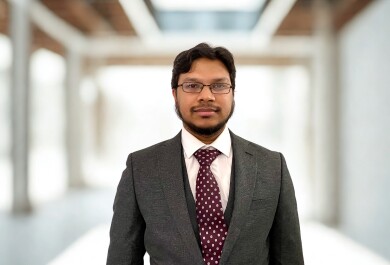
Dissertation defence (Pathology): MSc Umair Akhtar Hasan Khan
MSc Umair Akhtar Hasan Khan defends the dissertation in Pathology titled “AI-driven image-to-image translation for histopathology” at the University of Turku on 6 March 2026 at 12.00 (University of Turku, Medisiina D, Lauren 2 lecture hall, Kiinamyllynkatu 10, Turku).
Opponent: Professor Nataša Sladoje (Uppsala University, Sweden)
Custos: Associate Professor Pekka Ruusuvuori (University of Turku)
Summary of the Doctoral Dissertation:
When a tissue sample is tested in a hospital to diagnose a disease, it undergoes a process called tissue staining that has changed surprisingly little in over a century. Tissue staining is the process wherein chemical dyes are applied to make cells visible to human eyes under a microscope. The method is effective, but it is also slow, labor-intensive, chemically wasteful, and prone to inconsistent results.
My PhD research investigates whether artificial intelligence can offer an alternative. The central finding is that modern generative AI can examine an unstained, nearly transparent tissue sample and accurately predict what it would look like if it had been chemically stained. The AI model learns the visual patterns of real stained tissues and reconstructs them digitally.
In addition to virtual staining, the same technology can solve a longstanding problem in pathology: inconsistent staining across laboratories. With slight changes in the protocols or even using the same protocols, different labs produce tissue images that vary significantly in color and appearance which can be problematic in different ways. My research sheds light on the variability of this problem and explains the strengths and weaknesses of both AI and traditional methods to homogenize the tissue appearance.
Until now, most AI applications in medicine have focused directly on diagnosis. This work shifts the focus upstream. Instead of asking whether a disease is present, it asks whether the image itself can be improved before any analysis begins. The findings reveal that generative AI is a powerful tool for tissue preparation and image standardization. It is capable of learning the structural content of unstained tissue and translating it into meaningful, human-interpretable stained variants.
Ultimately, this work contributes to a leaner, more sustainable, and more standardized foundation for modern pathology. It brings the analysis of human tissue one step closer to a fully digital future.