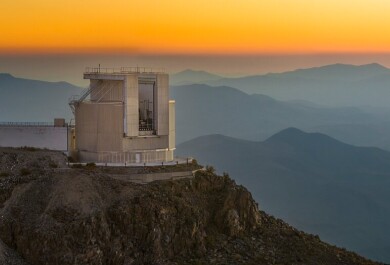
The 10-year Legacy Survey of Space and Time (LSST) has officially started, marking the beginning of a new era in astronomy and astrophysics. This means that the US funded Vera C. Rubin Observatory is now capturing the cosmos in an unprecedented detail, transforming the way we study the dynamic Universe.
Rubin will outperform previous time-domain surveys by two orders of magnitude. It will scan the entire southern sky every few nights, enabling the discovery of an unprecedented number of transients such as supernovae, which are exploding stars.
Impact on strongly lensed transients
Strong gravitational lensing refers to a rare astrophysical phenomenon in which the gravity of a foreground object, a galaxy or whole galaxy cluster, deflects the light of a background source such that it is multiple times visible. Imagining now a star explodes in the background galaxy. This implies that the light, which can be as bright as the entire galaxy for a short amount of time, reaches us at a specific time given its sudden appearance.
However, since the path length and gravitational potential are different, the different photons will reach us at different times. By measuring the brightening and following dimming of the supernova, astronomers can measure this time delay. This time delay is linear proportional to the current expansion rate of the universe, the Hubble constant. Importantly, this technique is fully independent of the two main methods currently providing significantly different results of the Hubble constant.
While only a handful of lensed supernovae are known to date, most not suited for cosmological studies, LSST is expected to boost that number to around 100 per year, of which around ten supernovae are perfectly suited for cosmological measurements.
Spectroscopic follow up with the Nordic Optical Telescope (NOT)
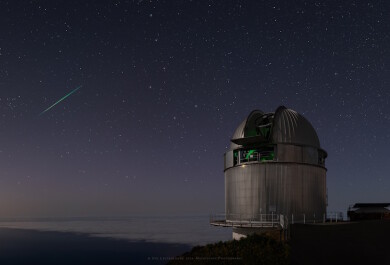
Lensed or not, to scientifically exploit a supernova firstly one needs to know the supernova type and its distance. The NOT, a 2.6m telescope based on the Canary islands and owned by the University of Turku and the Aarhus University in Denmark, is well suited for this.
In fact, so far every known supernova that is strongly lensed by individual galaxies has been followed up with the NOT. Also in the just started era of the LSST, NOT will dedicate a significant fraction of its observing time to the transient discovered by the LSST.
A novel instrument designed for transient studies: SOXS
Given the enormous numbers of transients that LSST and other time-domain surveys will discover, a dedicated instrument, SOXS, was recently built and mounted on the New Technology Telescope (NTT) of the European Southern Observatory (ESO). It is located in Chile like the Rubin Observatory, hence covering the same portion of the sky.
The Finnish Centre for Astronomy with ESO (FINCA) and the supernova group from the University of Turku were involved in building the novel SOXS instrument and will be in the forefront for exploiting it for follow-up of the flood of transients soon to be discovered.
Synergies to Europe’s space telescope Euclid
Since the Rubin Observatory is a ground based telescope, it is perfectly complemented with the European Space Agency’s (ESA) space telescope Euclid. Euclid is expected to deliver 170 000 static strong lenses – two orders of magnitude more systems that have space based images available to date.
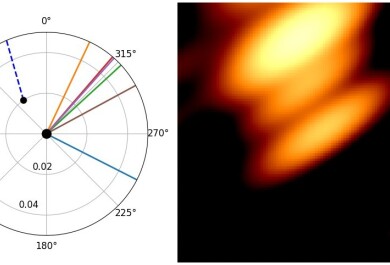
Astronomers are crossmatching the known static strong lenses, such as those from Euclid, with transient alerts from the LSST and other time-domain surveys, aiming for the discovery of strongly lensed transients like recently the supernova “Winny” (2025wny). Moreover, high resolution images, which Euclid provides, allow precise mass reconstruction of the galaxies serving as the lens which is required for precise time delay cosmography.
Stefan Schuldt
The author is a FINCA fellow working as a part of the supernova group at the University of Turku. Within LSST, he is a member of the Strong Lensing Science Collaboration and the Dark Energy Science Collaboration through the Italian research institute INAF. Furthermore, he is a member of the SOXS consortium, highly involved in the supernova Winny characterization and follow-up work (including the NOT) within the HOLISMOKES collaboration. In Euclid he is leading the static lens search. His main research focus is mass modelling for time delay cosmography application.