Picture this: a young woman discovers her lover murdered in cold blood, and her first instinct isn’t to call for help but to hide the evidence. In Sarah Waters’s The Paying Guests, Frances Wray makes this morally questionable choice, prioritizing her secret relationship over justice. This moment perfectly captures what makes Waters’s fiction so compelling. Her female protagonists refuse to be the pure, self-sacrificing heroines readers are used to seeing in literature.
Waters’s protagonists lie, steal, manipulate, and sometimes even kill. They’re driven by jealousy, desperation, and desire rather than noble ideals. Yet somehow, readers find themselves rooting for them as they feel real human nature in ways that traditional heroines often don’t.
Take Nan King from Tipping the Velvet, who transforms from an innocent oyster girl into a cross-dressing performer, then a kept woman, and finally a political activist. Her journey isn’t linear or morally clean. She makes selfish choices, hurts people she cares about, and sometimes acts purely out of survival instinct. But each morally ambiguous decision makes sense within the context of Victorian society’s crushing limitations on women, especially working-class lesbians.
This is where intersectionality theory becomes one desirable way to understanding Waters’s work. Intersectionality, developed by scholar Kimberlé Crenshaw, examines how different layers of oppression on minority groups, which based on gender, class, sexuality and race, overlap and compound each other. Waters’s characters don’t face just one layer of oppression. They navigate multiple, interconnected systems that limit their choices. A poor lesbian in Victorian England, for instance, faces different challenges than a wealthy heterosexual woman of the same era.
The question becomes: how would anyone behave if society offered no legitimate path to happiness, security, or even basic survival? Waters’s anti-heroines who lack traditional heroic virtues but remain central to their stories show that moral purity is often a luxury available only to those with power and privilege.
Waters’s genius lies in refusing to sanitize women’s experiences. Her anti-heroes represent the messy reality of marginalized lives, the gray areas where survival sometimes demands moral compromise. By embracing flawed, complicated female characters, Waters creates space for more authentic representation in feminist and queer literature.
I am currently interpreting the female anti-heroes in Sarah Waters’s novels with a lens of intersectionality theory. They often act in ways that do not align with conventional moral standards and may even defy patriarchal social norms. Their actions are frequently driven by motives such as selfishness, revenge, or the instinct to survive, rather than the selfless dedication typical of traditional heroes. These characters often exhibit distinctly human flaws, such as laziness, indifference, or irritability, which make them relatable to readers. Despite their morally questionable behavior, they may undergo personal growth or seek redemption as the story unfolds.
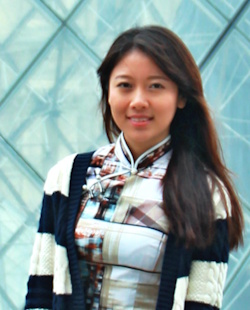
Dongyu Li
The writer is an MA in Humanity with ten years of experience in college teaching. Her expertise lies in English contemporary literature, focusing on feminist theories, queer theories, gender, sex and sexuality. She is currently conducting doctoral research on the aesthetic strategies and significance in feminist and queer discourse in Sarah Waters’s novels. She has published several academic papers related to her current studies. As a member of Joel Kuortti’s group at the University of Turku, one of the leading literary scholars in English literature research, she applies interdisciplinary approaches to the study of literature, culture, and gender to examine the narrative structures, thematic complexities, and socio-cultural implications.
Gothic, Sheffield. 2018. “Sue Trinder, Maud Lily, and Richard Rivers from the BBC Adaptation,” in “Gothic Adaptations: Fingersmith,” Sheffield Gothic (blog), April 16, 2018, https://sheffieldgothic.home.blog/2018/04/16/gothic-adaptations-fingersmith/. [Accessed 1st May, 2025].
Hagelin, Sarah, and Gillian Silverman. 2022. The New Female Antihero : The Disruptive Women of Twenty-First-Century US Television. Chicago: University of Chicago Press. https://research.ebsco.com/linkprocessor/plink?id=45a520de-7911-3a87-8898-007f5c37a74f.