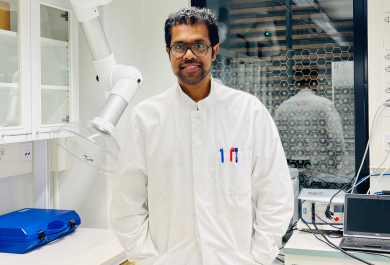
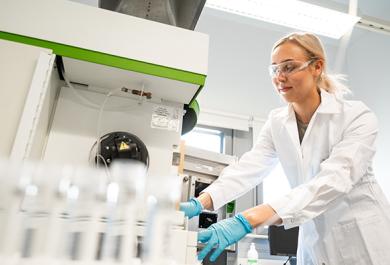
Hello everyone! I’m Razieh Moosavi, a PhD researcher at the University of Turku. Have you ever wondered if we could skip painful, scary medical tests and actually watch how molecules interact inside our bodies in real time?
It sounds like science fiction, but the answer lies in tiny, invisible structures thousands of times thinner than a human hair: Carbon Nanotubes (which are essentially microscopic, hollow strawlike tubes made of carbon).
Why these tiny tubes?
These microscopic straws have a hidden talent: they glow under a specific type of invisible light (near-infrared). This is a massive breakthrough for medicine because human skin and muscles are almost transparent to this specific light. It allows scientists to look deep inside the body almost like looking through a clear glass window without any biological "background noise" blocking the view.
The challenge: the "wrapped" problem
To turn these tiny tubes into smart sensors, we need to attach "molecular fishhooks" to them. In science, we use short strands of DNA (also known as oligonucleotides) to act as these hooks. In the past, scientists wrapped these DNA strands around the tube randomly. But "random" usually means unpredictable. This messy, cluttered coating covers the tube's surface and dims its glow. It’s like trying to use a high-tech flashlight covered in thick layers of winter blankets; the light becomes blurry, weak, and useless.
Our solution: the "brush" model and click chemistry
In my research, we are changing the game. Instead of wrapping the tube like a blanket, we are developing a "brush-like" model. We attach our molecular DNA hooks only to the very tips of the tubes.
By doing this, the DNA strands stand out like the bristles of a toothbrush. They are completely free to wave around, move, and "catch" their targets (like tiny warning markers for a disease) in a flash. Meanwhile, the rest of the tube remains completely uncovered, free to send a strong, bright light signal.
To snap these hooks onto the tubes with perfect precision, we use a Nobel Prize winning method called "Click Chemistry." This technique allows us to join molecules together flawlessly just like snapping two Lego bricks together. This method of safely and efficiently anchoring functional DNA pieces builds on years of advanced molecular design in our lab [1].
How the sensor works: the molecular lock
To make this work, we use a clever tool called a "split aptamer." Think of it as a tiny molecular padlock that we have cut exactly into two halves. We attach one half of the lock to one tube, and the other half to a second tube.
When a specific target for example, a drug molecule or a disease marker appears in a drop of fluid, both halves of the padlock instantly rush to grab onto it. This ability of split biomolecules to recognize and bind tightly to a target is a powerful mechanism we actively study and refine [2].
When they catch the target, it pulls the two tubes close together. When they touch, the color of the light they emit changes. We have essentially turned the hidden presence of a molecule into a bright color change we can easily see and measure!
Why this matters
This isn't just an isolated lab experiment; it is the absolute frontier of nanotechnology. Our ultimate goal is to create ultra-sensitive diagnostic kits that can detect diseases like cancer at a very early stage, just by "sensing" a few hidden molecules in a single drop of blood. By combining smart oligonucleotide probes with advanced nanomaterials, we are pushing the boundaries of what modern chemical biology can achieve [3].
By using simple, elegant chemistry, we are building tools that can truly save lives.
Razieh Moosavi
I am a PhD researcher at the University of Turku in Prof. Tuomas Lönnberg’s group. I focus on finding new ways to connect tiny materials to solve big problems in medicine. I believe chemistry is the ultimate bridge between nature and life-saving technology.