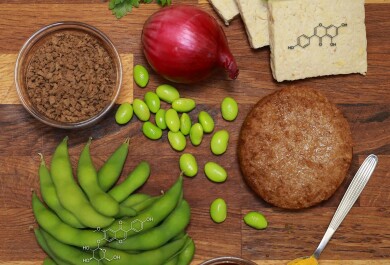
Ever thought about how the sausage is made? Me neither, and I think that’s part of the point. Why burden oneself with the intricacies of something that tastes good, but is way harder to swallow the more you start thinking about it. The guilt of living at the expense of other living beings lingers on the back of the throat like bitter zest from a grapefruit peel, and knowing how unhealthy processed meat is takes all the remaining taste from the experience.
What if I told you there could be a way to reduce ethical qualms involving such a product? As it stands, insects have a lower state of consciousness and no nervous system to experience subjective pain.1 It doesn’t rule it fully out, but is way better than unnecessarily sacrificing pain-sensing animals like mammals for sustenance. Insects are protein-rich and fatty, if not fattier than your average sausage filling, with a surpreme conversion rate for fat feeding: imagine sausages with omega-3 oils on par with fish.2,3 Think about it: even the carbon footprint of the foodstuff would be reduced, since insects occupy much less space and consume way less feed to achieve the same protein yield than beef.4,5 All that is to be solved is upscaling.6
The sausage so far is just a thought experiment, but could as well be reality in the near future. Earlier insect products have been terribly dry, which I assume has been due to a lack in proper product development and food design. But what is the structural level fat composition of the most typical insect models, if not the key to predict their nutritional value?

That is what I research in my PhD, I determine the nutritional properties of insects based on their total fat composition; that is analyzing the lipidome at different lifecycle phases of different insects and comparing them with each other. The fat of any given protein source consists of hundreds of molecular species of lipids, the consistency of which greatly affects the material and sensory properties of the product. Purification of these compounds for analysis is achieved via a modified Folch extraction,7 separation via ultrahigh-performance liquid chromatography, and identification or quantification via the fragmenting of ionized lipids in a quadrupole time-of flight mass spectrometer.8 The total bundle results in a mouthful: an UHPLC-QTOF.
It is already clear that some insect species are overall fattier than others (e.g. black soldier flies and mealworms top crickets), total fat varies highly by lifecycle phase (e.g. larvae may be fattier than adults) and that lipidomes tell a story of both genetic expression and the environment upon which they rely on (e.g. feed and climate). What is new is our structurally deeper distinction between structural isomers (i.e. differences where in the molecule which fatty acids are positioned), achievable now for most compounds with only one chemical analysis.9 This knowledge is novel in the field, especially for insect research.
I’ll leave the processing10 and sensory evaluation testing to someone else. But a healthy sausage? Sign me up!
Henri Avela
The writer is an analytical chemist, his broadest expertise in organic analysis and a passion for materials sciences. His second year as a PhD researcher focuses on his first batch of real project samples and his upcoming first research article. Henri spends his freetime with volunteering in associations such as the Finnish Chromatography Society.
- Love, S. Do Insects Feel Pain? The New Yorker. January 5, 2025. https://www.newyorker.com/culture/annals-of-inquiry/do-insects-feel-pain (accessed 2025-05-04).
- Oonincx, D. G. A. B.; Laurent, S.; Veenenbos, M. E.; van Loon, J. J. A. Dietary Enrichment of Edible Insects with Omega 3 Fatty Acids. Insect Sci. 2020, 27 (3), 500–509. https://doi.org/10.1111/1744-7917.12669.
- Fatty Acid Ratio in Food. Wikipedia; 2025.
- Akhtar, Y.; Isman, M. B. Insects as an Alternative Protein Source. In Proteins in Food Processing; Elsevier, 2018; pp 263–288. https://doi.org/10.1016/B978-0-08-100722-8.00011-5.
- Bbosa, T.; Ndagire, C. T.; Mukisa, I. M.; Fiaboe, K. K. M.; Nakimbugwe, D. Nutritional Characteristics of Selected Insects in Uganda for Use as Alternative Protein Sources in Food and Feed.
- Veldkamp, T.; van der Fels-Klerx, H. J. ‘SUSINCHAIN’: The European Project on Upscaling the Insect Value Chain for Food and Feed in Europe. J. Insects Food Feed 2025, 1 (aop), 1–5. https://doi.org/10.1163/23524588-111701ED.
- Tzompa-Sosa, D. A.; Yi, L.; van Valenberg, H. J. F.; van Boekel, M. A. J. S.; Lakemond, C. M. M. Insect Lipid Profile: Aqueous versus Organic Solvent-Based Extraction Methods. Food Res. Int. 2014, 62, 1087–1094. https://doi.org/10.1016/j.foodres.2014.05.052.
- Murphy, R. C. Tandem Mass Spectrometry of Lipids; Robert C Murphy, 2014. https://doi.org/10.1039/9781782626350.
- Pontus, B.; Mikael, F.; Heikki, K.; Marika, K.; M, L. K.; Al, S. M. A.; Marko, T.; Baoru, Y. A Novel UHPLC-ESI-MS/MS Method and Automatic Calculation Software for Regiospecific Analysis of Triacylglycerols in Natural Fats and Oils. 2022. https://doi.org/10.1016/j.aca.2022.339887.
- Rocchetti, G.; Leni, G.; Rebecchi, A.; Dordoni, R.; Giuberti, G.; Lucini, L. The Distinctive Effect of Different Insect Powders as Meat Extenders in Beef Burgers Subjected to Cooking and in Vitro Gastrointestinal Digestion. Food Chem. 2024, 442, 138422. https://doi.org/10.1016/j.foodchem.2024.138422.