Every year, thousands of people undergo surgeries to repair or reconstruct bones, whether from injury or disease. But unfortunately, bone doesn’t heal like skin. Having it regrow reliably, especially when large repairs are needed, is a huge challenge in medicine that needs to be solved!
Bone scaffolds and the “dead zone” problem
Imagine you’ve just undergone surgery, like facial reconstruction, and you need something to help repair the bone. Usually, we use bone implants or scaffolds in these situations. These are placed inside your body, with the hope that new bone will grow through them. Think of it as ivy climbing through a trellis in a garden.
However, when a large scaffold is needed, the centre of the “trellis” can become a bit of a dead zone. Blood vessels that bring oxygen and nutrients are essential for new bone growth, but they might not reach the deepest parts easily. Less oxygen and nutrient delivery, along with reduced waste removal, can make healing much more challenging. And it also increases the risk of infections, which is one of the biggest concerns!
Bacteria behind a shield
Dealing with implant infections can be quite challenging, as they are tougher to treat than regular infections. Instead of just floating around where antibiotics can easily reach them, bacteria tend to stick to the implant and form a slippery layer called a biofilm, which acts as a protective shield, protecting the bacteria from both antibiotics and the body’s own immune response. If we catch the infection too late, doctors sometimes have no choice but to remove the implant completely, which can be stressful for the patient and costly for healthcare. That's why early treatment is so important!
It makes us wonder: could an implant itself help start treatment from within, reducing the need for additional surgery?
Light: both the problem and the solution
Many innovative ideas have been floating around about using light as an on/off switch for implants: shine a light on it, and a drug gets released or activated. It sounds promising in theory, doesn't it? However, in real life, this approach faces challenges because the light typically needed is visible light, like green or blue, which our bodies tend to absorb and scatter quite a bit. This means the light doesn’t travel very far through tissue to reach the implant, similar to trying to shine a flashlight through thick fog.
Different types of light, like near-infrared light, which our eyes can't see, can penetrate much deeper into the body. The exciting idea is to use this type of light to make visible light appear right inside the implant!
To make this happen, we'll use special glowing (luminescent) materials that contain lanthanides, also known as “rare earth” elements. These are a group of 15 metallic elements that sit in their own row at the bottom of the periodic table and have the extraordinary ability to absorb energy and re-emit it as different-coloured light, which is why these elements are used in devices such as your phone. I plan to use two different lanthanide-containing materials inside the implant, each utilising light in unique and fascinating ways.
The first material absorbs low-energy near-infrared light and converts it into higher-energy blue light. It might sound like magic, creating energy out of nowhere, but it’s actually a real process called upconversion luminescence: two lower-energy photons, essentially particles of light, combine to produce a single higher-energy photon.
This alone might be enough to release the drugs in our implants, but there's a catch… upconversion luminescence is like a lamp; once you switch off the near-infrared light, the glow immediately stops. That's where the second luminescent material comes into play: it can continue to glow even after the light is turned off, much like the glow-in-the-dark toys you might be familiar with.
What success could look like
The idea of combining these materials is exciting! It involves 'charging' the implant with near-infrared light from outside the body. Then, the upconversion material locally emits blue light, causing persistent luminescence. This keeps the light active long enough to activate the medications effectively. If successful, this could revolutionise implants, making them not just supportive but actively helpful in treating infections by using light as medicine!
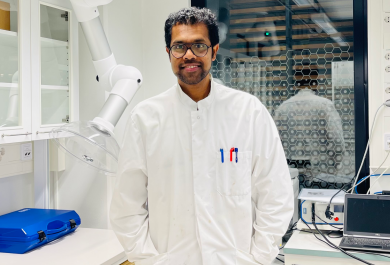
Joshua Baggott
I’m a PhD researcher working on the MAXHeal Project as part of the Intelligent Materials Chemistry Research Group at the University of Turku. I specialise in the synthesis and analysis of luminescent materials. More specifically, upconverting and persistent luminescent materials to be used in bioactive bone implants. I also investigate other optical materials for a range of applications, such as sensors and devices.
References:
L.H. Nguyen, N. Annabi, M, Nikkhah, H. Bae, L. Binan, S. Park, et al, Vascularized Bone Tissue Engineering: Approaches for Potential Improvement, Tissue Eng. Part B Rev., 18 (2012) 363-382.
H. van de Belt, D. Neut, W. Schenk, J. R van Horn, H. C van der Mei, H. J Busscher, Infection of orthopedic implants and the use of antibiotic-loaded bone cements: A review, Acta Orthopaedica Scandinavica, 72(6) (2001) 557-571.
J. L. Sandell, T. C. Zhu, A review of in-vivo optical properties of human tissues and its impact on PDT, J Biophotonics. 4(11-12) (2011) 773–787.
S. Chen, A. Z. Weitemier , X. Zeng, L. He, X. Wang, Y. Tao, et al, Near-infrared deep brain stimulation via upconversion nanoparticle–mediated optogenetics, Science, 359 (2018) 679-684.
D.E. Hudson, D.O. Hudson, J.M. Wininger, B.D. Richardson, Penetration of Laser Light at 808 and 980 nm in Bovine Tissue Samples, Photomed Laser Surg, 31(4) (2013) 163-168.
T. Aitasalo, J. Holsa, H. Jungner, M. Lastusaari, J Niittykoski, Thermoluminescence Study of Persistent Luminescence Materials: Eu2+- and R3+-Doped Calcium Aluminates, CaAl2O4:Eu2+,R3+ , J. Phys. Chem. B, 110 (2006) 4589-4598.