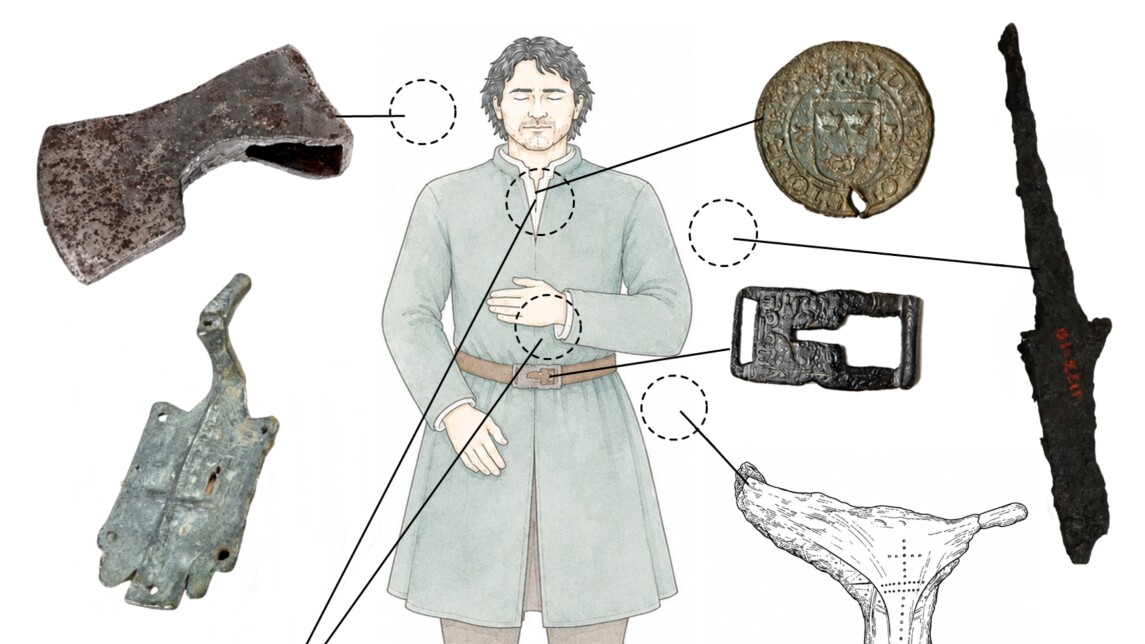
A new study by the University of Turku and partners provides fresh insights into an individual buried near Lake Kitka in Kuusamo, Finland, at the turn of the 16th and 17th centuries. DNA and isotope analyses show that the individual, whose grave has been linked to Sámi cultural heritage, had a genetic connection to present-day Sámi populations and spent part of his life outside Finland.
Researchers from the University of Turku used DNA and isotope analyses to study an individual whose grave was discovered near Lake Kitka in Kuusamo, Finland, in the 1970s. The individual lived at the turn of the 16th and 17th centuries and the new research results shed more light on his life history.
DNA extracted from the teeth of the approximately 40-year-old man was compared with previously studied ancient and modern genomes. The results showed that the Kitka individual’s genetic profile was closest to that of present-day and historical Sámi. He also shared short DNA segments with present-day people of Finland, especially in North and Northeast Lapland, but clearly less in the Kuusamo region and further south.
“A similar pattern emerges when present-day Sámi are used in the comparison instead of the Kitka individual. This suggests that the results reflect broader historical interaction and admixture between Sámi and Finnish populations,” says Researcher Sanni Peltola from the University of Turku.
Peltola also emphasises that although ancient DNA helps researchers understand population history, it does not define ethnicity or identity.
“Sámi identity is not a biological trait, but a historical, cultural, and social phenomenon,” she notes.
The Kitka burial has also attracted considerable interest among genetic genealogists. However, according to the researchers, DNA cannot reliably connect an individual who lived this long ago to specific present-day families or individuals.
Isotope analysis reveals changes in diet and living environment
Isotope analyses from the teeth indicate that the Kitka individual arrived in Kuusamo only shortly before his death. During childhood, his diet included terrestrial animals, freshwater fish, and marine resources. Later in life, marine foods became more prominent, and freshwater fish, which is an important food source in the Kuusamo region, disappeared from his diet. Isotope values reflecting the source of drinking water further suggest that, during his teenage years, he lived in an area whose geology differed markedly from that of Finland.
“The most likely location is a region with volcanic bedrock in the North Atlantic, likely Iceland. This interpretation is supported by historical evidence of contacts between Northern Fennoscandia and the North Atlantic during the 16th century,” says Senior Researcher Ulla Nordfors from the University of Turku.
Earlier studies have interpreted the Kitka individual as a noaidi, a Sámi ritual specialist. The new study does not rule out this possibility, but it suggests that the individual’s life history was more complex than previously assumed.
“The results show that historical Sámi communities and their social roles do not correspond to the images presented in older research literature,” Nordfors notes.