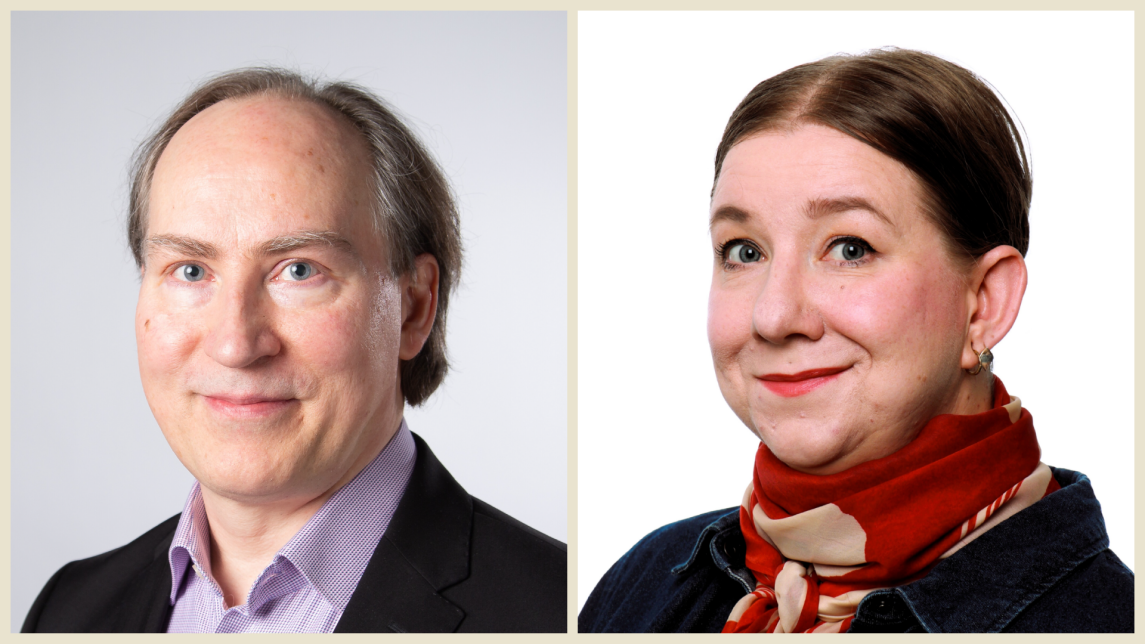
The consortium “Autostory – Authors of the Story Economy”, which is funded by the Research Council of Finland, studies the impact of social media on 21st-century literature and authors. It is a joint project between Tampere University, the University of Turku, and the University of Helsinki. The questions are answered by Professor of Literary Studies Markku Lehtimäki and Senior Research Fellow in Literary Studies Laura Piippo, who will soon be joining the research group at the University of Turku.
1. What impact does social media have on contemporary literature?
Social media is transforming the environment of the production and reception of literature, as literature is increasingly being read, shared, and discussed on platforms based on rapid reactions, emotional engagement, and visibility. This shifts the focus towards stories that emphasise personal experiences and hybrid forms where the distinction between fact and fiction becomes unclear. It is evident that, as new forms of digital media compete for readers’ time, the time spent on literature decreases.
2. How are novels changing in the age of social and digital media?
Novels are incorporating digital textual practices, such as the commenting culture and multimodal structures. Social media and other digital interfaces create an environment that subtly shapes literary forms: they favour instant recognisability, clearly defined ethos, and emotional impact. Contemporary literature is adapting to this logic, as can be seen in short, aphoristic, or visually oriented forms, for example.
3. Does the novel have a future in the age of social and digital media?
The novel is a historically flexible and diverse genre for which it is impossible to draw clear limits or identify distinctive characteristics. The novel has retained its cultural significance and institutional standing both in Finland and in many other countries, even though it is occasionally challenged by other forms of media. Both social media and other aspects of digital culture, including artificial intelligence, influence the form and content of the novel, but the novel is also capable of adapting to the situation and adopting techniques from other media.
4. How does social media influence authors?
The role of authors is expanding: they are not only artists, but also increasingly debaters, activists, and performers who are constantly discussing their work. Social media gives them the opportunity to have a direct relationship with the audience, but it also increases the pressure to maintain a constant presence online. Authors can become focal points of public debate, around whom audiences project their values and feelings.
While social media makes writers increasingly prominent cultural figures, it also exposes them to hidden expectations. Platforms encourage the production of easily recognisable and affective content that can be measured in terms of its reception, for example by showing the amount of likes and shares.
5. What skills are required of authors in the age of social media?
They are required to possess a range of skills, which can be categorised under the concepts of narrative and digital capital. Some authors have more digital capital that is related to the use of social media platforms than others. On the other hand, choosing to stay off social media can also be seen as a comment or statement while traditional forms of public appearance and publicity still exist and are used.
6. Does the attention economy of social media influence the stories told in literature?
Yes. The attention economy favours narrative structures that are clear, emotionally engaging, and easily shareable, such as personal stories of crisis and growth. At the same time, the implicit normativity of these platforms creates a subtle pressure to simplify content and amplify its emotional impact, and to erase multidimensionality or ambiguity. This reinforces the trend in contemporary literature of highlighting personal, easily shareable stories, and morally distinct positioning.
7. In what ways do the algorithms of digital platforms shape the literary field?
Algorithms dictate which works and discussions gain visibility in the first place: they favour content that provokes a reaction and is quickly consumed. This reinforces certain themes and narrative forms at the expense of others. The literary field is, to some extent, evolving into an environment where visibility depends more on the logic of the platforms than on the traditional gatekeepers of the field of literature. This also plays a part in determining what type of books are published and how they are read.
8. What kind of attention do books and authors receive on social media?
The attention is often emotional, fast-paced, and person-centred. Authors’ lives, public appearances, and personal stories can become as important, and sometimes even more important, than their books. Attention is both a reward and a gatekeeper – authors have to be able to create content that both evokes immediate emotions and is suited to the formats of different platforms.
Social media also polarises the discussion, with literary works being discussed more in terms of their political, ethical, or representational aspects than their aesthetic qualities. Nonetheless, social media also offers lesser-known writers new opportunities to gain visibility.
9. What does the future of literature look like in an increasingly evolving digital environment?
The future is diverse and increasingly intermedial, with novels incorporating visuals, data, algorithms, and digital structures into their form. The work of authors and readership are evolving into environments where different platforms, AI, and computational practices influence the ways in which text is produced and interpreted. Literature will endure, but its materials, forms, and concepts of authorship will continue to change fast. The future therefore depends on how aware we become of the conditions of the digital environment and on literature’s ability to challenge them.
10. Which authors do you base your research on?
We conduct qualitative research that combines narrative theory and literary sociology from literary studies, focusing on a total of 24 European authors and their transmedial ethos, which can be seen in their work both in novels and other literary work, as well as on social media platforms and in public appearances, such as interviews.
The authors that are analysed include, for example, Kari Hotakainen (Finland), Katarina Frostenson (Sweden), Jón Kalmar Stefánsson (Iceland), Karl Ove Knausgård (Norway), Kaspar Colling Nielsen (Denmark), Édouard Louis (France), Olga Tokarczuk (Poland), Talia Hibbert (United Kingdom), and Oksana Zabuzhko (Ukraine).
Text: Rosa Lampela
Translation: Elli Elo
Photo: The University of Turku, Tampere University