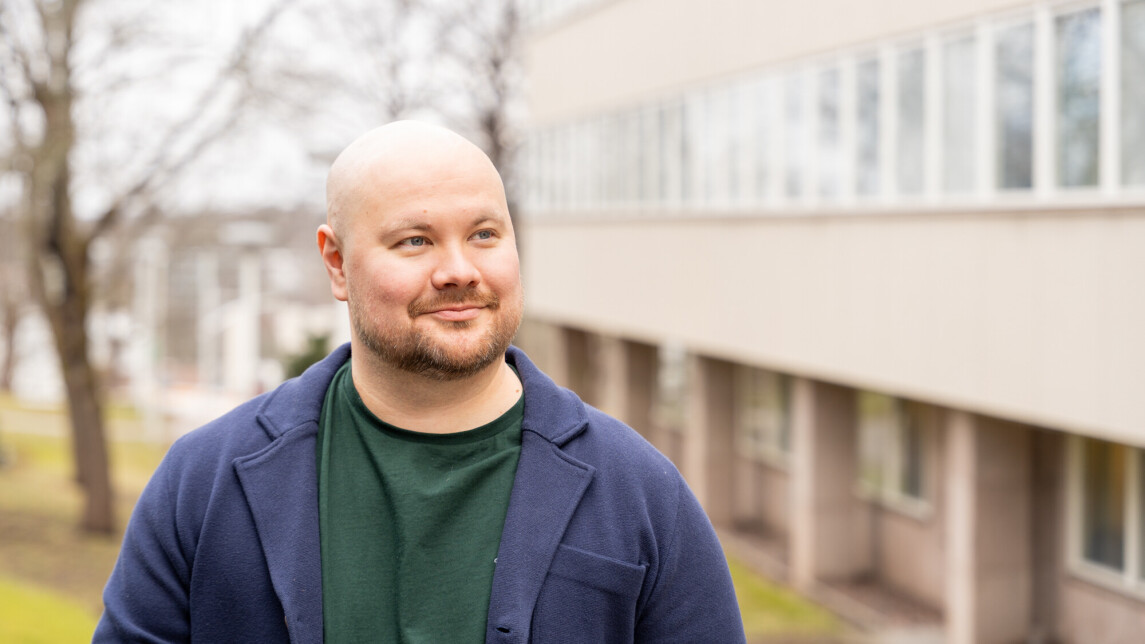
The new Professor of Theoretical Physics Risto Paatelainen at the University of Turku has spent nearly ten years working on a single unanswered question in particle physics. He aims to find out whether so-called quark matter can form under the extreme densities found in neutron stars. The answer is getting close.
Let us start from the very beginning. In the early universe, right after the Big Bang, all matter was extremely hot and dense. The elementary particles that existed, quarks and gluons, formed what is known as quark-gluon plasma.
When the universe expanded and cooled, the quarks bonded together to form protons and neutrons. Eventually these formed atoms, and hundreds of millions of years later, stars and planets — including all visible matter in the universe.
A similar change could also occur under extreme compression. When matter reaches sufficiently high densities, protons and neutrons may dissolve into their constituent quarks, forming a new state of matter known as quark matter. Its properties are still not well understood.
This fundamental force of nature, which binds quarks into protons and neutrons, is called the strong interaction. It is precisely this strong interaction that is at the heart of Paatelainen’s research.
Paatelainen studies how this interaction operates under conditions that occur only in the densest known objects: inside neutron starts.
Neutron stars are the remnants of collapsed massive stars. Matter is compressed so densely in them that even a teaspoonful of it would weigh billions of tons. Under such compression, the structure of matter can change fundamentally.
The possible solution would be a significant breakthrough for physics.
These conditions cannot be replicated in a laboratory. Therefore, the key unanswered question is whether quark matter actually exists inside neutron stars. Research led by Paatelainen develops theoretical methods for predicting the behaviour of a given substance under these conditions.
“I have been trying to solve a problem related to this very question for almost ten years, which sounds rather extreme,” notes Paatelainen with a laugh.
The work has generated several publications in leading international scientific journals, and the results have gradually become more precise.
“We are now at a stage where the answer is starting to take shape. It is possible that we will be able to solve this problem in the next few years. Identifying quark matter inside neutron stars would reveal how the strong interaction behaves at extreme densities and would help us understand the structure of these stars,” explains Paatelainen.
The possible solution would be a significant breakthrough for physics.
Turku at the forefront of research
Paatelainen started as a professor of physics at the University of Turku in early April. He brings with him a new line of research in particle physics and an internationally recognised Consolidator Grant project funded by the European Research Council (ERC).
One of the reasons for moving to Turku is the world-class expertise in neutron star physics that the city has to offer. The Universities of Turku, Helsinki and Jyväskylä have launched a Centre of Excellence in the field, which is funded by the Research Council of Finland.
“Alongside theoretical knowledge, precise observations are needed, for example of the masses, radii, and gravitational waves of neutron stars. Strong expertise in exactly these types of observations can be found in Turku, which enables closer collaboration between theory and observation."
From CERN to neutron stars
As a child, Paatelainen did not yet dream of becoming a particle physicist. Paatelainen, who grew up in Anjalankoski in southern Finland, was as interested in soccer as he was in mathematics when he was in school.
An important source of inspiration came from close to home early on in life. Paatelainen often visited his grandparents, and his grandfather enjoyed solving logic puzzles.
“He would often give me some of these problems to solve. That is most likely where the specific mindset required of a physicist comes from. In upper secondary school, my interest in natural sciences grew stronger,” says Paatelainen.
Later, he chose the University of Jyväskylä as his place of study. During his studies, teachers’ enthusiasm for their own field fuelled his interest, which encouraged Paatelainen to pursue a career in research. He decided to focus on the strong interaction already in his doctoral dissertation. The dissertation aimed to understand the properties of quark-gluon plasma at high temperatures.
After completing his doctoral dissertation, Paatelainen headed abroad, including to CERN in Switzerland, which is the world's largest particle physics laboratory.
Let us return briefly to the Big Bang, elementary particle plasma, and the various states of matter.
“One of the fundamental principles of physics is that the state of matter changes when conditions change. For example, water turns into steam when heated. The quark-gluon plasma I study is a state of matter that does not exist under normal conditions. It can only form under extremely high temperatures or densities, such as those found in the Big Bang. In CERN, strong evidence of the momentary formation of this elementary particle plasma has been obtained in particle acceleration experiments involving heavy-ion collisions,” explains Paatelainen.
During his CERN years, Paatelainen studied the theory of quark matter and participated in the analysis of particle collision experiments.
“In CERN, these phenomena are measured in a laboratory. My own research has since focused on whether a similar phenomenon can occur in nature, particularly inside neutron stars,” says Paatelainen.
New mystery awaits
After CERN, Paatelainen continued his research at the University of Helsinki as an Academy Research Fellow. The University of Turku is new to him, but he is already familiar with the Turku area.
“I have already lived here for several years. My spouse already worked here, so Turku was a natural choice for us."
There are also other new beginnings in the horizon. If nearly a decade of hard work is about to come to an end, does the researcher already know where to focus his attention next?
“I might take a moment to pause and catch my breath. However, I do already have a vision for my next steps, and in fact, I have already started taking them”, notes Paatelainen.
The theoretical calculation methods developed by the research group led by Paatelainen can also be applied to broader questions in fundamental physics.
“One major question is whether there might be new particles in the universe that are not yet known. Given that not all observations can be explained by the current Standard Model, it is likely that there is still unknown physics beyond it,” says Paatelainen.
In an ideal scenario, new discoveries could lead to an extension of the current Standard Model of particle physics.
He gives dark matter as an example. Approximately five percent of the universe is visible matter, and the remaining 95 percent consists of dark matter and dark energy.
No one has yet been able to answer the question of what this matter is — Paatelainen would like to do so.
“In order to find answers to this question, we need to make new and more precise observations. If such new particles or interactions exist, they may have influenced the evolution of the early universe and caused phase transitions. These transitions may create gravitational waves that could be detected in the future by LISA, the first space-based gravitational wave observatory."
These new observations will be one piece of the puzzle. In addition, what is needed again is a precise theory.
“The theoretical methods we have developed help describe these transitions, or changes, more accurately. This way, we can predict what kinds of gravitational wave signals different theories would produce and compare them with observations."
Research into gravitational waves involves extensive international collaboration, with thousands of researchers around the world searching for answers. In an ideal scenario, new discoveries could lead to an extension of the current Standard Model of particle physics. It would be one of the biggest breakthroughs in physics.
Text: Liisa Reunanen
Translation: Saara Yli-Kauhaluoma
Photos: Suvi Harvisalo