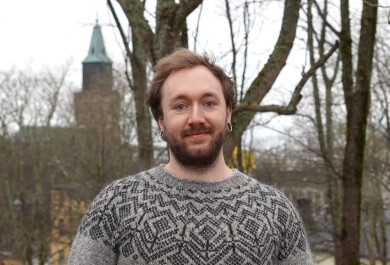
The People of TECH series introduces you to the staff of the Faculty of Technology. This time, we met with Senior Research Fellow Heidi Piili from the Department of Mechanical and Materials Engineering. The opportunity to help set up the new Faculty of Technology was one of the reasons that encouraged her to move to Turku in 2021.
What is your area of research?
I am studying modern manufacturing technologies, including laser technologies and industrial 3D printing. In this context, ‘laser technologies’ refers to everything that can be done to materials using a laser beam; for example, materials can be marked, engraved, cut, welded, and so on.
Why did you become interested in this particular field?
Mechanical engineering and laser technologies were not actually on my mind at all in the beginning. Instead, I studied chemical engineering and specialised in wood fibre technology at LUT University in Lappeenranta. When I was looking for a topic for my master's thesis in the early 2000s, the paper industry in Finland was at a turning point, as it was being run down. It was difficult to find a topic for my thesis, but eventually I came across the laser cutting of paper materials.
That was the moment when a laser beam lit up inside me, and I entered the world of laser technologies. At that time, in 2002, there were major projects underway about laser cutting of paper materials, and I became intrigued by the wide range of things that could be achieved using a laser beam on all kinds of materials. In the end, I ended up staying at the Department of Mechanical Engineering at LUT University as a doctoral researcher.
I came across 3D printing while doing my doctoral training and working on my first doctoral dissertation on laser technologies. Just a few hundred metres from here, in Kupittaa, is a company that originated at the University of Turku – now known as EOS Finland – where one of the world’s most widely used metal 3D printing technologies was invented and developed.
I visited Turku in 2009 to find out more about this company, and the metal 3D printing technology hit me like a ton of bricks. I knew this was something I wanted to do for the rest of my life. I later worked at the same company for a while, and 3D printing was also the subject of my second doctoral dissertation. Eventually in August 2021, I came here to the University of Turku just as the Faculty of Technology had begun its operation.
What do you hope to advance in your field in the future, and why is it important?
I would like to highlight a couple of points here. The first is related to the shortage of skilled workers in the field and how to resolve it. There is a severe shortage of skilled workers in the field of mechanical engineering, and it is important to encourage young people to enter the field. Furthermore, this field is highly polarised in terms of gender distribution, meaning that only a few percent of our new students are women. One of the problems is probably that the impression many young people have about mechanical engineering does not quite reflect today’s reality. If young people had a clearer idea of what we actually do here, in the fields such as 3D printing and laser technologies, I believe more of them would become more interested.
Another important issue that I would like to develop further in this field, and which I often discuss with young people, is sustainable development. We live in a society where all the things we use have to be manufactured in some way. From the moment we wake up in the morning and brush our teeth, we are constantly surrounded by things that have been manufactured in one way or another. And none of us are prepared to give up the everyday items we use, such as our phones. Therefore, it is important to develop more sustainable and environmentally friendly manufacturing technologies. And we, in the field of mechanical engineering, can do just that.
When we visit upper and lower secondary schools to talk about our work and these sustainable manufacturing technologies, it usually sparks the interest of many young people.
What should everyone know about 3D printing?
There are many misconceptions about industrial 3D printing, including some completely nonsense claims.
People sometimes talk about it in such a way as to suggest that, in the future, we will be able to print absolutely anything at the touch of a button, from pizzas to cars, and that all of humanity’s problems will be solved as a result. This is certainly not the case. Rather, the true potential of industrial 3D printing lies entirely elsewhere.
A more realistic picture is that since there are over 12,000 different printable materials and 250 possible techniques, the field has an enormous amount of potential. Nevertheless, not everything can or should be 3D printed; instead, the most appropriate and useful production method must be chosen.
With 3D printing we can do things we otherwise could not, such as various flow-optimised structures that can be used in filters, for example. By 3D printing metals, we can also create new types of lightweight structures or structures that mimic natural forms, such as components and materials used in aircrafts and space technology. Generally speaking, whenever something needs to be moved, be it a high-speed motor, a car, or an aeroplane, every gram saved in materials can make a significant difference in terms of fuel savings and reduced carbon dioxide emissions.
For example, SpaceX uses metal 3D printing in the manufacture of its rocket engines, and thanks to this technology, their Raptor rocket engine has become significantly smaller and lighter in just a few years. And considering that one of the most widely used metal printing methods was invented right here in Turku, it is truly impressive.
Why do you think it is important to popularise research? In what ways do you personally help make research accessible to the public?
I do it a lot, precisely because so many people have misconceptions about things like 3D printing to begin with. Many people think that the widespread adoption of this technology will lead to an explosive increase in plastic waste. However, the key point here is actually to improve sustainability. This means optimising structures to be smaller, lighter, and more durable than ever before, thereby reducing raw material consumption and industry emissions. And not everything is worth printing. It is important that also this information is communicated to people.
My other goal is to make the field familiar and appealing to young people. There is still far too little discussion in schools about various fields of technology and industry, which makes it difficult to inspire young people to pursue a career in these fields, even though we are doing some truly fascinating work.
The Faculty of Technology celebrates its 5th anniversary this year. What has it been like to be involved in setting up a new faculty?
It was actually one of the reasons why I decided to come here, the opportunity to build something completely new from scratch. And these past five years have been really great.
Setting up new research infrastructure has of course had its challenges. What has been surprising is the rapid growth rate of this Faculty. I was the third to join our research group in August 2021, and now there are over forty of us conducting research into industrial 3D printing. But right from the start, there has been a really wonderful and supportive atmosphere with a positive can-do spirit. There has clearly been a need for this expansion in the Turku region, and we have found many partners interested in collaborating with us.
Could you tell us something surprising about yourself?
I like cats, but I do not know if that is all that surprising. Well, I can tell you that I was involved in the discovery of a 11,700-year-old quartz quarry. I am really passionate about history and archaeology. The feeling when you hold such old, handcrafted pieces in your hands, see how magnificent they are and think about their age – it is incredible. For example, I was involved in discovering a quartz drill with a clear spiral groove carved into it. It was probably used to pierce leather, for example. Given that Stonehenge is presumed to be around 5,000 years old and the pyramids around 4,000 years old, it is hard to fathom that you have been involved in discovering something even older than that.
I always say that if you study modern things for a living but have a hobby that revolves around something really old, they kind of cancel each other out. It keeps everything in balance.
What inspires you the most in your free time?
Being outdoors and spending time in nature in general. It usually involves some motive or project specifically related to history or archaeology, so I often find myself exploring places and wondering what I might find there.
I study maps before I go out and ponder where I should go to look for something. Then I spend a while in the terrain in different spots and eye my surroundings. You need to use your imagination, put yourself in the shoes of the people of that time, and picture what they might have been doing if they had been there.
I was once involved in uncovering a very old path in my hometown of Imatra, and on the same occasion, we also found an old spearhead on one of the islands in Imatra. I am actually a member of an amateur archaeology society. I discovered the quartz quarry when I went to look at an old sea inlet or fjord. While sitting on a rock drinking coffee, I started looking at a cliff on the opposite side and realised there was something unusual about it.
What is the best memory you have from the past five years at the Faculty?
With regard to my interest in archaeology, I could mention a personal highlight of mine here. We are currently working on a new collaborative project with the Satakunta Museum, where we are creating digital models of the museum’s historical artefacts, which will later be printed using 3D printers. We just had a thousand-year-old sword digitised here. Although I only got to see the sword in photos, it felt incredible to be able to include something so great in our project. And the thought that someone actually used it back in the day is mind-boggling.
Overall, the fact that we have been given this project is truly great, especially since I have been so passionate about history and archaeology from a young age. For me, this is a long-time dream come true.