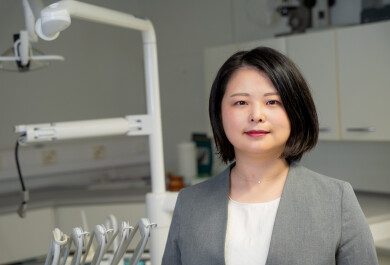
SYS-LIFE Postdoctoral Researcher Julian Brandmeier wants to improve Alzheimer’s and Parkinson’s diagnostics and facilitate earlier detection of these diseases. The goal of his research is to enable wide screening for these diseases by creating ultrasensitive immunoassays, which make it possible to detect neurodegenerative biomarkers in blood samples.
Julian Brandmeier, Postdoctoral Researcher in the University’s MSCA-co-funded SYS-LIFE programme, arrived in Turku in August 2025. This is not Brandmeier’s first time in Finland, as he has previously visited the country many times, and even done a three-month research-stay at the University’s Department of Life Technologies, where he now works. Brandmeier finds Turku to be a nice place to live and work.
“The city itself is super pretty. What I really enjoy is that it’s a big city, but it kind of feels smaller than it is. Everything is close by, you can bike everywhere, and it’s also so quiet and peaceful compared to other big cities.”
According to Brandmeier, his experience working for SYS-LIFE has also been positive:
“The SYS-LIFE community is really nice, and all the SYS-LIFE meetings are always fun. The directors are also very approachable and there’s not really a fixed hierarchy. We can just go talk to them or go out for a beer, so they’re really more like colleagues instead of bosses.”
Before arriving in Turku and starting as a full-time researcher at SYS-LIFE, Brandmeier obtained his PhD at the University of Regensburg, Germany. During this time, Brandmeier worked on developing ultrasensitive immunoassays, focusing mainly on cancer biomarkers but studying COVID‑19 biomarkers as well.
Aiming for early detection of Alzheimer’s and Parkinson’s
Now Brandmeier is using his expertise to research how ultrasensitive immunoassays could improve the diagnostic process of Alzheimer’s and Parkinson’s diseases. To do this, he is studying neurodegenerative disease biomarkers, which are typically small proteins released from the brain. Because of the brain–blood barrier, they can be found in blood, but in small concentrations, which in turn makes wide screening and early diagnosis of neurodegenerative diseases difficult.
“Today these diseases are diagnosed via immunoassays, but the samples are taken from spinal fluid. This means you need a lumbar puncture to take the sample, which is not a pleasant procedure. It also takes time and is expensive, which means that the ability to do wide screening is super limited and basically impossible.”
Alzheimer’s and Parkinson’s diseases are often diagnosed at a late stage when symptoms have already appeared, which is too late to stop the disease. The symptoms can be alleviated and the worsening can be postponed, but the diseases are irreversible, which is why earlier detection is needed. These diseases affect the older parts of the population, and as the population in general is aging, more and more people will be affected by these diseases in the near future, which is why early detection and wide screening are a priority to Brandmeier.
Using upconversion nanoparticles to increase immunoassay sensitivity
To make early detection and wide screening possible, Brandmeier is creating ultrasensitive immunoassays using upconversion nanoparticles as labels. They emit visible light when excited with laser light in the near-infrared region, which improves their visibility compared to other optical labels. This increases the immunoassay sensitivity and makes it possible to notice neurodegenerative biomarkers even in blood samples.
“This enables us to detect the diseases much earlier than the current systems and also to detect those biomarkers in blood instead of spinal fluid. This makes sampling much easier, much faster, because you can just go to a normal doctor, get your blood drawn, and have them run a certain set of tests.”
Brandmeier’s research goals also include the creation of an instrument to perform the digital readout of the immunoassays. The instrument, an upconversion microscope, is not fully a novel instrument, as Brandmeier has already worked with one during his PhD.
“With this microscope we can see individual nanoparticles, and since one nanoparticle means one binding event – so one nanoparticle means one biomarker – we basically are able to detect one single molecule of biomarker, which is pretty good.”
According to Brandmeier, the upconversion microscope would not however be used for widespread screening, as it is meant for extremely sensitive detection. For wide screening, normal readout methods would still be best.
Brandmeier’s postdoctoral fellowship at SYS-LIFE is in its first year, and his research is ongoing. He finds inspiration in the unknown and is fascinated by the as yet unanswered questions in his research area:
“There is still so much unknown stuff, especially with biomarkers. It’s really interesting to make sense out of all this and maybe find something that can be really useful in the future.”
SYS-LIFE, Systemic Approaches to Improve Cardiometabolic and Brain Health during Lifespan is Marie Skłodowska-Curie postdoctoral programme cofunded by University of Turku and European union (project 101126611) in 2023–2028. SYS-LIFE supports excellent international early and mid-career stage researchers by providing 22 three-year bottom-up project grants in cardiometabolic and brain research, complemented with training and possibility for secondments outside academia. SYS-LIFE partners include Turku University Hospital, Business Turku, Siemens Healthineers and Ghent University.
Text and photo: Iida Taskila