A Star Swallowed Its Companion in the Andromeda Galaxy, and Astronomers Watched It Happen
About 2.5 million light-years away, on the outskirts of the Andromeda Galaxy, one star has swallowed another. Astronomers have now, for the first time, followed the complete evolution of a stellar merger from beginning to end. The results have been published in the journal Nature.
The binary star studied by the researchers consisted of an aging red giant, nicknamed Bao, and a smaller companion star orbiting it.
Before the merger, Bao had a mass about seven times that of the Sun. It had expanded to 350 times the Sun’s radius and shone roughly 18,000 times as bright. Quietly orbiting the giant was a much smaller companion star, with a mass about 70% that of the Sun. In 2018, the system began to brighten slowly, as the small star dipped into the giant’s outer atmosphere and started to drag, like a spoon through thick soup. Over about seven years, in fewer than ten orbits, it spiralled inward.
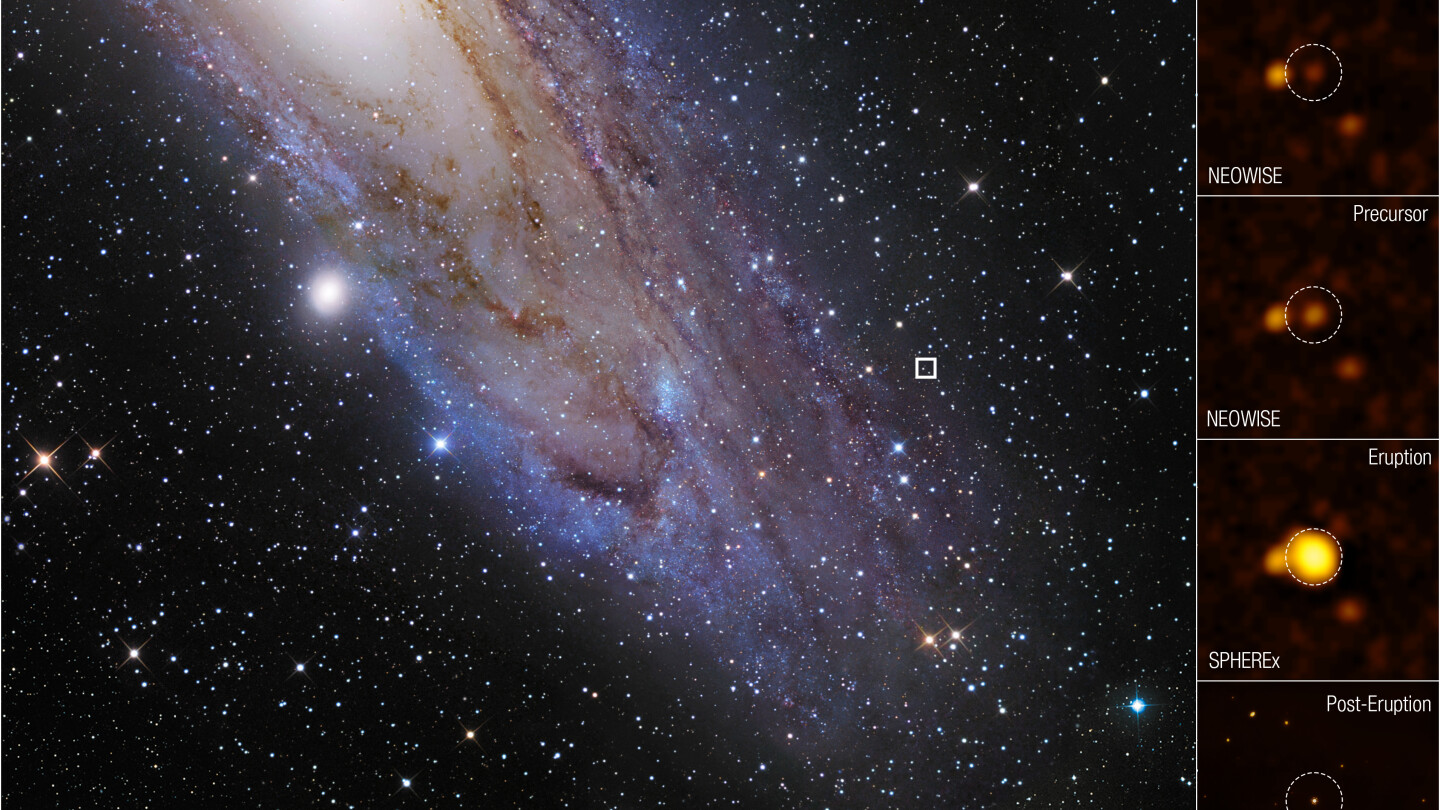
On 17 October 2025 the system erupted, brightening around a hundred times in under a month.
“Stellar mergers are very, very difficult to observe in real time because they are hard to predict. However, we noticed something unusual was going on in 2023 and continued to monitor the system to see what it would do,” said Viraj Karambelkar, first author of the study and a NASA Hubble Fellow at Columbia University in New York.
The decisive clue came from NASA’s James Webb Space Telescope, which observed Bao on 24 December 2025, about two months after the eruption began. Its infrared vision revealed the dust the giant had shed over centuries. By matching that dust to computer simulations, the team showed that the small star did not escape. It plunged into the giant’s core and merged with it, blasting away roughly the outermost tenth of the giant’s gas at about ten times its escape speed. That gas flew freely above and below the star, but was held back around its middle by older dust.
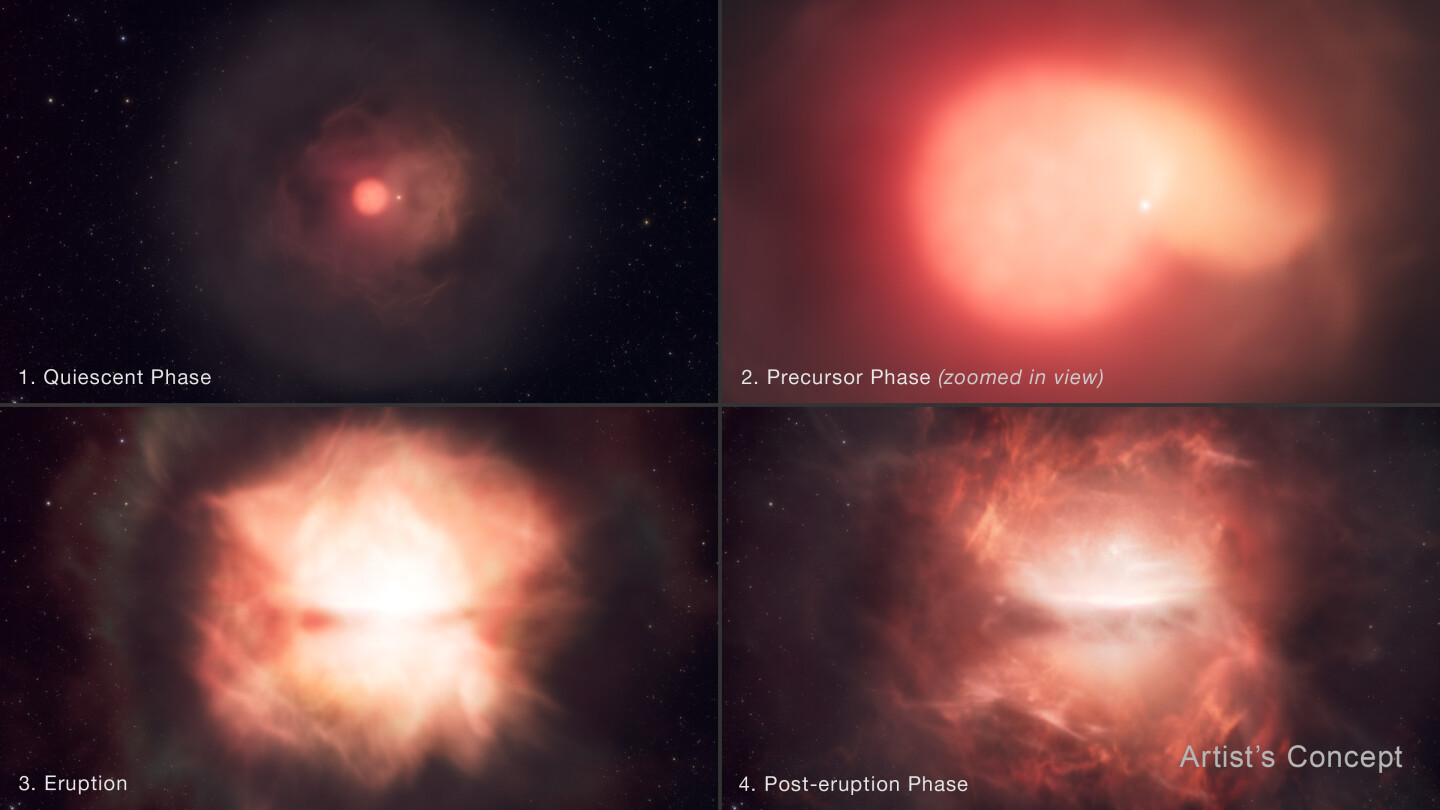
Events like this matter well beyond one star. The process, called common envelope evolution, is how many tight pairs of stars form, including pairs that will one day send out gravitational waves of the kind the future space mission LISA is built to detect.
Bao gives astronomers a rare, real-time test of how it works. Karambelkar expects many more to follow as new sky surveys come online. “There’s going to be a large influx of similar discoveries just ahead.”
The story is to be continued.
“We know how the story began, but not how it ends. It’s exciting to have the next chapter already in hand – each new spectrum will bring us closer to knowing Bao’s fate,” said Rubina Kotak, an astronomer at the University of Turku, and part of the team.