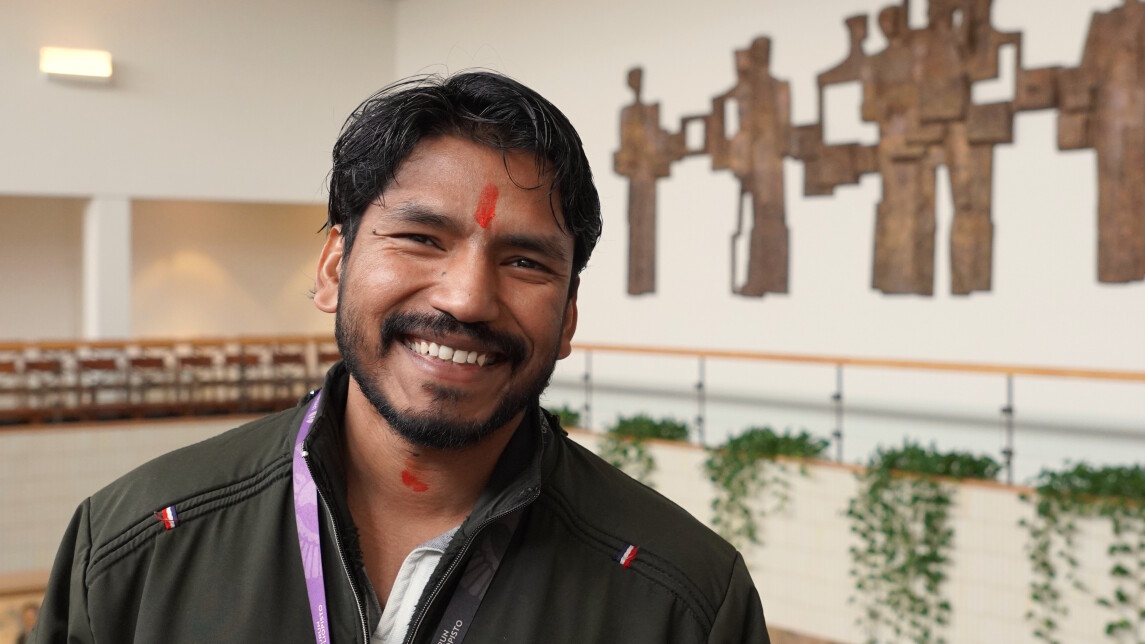
Materials Scientist Krishna Kant Pandey has just finished his postdoctoral fellowship at the Turku Collegium for Science, Medicine and Technology. During his stay at the University of Turku, Dr Pandey worked on multiple projects in his field.
Krishna Kant Pandey came to Turku in 2025 for a postdoctoral fellowship at the Turku Collegium for Science, Medicine and Technology (TCSMT). Researchers at TCSMT have the opportunity to work in a multidisciplinary research environment of a high international standard.
According to Dr Pandey, the international research experience and protected research time offered by TCSMT piqued his interest and made him apply for a postdoctoral position at the collegium:
“Before joining TCSMT, I hadn’t had the chance to expand my research and focus on many different projects. When I learned about TCSMT and found out that the researchers there do independent research and select their own topics, I was immediately interested.”
While TCSMT postdoctoral researchers are appointed to fixed-term positions of three years at a time at the University of Turku, Pandey’s stay at the University lasted for a year. He remarks it to be one of the most fruitful years in his career as a researcher so far, in terms of publishing articles. During his time at the University, he worked on many different projects and published two articles, with two more on the way.
Looking at coatings from versatile perspectives
Dr Pandey is a materials scientist specialising in coatings. He did his PhD in metallurgical and materials engineering at Indian Institute of Technology Patna, where he also undertook a six‑month postdoctoral fellowship. Before coming to Turku, he held another postdoctoral fellowship at IIT Ropar.
At IIT Ropar, Dr Pandey was a part of a project focusing on developing a laser ablation resistant coating. The purpose of the research project was to create a coating that could protect drones against high‑energy laser attacks. Pandey had completed his work on the project during his time at IIT Ropar, but he still had some analysis to do. In Turku, he had time to work on this, which led to him publishing an article on the subject.
At the University of Turku, one focus of Pandey’s research has been the sustainability of metal powders:
“We obtained waste metal powders that were not meant for reuse from different sources and tried to make coatings out of them. Interestingly, all the coatings we made worked comparably to the coatings made with the original metal powders.”
Dr Pandey remarks that waste metal powders pose an environmental risk, as the powders are very toxic to nature. A waste–to–wealth approach could solve major sustainability issues and enable a more environmentally friendly way of producing metal coatings.
Another project that Pandey worked on in Turku focused on an idea called in-situ resource utilisation (ISRU). What this means is that appliances and spacecraft going to space – to the Moon, for example – would not have to carry materials for coatings with them all the way from Earth. Instead, they could use materials found on the surface of the Moon to make any necessary coatings in situ.
“It’s very expensive to take materials from here to the Moon, even for small coatings. Instead of taking them from here, we suggest that the resources available on the Moon surface could be used for coatings. The aim is not only to reduce launch mass, mission cost, and dependence on Earth-based resupply, but also to improve mission safety and self-sufficiency by enabling local manufacturing and repair on the Moon surface.”
Work and life in Finland and at the University of Turku
Dr Pandey has found his time in Finland and at the University of Turku to be enjoyable. He was positively surprised by the Finnish people, who were not nearly as quiet and reserved as they are often thought to be:
“I had heard that Finnish people don’t talk much, but all the Finnish people I met here were quite engaging and nice. It’s been very easy to talk to them and have laughs together, and I’ve received some very important support from my Finnish friends here.”
Friends, both Finnish and international, have been an important asset for Dr Pandey during his time in Finland. He encourages future international researchers in Finland to find people to spend time with after work and during the weekends, when there’s plenty of free time:
“The best part about working in Finland has been the work–life balance. We work from eight to four and after that, life is ours. During the weekends, it’s been nice to visit different places. For example, I visited Vilnius and Stockholm during my time in Turku.”
Dr Pandey’s year at the University of Turku is over, and he has returned to India. He looks back on the year with an optimistic eye, knowing that it will yield many positive outcomes for his career in the future:
“It was a good experience. Because of this time, I have gained international experience and collaborations, which will help with my career in India. These are very important to have to obtain permanent academic positions. This year has been the golden year for my career considering that.”
The call for applications to the Turku Collegium for Science, Medicine and Technology will be open 1.11.2026–15.1.2027. TCSMT selects its researchers through an international competition, which is open to all researchers in the fields of science, medicine, and technology.
Text and photo: Iida Taskila