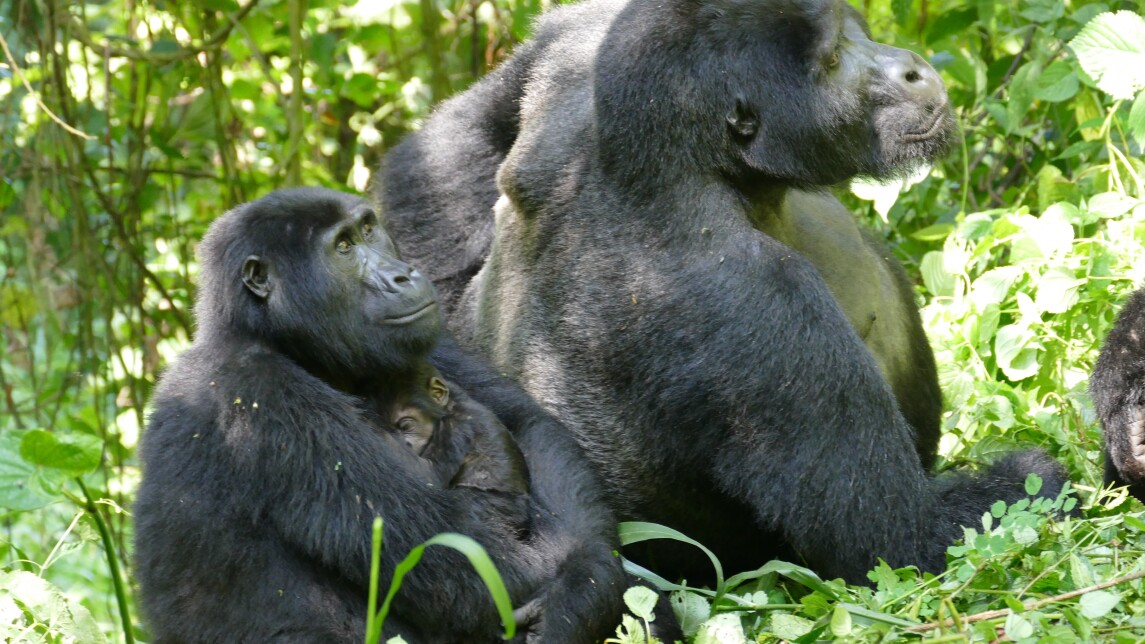
Recent research, including a new study from the University of Turku and the Max Planck Institute for Evolutionary Anthropology challenges traditional assumptions of universal male dominance in mammals. Analysing three decades of data on wild mountain gorillas, which have long been considered to have strictly male-biased hierarchies, this study reveals that most females can overpower at least one adult male, securing wins in conflicts and priority access to resources.
Over 50 years ago, the idea that males had universal social power over females across all mammalian species was challenged by the discovery that females had power over males in spotted hyenas and some species of lemur. An expanding body of research suggests that these species are not exceptions but represent one end of a continuum of intersexual power relationships varying from strictly male- to strictly female-biased.
A new study by scientists at the University of Turku, Finland and the Max Planck Institute for Evolutionary Anthropology in Leipzig, Germany adds to this work, showing that female–male power relationships are not as strictly male-biased as previously thought, even in gorillas.
“We wanted to investigate female–male power relationships in gorillas because gorillas exhibit extreme male-biased asymmetries in body and canine size, and are typically considered to exhibit the strictest male-biased power over females among great apes. At the same time, we knew that female gorillas can choose which males to reproduce with, a trait linked to increased female power across primates,” says lead author Nikos Smit, Postdoctoral Researcher at the University Turku.
Traditional female–male power relationships revisited
Based on behavioural observations spanning three decades and four social groups of wild mountain gorillas, this new study shows that almost all females in multi-male gorilla groups overpower at least one male. Despite weighing half as much as males, females win one in four conflicts and overpower one in four non-alpha males.
A possible explanation for this pattern is that alpha males support females against non-alpha males and non-alpha males yield to females as a means to be permitted in the group. Another possible explanation is that non-alpha males yield to females as a means to bribe them and gain access to these females in the future.
Finally, female gorillas enjoy priority access to certain food resources over males they overpower, challenging the traditional narrative that females and males compete over different resources (females over food and males over females).
“Our results showed that females were more likely to outrank younger and older adult males, which are still so much larger than adult females. This suggests that other mechanisms influence female–male power relationships besides basic size and strength,” says senior author Martha Robbins, director of the long-term Bwindi mountain gorilla research project, which provided the data for this study.
Human patriarchy – a cultural construct, not a primate legacy
A broader understanding of the female–male relationships in the most sexually dimorphic great ape has important implications for interpreting these relationships in humans and other species.
This study adds to the variation in female–male power relationships observed among great apes, ranging from female-biases in bonobos to male-biases in chimpanzees, and it contributes to a new perspective on the ecology and evolution of female–male power relationships that is not solely based on size and strength. Thus, it questions the notion that human patriarchy is a primate legacy and indicates that it is probably rather a cultural construct.
The research article was published in Current Biology on 7 August 2025.
Photo above the headline: The size difference of a female (left), and a male (right) mountain gorilla in Bwindi Impenetrable National Park, Uganda. Photo credits: Martha M Robbins/ MPI-EVA.