A 25-year observational study of female gorillas shows that individual circumstances and social context influence individual decisions to engage in more risky aggressive behaviours.
Non-human animals can adapt the intensity and direction of aggression to suit their individual needs and social contexts, according to new research conducted at the University of Turku and Max Planck Institute for Evolutionary Anthropology. The study used long-term behavioural observations to understand the factors that influence female-on-female aggression in gorilla social groups.
Animals that live in groups often compete for access to resources such as food and mates, forming hierarchies that determine priority of access. Individuals in the group must choose strategically who to compete with, at different timepoints, to maximise gain of resources and status while minimising costs – such as energy expenditure and risk.
“Aggression – a proxy for competition – tends to increase when resources are limited and is usually directed towards lower-ranking individuals but can vary towards groupmates of different ranks and variation is observed even within species,” says co-author Nikos Smit, Postdoctoral Researcher at the University of Turku and the Max Planck Institute for Evolutionary Anthropology. “In this study we tested the hypothesis that this variation arises due to different conditions individual animals experience, and that both an individual’s needs and social environment shape their aggression towards different ranking individuals, as predicted by risk-taking theory.”
To test this hypothesis, the authors used 25-year long behavioural observations among a total of 31 adult female gorillas from five wild gorilla groups – one group of western gorillas in Gabon, Central Africa, and four groups of mountain gorillas in Uganda, East Africa.
Trained observers recorded behaviours used to infer female gorilla hierarchies (such as decided avoidance – walking away from an approaching individual) and assigned each female gorilla a rank in the hierarchy. The observers also recorded aggressive interactions among adult females, and assigned a score to each of these interactions to quantify direction of aggression, and specifically if aggression was directed towards more or less powerful individuals, according to aggressor–recipient rank relationship.
After analysing 6,871 aggressive interactions, most of the aggression was directed from higher-ranking to lower-ranking individuals, consistent with the hypothesis that high-ranking individuals commonly use aggression to reinforce their status. The percentage of aggressive interactions from lower-to-higher ranking individuals was lower, at 42%, but higher than observed in previous studies and higher than in many other animals.
In comparison to other females, pregnant and lactating ones directed aggression towards more powerful groupmates – reflecting their increased energetic needs. However, despite the potentially higher energetic needs of lactating females, pregnant females directed aggression towards more powerful groupmates in comparison to them. The authors suggest this might be because lactating females are less likely to take the risk of aggression towards superior groupmates because they need to protect their dependent infants.
Female gorillas directed more aggression to more powerful, higher-ranking, females when there were more males in the group, suggesting that male protection affords an environment in which females will take greater risks. By contrast, female gorillas directed more aggression to lower-ranking, less powerful, females when there were more females in the group, suggesting that females prefer to target weaker opponents when they have such an option. Together, these results confirm that gorillas can adapt aggression to their social context.
“Overall, our results confirm that an individual’s circumstantial needs and their social environment may influence individual decisions to engage in more risky behaviours such as aggression towards more powerful groupmates,” concludes co-author Martha Robbins, Group Leader at the Max Planck Institute for Evolutionary Anthropology.
The research article was published on 23 July 2025 in eLife.
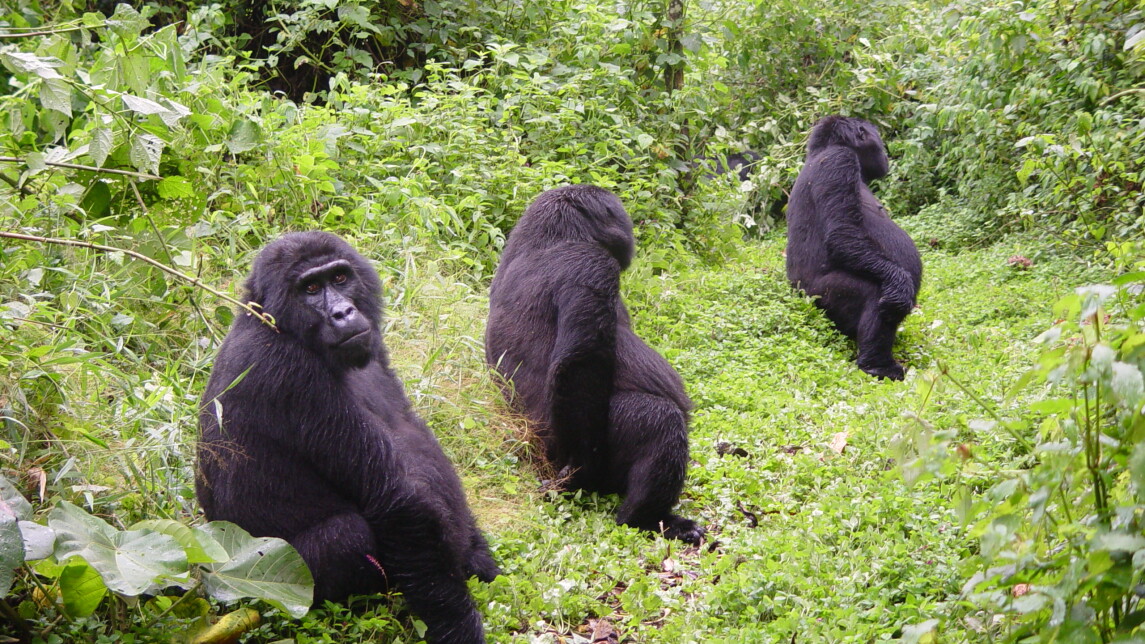
Photo above the headline: Three female mountain gorillas in Bwindi Impenetrable National Park, Uganda. Photo credits: Martha M Robbins/ MPI-EVA.