A recent study shows that the genetic makeup of the inhabitants of coastal and inland southwestern Finland diverged following migration from Sweden after the early Middle Ages. The findings also indicate that the Finnish region was already closely linked to the international networks of the Baltic Sea during the Viking Age.
A new study led by the University of Turku provides important new insights into the population history of Finland during the Late Iron Age and the Middle Ages. The researchers analysed the genomes of people who lived in southwestern Finland and Häme between the 11th and 13th centuries to investigate how the population changed over the course of the Middle Ages and how people were connected to other regions around the Baltic Sea.
The results reveal a striking difference between the population histories of the coastal and inland regions. During the Early Medieval period (1050–1250 CE), the inhabitants of coastal and inland southwestern Finland were genetically very similar, despite cultural and economic differences between the regions. After this, the two regions developed differently: genetic continuity persisted in inland areas to the present day, while the genetic composition of the coastal population changed after the Middle Ages. Medieval migration from Sweden left a lasting genetic legacy along Finland’s coast: people living there today have considerably more Scandinavian ancestry than those who inhabited the same region around a thousand years ago.
“Our findings suggest that migration from Sweden began to have a broader impact on Finland’s population relatively late, during the Middle Ages", says lead author, Postdoctoral Researcher Ronan James O’Sullivan. “Of course, people were already moving across the Baltic Sea earlier than 1250 CE, but migration from Sweden to Finland on a larger scale seems to have taken place only after the Early Medieval period.”
Finland had close connections across the Baltic Sea already in the Viking Age
The study also shows how closely the area of present-day Finland was connected to networks spanning the Baltic Sea. The researchers searched ancient DNA data from across the Baltic Sea region to identify distant genetic relatives and trace human mobility. Early Medieval individuals from Finland had genetic links to Viking Age Sweden, Gotland, Latvia, and the Lake Ladoga region, among other areas. The strongest links were found with Gotland, which reflects the island’s central role in Baltic Sea trade.
One particularly interesting finding comes from a later period. Two individuals who died when the Swedish warship Kronan sank in 1675 shared DNA segments with Early Medieval individuals from Finland. Historical records show that people from Finland were recruited to serve aboard the Kronan, and the genetic evidence suggests that at least some of those on board had roots in Finland.
“Finland was never isolated from the wider Baltic world,” O’Sullivan points out. “Our results show that people living here were closely connected to the vibrant, international networks that spanned the Baltic Sea”.
The research is published in the prestigious journal Genome Biology.
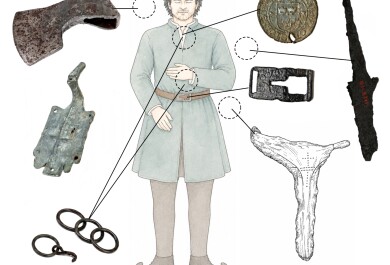
Main image: Early medieval fashion from Finland. The costumes are based on grave finds from the Yliskylä cemetery in Perniö, Salo. Photo credit: Ulla Nordors.
Read the research article:
For more information, please contact:
Postdoctoral Researcher Ronan James O'Sullivan
tel. +358505018224
ronan.osullivan@utu.fi
Postdoctoral Researcher Sanni Peltola
sanni.peltola@utu.fi