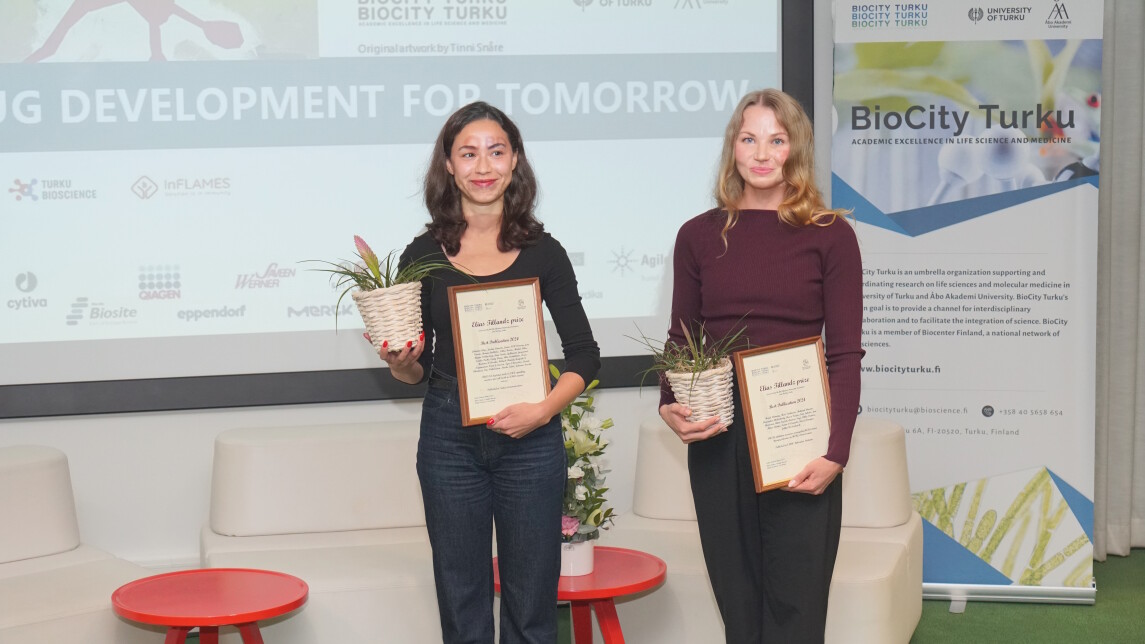
The Elias Tillandz prize for the best scientific publication of 2024 was presented for two groundbreaking cancer studies. The prizes were awarded to the researchers on Thursday, 28 August 2025, at the BioCity Symposium.
The Elias Tillandz prize is awarded annually to the best scientific paper published by a research group in BioCity Turku. The Prize is €12,000, jointly funded by BioCity Turku and Åbo Akademi University Foundation. BioCity Turku is an umbrella organisation supporting and coordinating research on life sciences and molecular medicine at the University of Turku and Åbo Akademi University.
BioCity Turku's new scientific advisory board selected the winner from amongst the suggestions made by the research community.
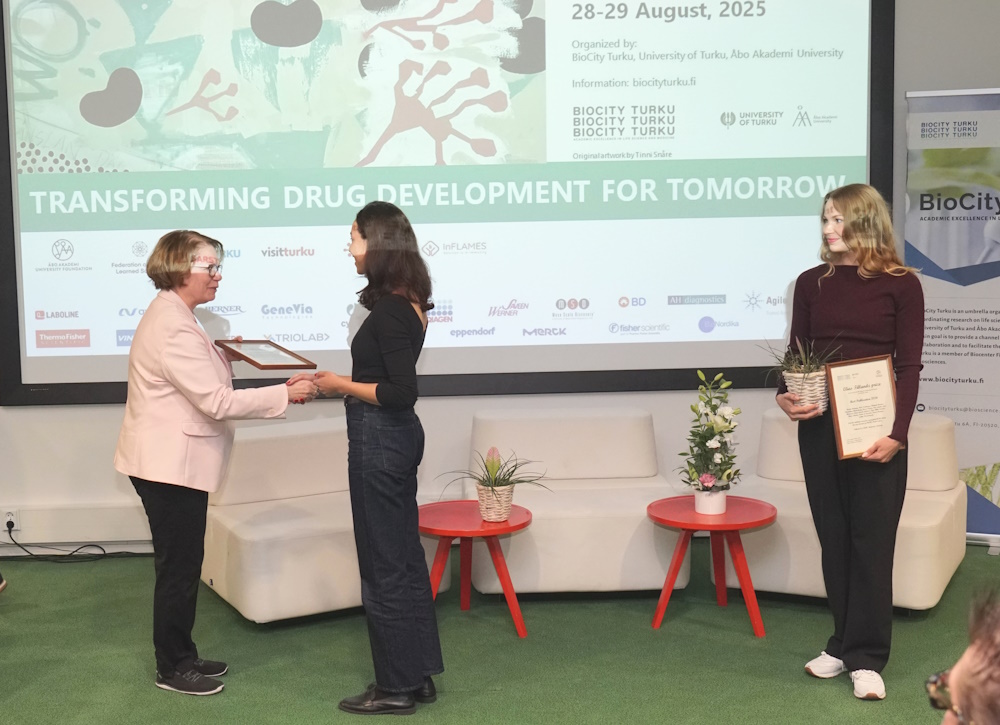
Rector of the University of Turku Marjo Kaartinen awarded the prizes.
This year, the award was given to two scientific publications: one by Professor Jukka Westermarck's research group and one by Professor Johanna Ivaska's research group.
Both award-winning research groups represent the Turku Bioscience Centre – researchers from Turku Bioscience Centre have received the award 15 times in the 21 years that it has been presented.
The lead authors of the Westermarck research group's study were Majid Momeny and Mari Tienhaara. The study investigated why HER2-positive breast cancer can recur after long symptom-free periods and identified a key mechanism in the development of drug resistance.
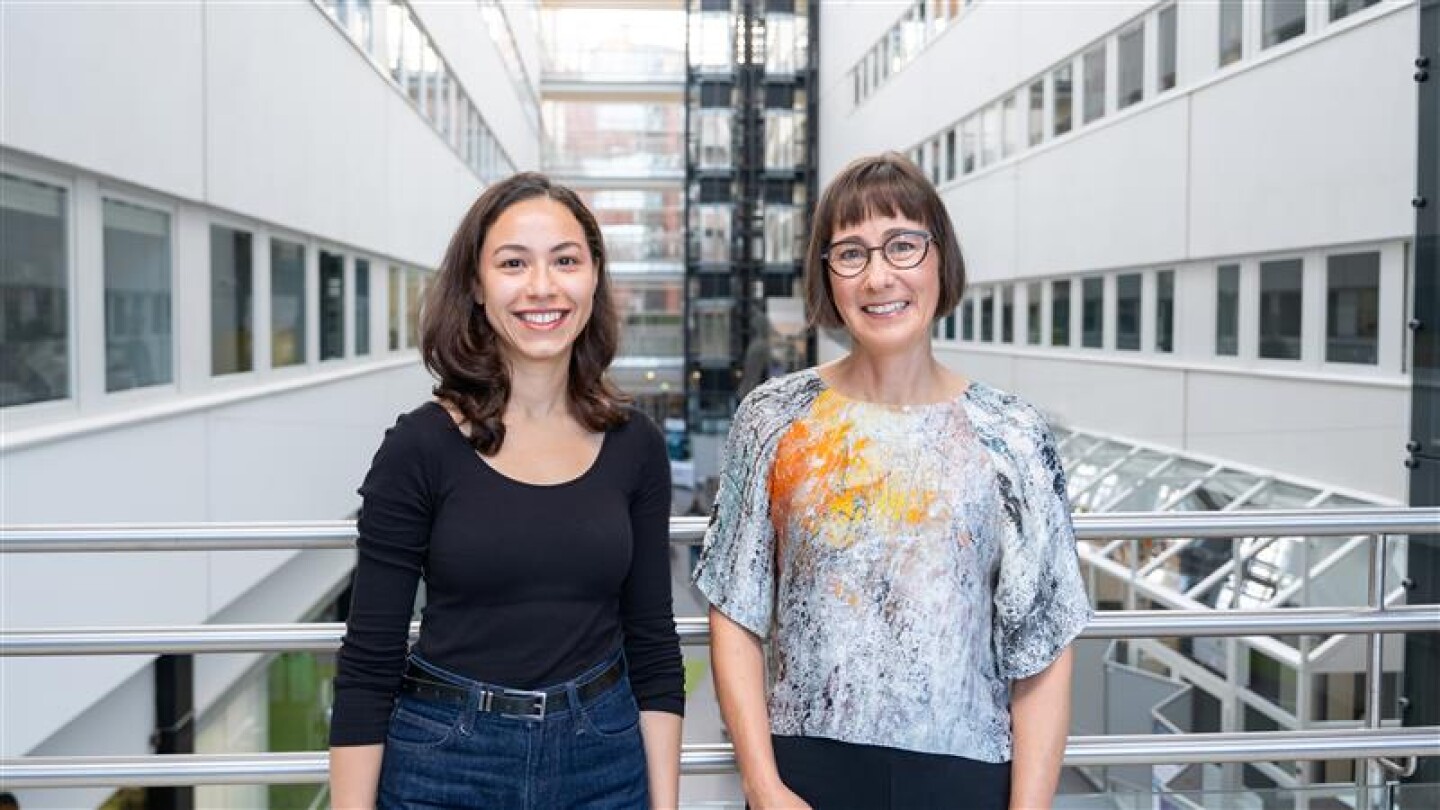
The lead authors of the Ivaska research group's study were Johanna Lilja and Jasmin Kaivola, and it discovered a possible way to treat difficult-to-treat cancers caused by mutations in the KRAS cancer gene when it was found that a protein called SHANK3 acts as a modulator of KRAS-driven cancer signalling.
The Elias Tillandz prize has been named after Professor Elias Tillandz (1640–1693) of the Royal Academy of Turku. Tillandz introduced empirical life science to Finland and published the first scientific study in Turku.
Study identified the mechanism behind HER2-positive breast cancer recurrence
A particular challenge in breast cancer treatment is when treatment is initially effective but the disease later recurs either locally or by spreading to other parts of the body. The research group led by Westermarck found a possible explanation for this: breast cancer cells belonging to the HER2-positive subtype are able to awaken during treatment when they become resistant to long-term HER2 inhibitor therapy. HER2-positive breast cancers account for about 20 percent of all breast cancers.
With the help of RNA sequencing, the researchers identified the DUSP6 protein as a key factor in the development of drug resistance. Its activity was essential for the "awakening" and regrowth of cancer cells during treatment. When DUSP6 was blocked, the cells became more sensitive to HER2 inhibitors, and the therapeutic effect of combination therapies was significantly enhanced. Another important finding was that inhibiting DUSP6 slowed the growth of breast cancer metastases in the brain in mouse models.
The researchers were also able to demonstrate with experimental DUSP6 inhibitor molecules that blocking DUSP6 with drugs would be an effective form of cancer treatment.
“The molecules used in the study are not yet suitable for patient treatment, but the discovery shows that it is possible to inhibit the DUSP6 protein with medication and motivates the development of a new generation of inhibitor drugs. We have continued this line of research in collaboration with a US research group, with the aim of exploring the potential for developing new inhibitor molecules,” Westermarck explains.
DUSP6 inhibition has previously been shown to be a potential future treatment for other cancers as well, so the applications for inhibitor drugs may be even broader.
The award-winning article "DUSP6 inhibition overcomes neuregulin/HER3-driven therapy tolerance in HER2+ breast cancer" was published in the journal EMBO Molecular Medicine in June 2024.
Cancer gene overactivation led to the death of cancer cells
Alterations in the KRAS gene is one of the most common changes underlying cancer, and its mutations cause several serious and deadly cancers, such as pancreatic, lung, and colon cancer. KRAS inhibitors on the market have attempted to prevent uncontrolled cell growth by inhibiting cancer cell signalling. However, cancer can quickly become resistant to drugs that work in this way.
The research group led by Ivaska discovered a surprising new role for a protein called SHANK3, which is normally known for its role in nerve cell function and is associated with autism.
"We noticed, unexpectedly and even somewhat by accident, that removing KRAS signalling from cancer cells leads to uncontrolled signalling hyperactivation. It “overheated” so much that the cancer cells died, but normal cells did not," Ivaska explains.
The study found that SHANK3 binds to active KRAS, including the mutant form, and modulates its activity. It suppresses the growth signal transmitted by the KRAS gene—when SHANK3 expression is eliminated by RNA interference, the gene's signalling accelerates uncontrollably, ultimately leading to the death of cancer cells.
The researchers also developed nanobodies that block the ability of the SHANK3 protein to modulate KRAS signalling. Drugs based on both RNA interference and nanobodies are being introduced to the market, and the research group has shown in preclinical trials that both methods are effective against cancer tumours.
The discovery offers a completely new approach to treating cancers caused by mutations in the KRAS gene: instead of trying to inhibit the gene's activity, its overactivation can be harnessed to kill cancer cells.
The award-winning article "SHANK3 depletion leads to ERK signaling overdose and cell death in KRAS-mutant cancers" was published in Nature Communications in September 2024.