Exceptionally feeble supernova explosion from a feeble star
Armed with advanced sky surveys that monitor the night sky almost continuously, astronomers have discovered one of the faintest supernovae ever recorded. Rapid follow-up observations using worldwide cutting-edge instrumentation enabled astronomers to capture the evolution of the supernova and conclude that the star that exploded must also have been a faint one.
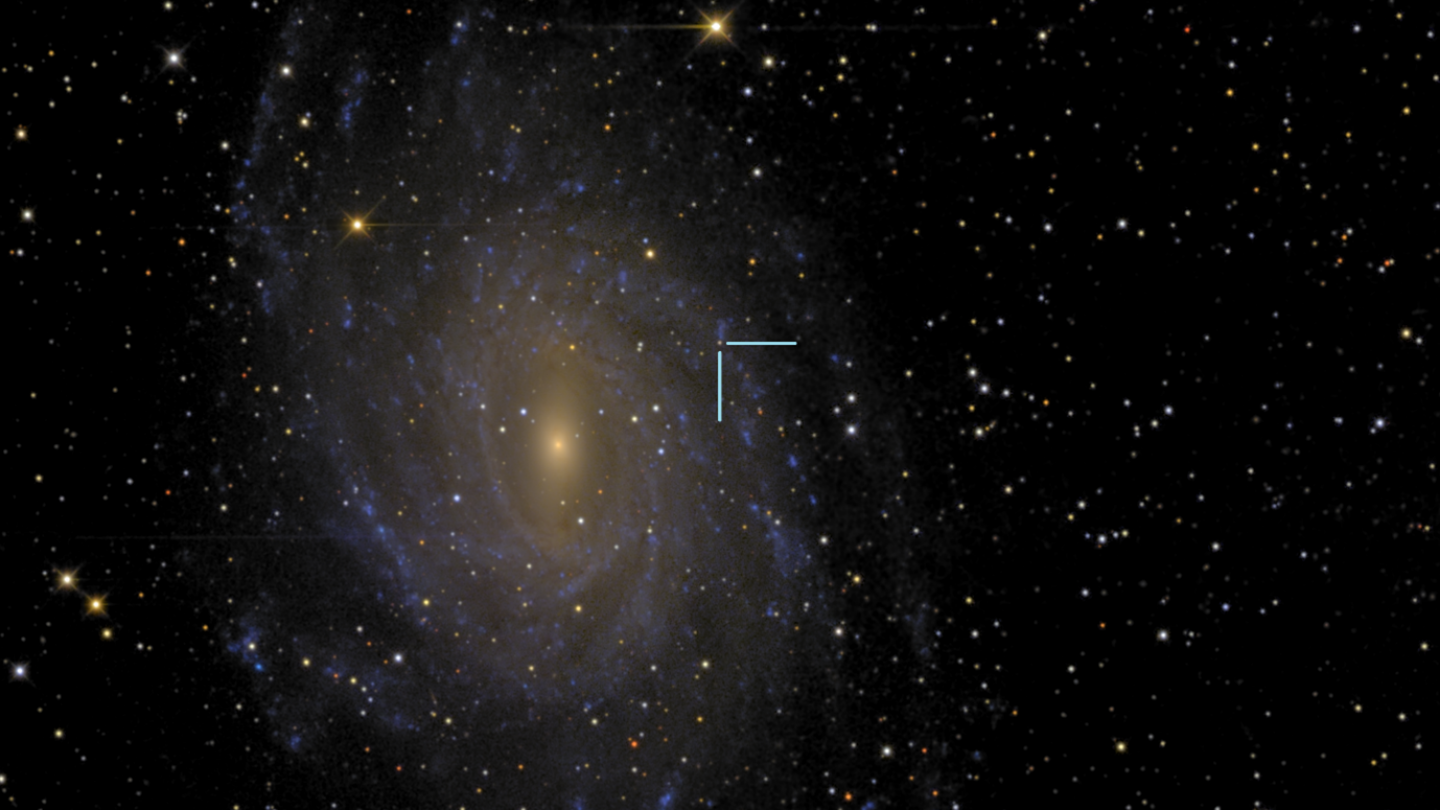
Supernovae are known to be enormously powerful cosmic explosions with brightness comparable to a billion Suns.
Some of these supernovae can be calibrated, so that they act like candles with standardized brightness. This enables astronomers to accurately measure the distances of supernovae across the Universe, based on the reduced apparent brightness with distance. The distance measurements revealed that the Universe is expanding at an accelerated rate, a discovery that was awarded Nobel Prize in Physics in 2011.
Such a standardizable class of supernovae are called Type Ia supernovae. They are thought to be the explosions of white dwarf stars – the inner core of stars like the Sun that has shrunk to the size of Earth, resulting in a density of a million times that of water.
Within the Type Ia class, the subclass of Type Iax supernovae is characterized by lower brightness compared to the standard Type Ia supernovae, and the properties of the exploding star are relatively unknown.
Astronomers have now identified a Type Iax supernova that could very well be the faintest explosion ever found so far – supernova SN 2024vjm was found to be 300 times fainter than typical Type Ia supernovae. It appeared faint not because it was far away, but because it was actually a faint explosion.
To find supernovae, astronomers monitor the whole night sky almost continuously using telescopes in various places around the world, in order to find new objects that were not there in the night before.
These transient objects are visible only for a limited time before they disappear again. They usually turn out to be supernovae, and the fainter ones are the most difficult to catch. Once an interesting object is found, astronomers would follow up the discovery with more detailed observations.
SN 2024vjm was followed up immediately after its discovery.
“Supernovae are discovered at an astonishing rate of thousands of new objects per night nowadays, and rapid continuous follow-up after discovery is challenging. International collaboration using facilities around the world is usually done for this reason,” says Hanindyo Kuncarayakti from the Department of Physics and Astronomy at the University of Turku and Finnish Centre for Astronomy with ESO, who was involved in the study.
The data show that SN 2024vjm was faint, suggesting that the amount of radioactive material powering the explosion was very low. However, it evolved slower than expected, completely in reverse of the behaviour seen in regular, standardizable Type Ia supernovae.
This was explained by the weak explosion struggling to accelerate the ejected material to high velocities, therefore keeping the material density high and causing the radiative power to spread more slowly. The mass of the material ejected in the explosion was found to be very low, around 10% of the mass of the Sun, suggesting that the weak explosion likely produced a gravitationally bound leftover.
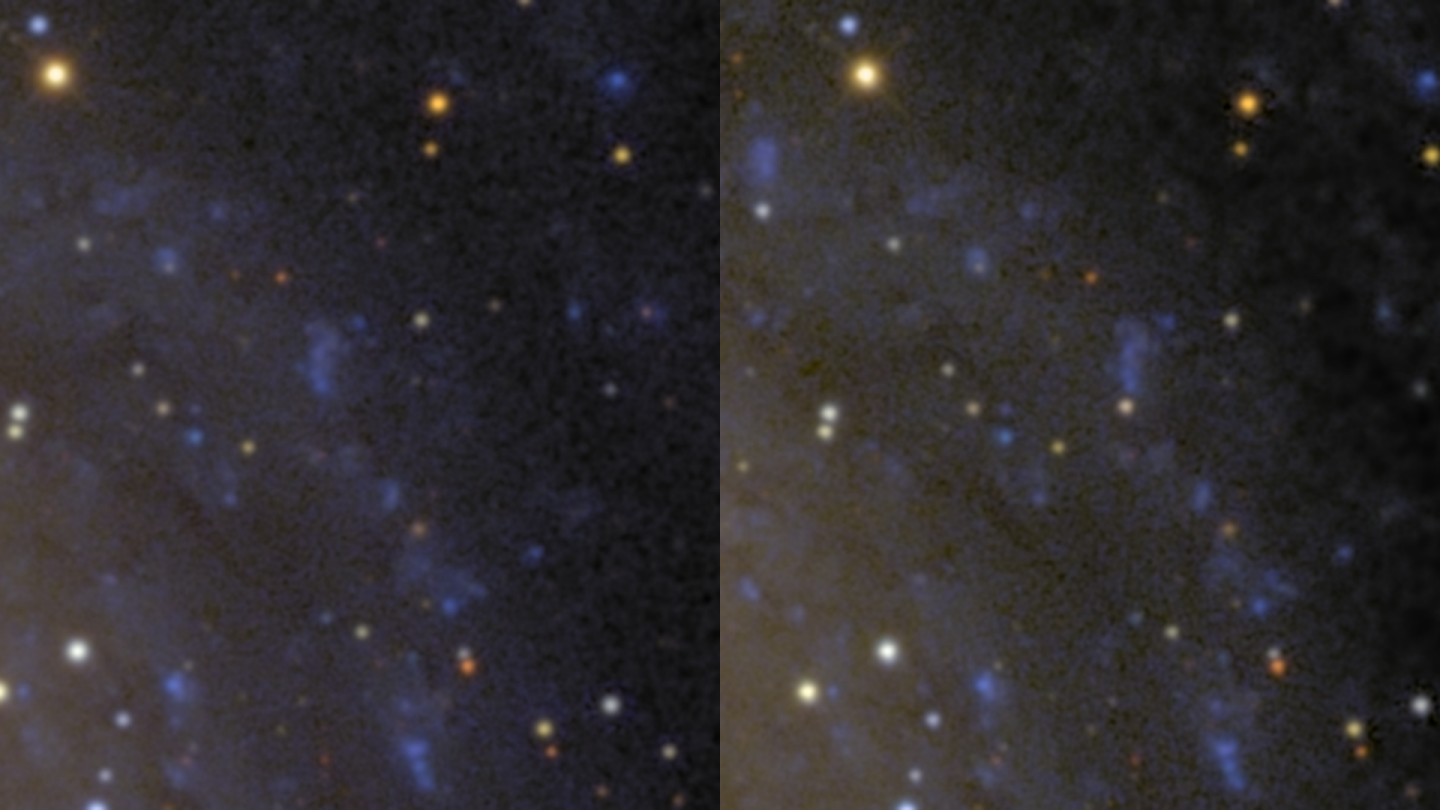
In order to find out what kind of star produced such a weak explosion in SN 2024vjm, astronomers searched the data archives of space telescopes to find an image of the star before it exploded.
They found that luckily the area of the sky was previously observed 11 months earlier by the space telescope Euclid; however, no bright star was seen at the position of the supernova.
Based on this, it was concluded that the star that exploded as SN 2024vjm must have been very faint, fainter than any other progenitor stars of supernovae.
This indicates that the progenitors of similarly faint explosions are most likely composed of low-mass stars in binary star systems, in which the stars orbit each other in a cosmic dance. Such systems, and the eventual faint explosions produced, open a new window to the largely unexplored aspects of stellar evolution.
These discoveries are only made possible by modern sky surveys and rapid follow-up observations across continents and time zones, requiring a synergy between the frontier science and the enabling technology.