Welcome to the postdoctoral programme in nursing science, PDNurs!
The purpose of the programme is to further postdoctoral research and academic career of the graduates.
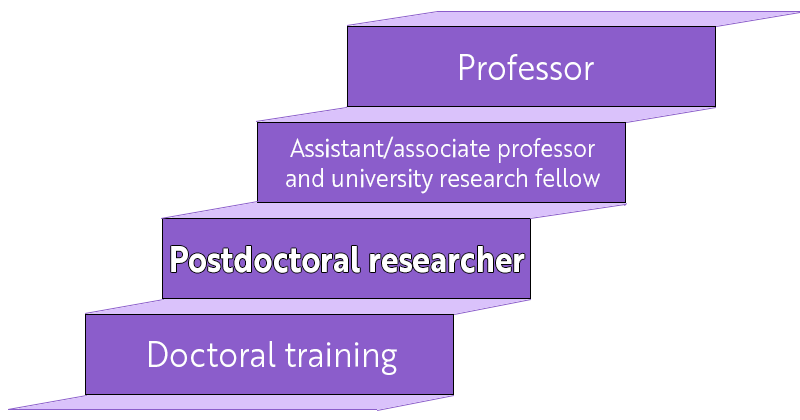
The duration of the postdoctoral period is generally five active years following a dissertation. During these years the postdoctoral researcher establishes their own research group and area of study, as well as an international network. Progressing according to the postdoctoral programme enables applying for a title of docent after the postdoctoral period.
In case the postdoctoral programme is not suitable as a whole, individually planned and shorter postdoctoral periods are possible. Shorter postdoctoral periods can be mentored if the postdoctoral research plan is of high-quality and complements to the research programme of the Department. In addition, we are willing to mentor suitable postdoctoral researchers in their application for external funding. However, we cannot guarantee that the application to the funding body will be successful.
Requirements for becoming a postdoctoral researcher at the Department of Nursing Science:
- a doctoral dissertation that has been defended or will be defended in the near future
- a research plan for the postdoctoral stage (including a plan for financial resources)
- a career plan in nursing science
Applying for the programme
- A researcher planning their postdoctoral study should contact the head of the research area of interest. An academically responsible senior researcher from the Department is needed to act as a mentor of the postdoctoral researcher during the postdoctoral period.
- The researcher draws up a research plan in co-operation with the mentor and/or the research group. The research plan is written following the instructions of the Academy of Finland and it must include a plan for financial resources and a career plan in nursing science. The plan must include the contact information of the Department’s senior researcher (mentor).
- The application includes the following documents. It's recommended that the documents are written in English.
- Postdoctoral research plan (including financial plan and career plan in nursing science and following the instructions of the Academy of Finland)
- CV (following the instructions of Finnish National Board on Research Integrity (TENK))
- List of publications (following the instructions of the Academy of Finland).
The reseacher sends the documents to the coordinator of the Doctoral Programme in Nursing Science (hanna.heikela@utu.fi). - The steering committee of the Doctoral Programme in Nursing Science reviews and considers the postdoctoral plan for approval. The committee makes a proposal to the head of the Department for the approval of the postdoctoral researcher.
- Based on the proposal by the steering committee, the head of the Department makes the decision on whether or not to approve the postdoctoral researcher in the Department. A decision of approval does not entail an employment relationship with the University of Turku. If necessary, the head of the Department will discuss the financial issues with the postdoctoral researcher.
Applying for a shorter post doc period
Length of a postdoctoral period will be negotiated individually. The researchers interested in visiting the Department as a postdoctoral researcher should:
- contact the head of the research area of interest. An academically responsible senior researcher from the Department is needed to act as a mentor of the postdoctoral researcher during the postdoctoral period.
- conduct a plan for the postdoctoral period about the aims and collaboration with the Department of Nursing Science. The mentor supports and approves the plan.
- prepare a research contract with the mentor. The length of the postdoctoral period should be defined in the contract which is signed by the Head of the Department.
The aim is that after completing the postdoctoral period, eligibility requirements for the title of Docent would be fulfilled.
The postdoctoral researcher should proceed, according to his/her plan, to contribute to the development of nursing science. Regular discussions with mentor are recommended at least yearly basis. Postdoctoral researcher is responsible for organizing the mentor discussions.
For the promotion of academic progress it is recommended for the postdoctoral researcher:
- to participate in at least one international meeting per year (e.g. network, visit, conference). In addition, one longer-term, international working period during the postdoctoral stage is recommended. The aim is to build systematic international cooperation.
- active international scientific output, meaning 1–3 international publications per year (in peer-refereed journals, with an impact factor and JUFO classification of level 2, at least) NOTE! To apply for the title of docent, a minimum of 20 publications are needed.
- active national scientific output, meaning 1–3 publications in national professional journals (includes publications of the Department of Nursing Science), with the purpose of implementing the findings of the research.
- activity in applying for research grants.
Academic career advancement requires cooperation and interaction between researchers. Academic cooperation may take the form of
- an annual seminar day for postdoctoral researchers to promote peer support
- an annual research symposium for junior researchers.
Such events are arranged by the postdoctoral researchers with the support of the coordinator of the Doctoral Programme in Nursing Science. Postdoctoral researchers are welcome to offer suggestions regarding forms of cooperation and to be proactive to develop collaboration between themselves, the staff of the Department, and other researchers as rewarding as possible to all parties concerned.
One of the goals of the University of Turku is to enable a straightforward and attractive research career. In the 2021–2030 Strategy, the University has committed to developing the postdoctoral phase. To promote this goal, a new webpage gathering information for postdoctoral researchers has been launched and an email list for postdoctoral researchers has been created.
The Postdoctoral Researcher at the University of Turku webpage gathers information on e.g. services and funding possibilities targeted both for postdoctoral researchers employed at the University and for post docs working on a grant.
There is also a new email distribution list which aims to reach postdoctoral researchers more easily and improve the support offered to postdoctoral researchers. Postdoctoral researchers may join the list by following the instructions on the abovementioned webpage. The postdoctoral researchers employed at the University of Turku have already been added to the list. It is also possible to opt-out from the list.
See the Postdoctoral Researcher at the University of Turku webpage for more information.
Steering Committee
Steering committee of Doctoral Programme in Nursing Science covers also the issues regarding the Postdoctoral Programme in Nursing Science.
Steering Committee 1.8.2025- 31.7.2029
- Riitta Suhonen, Professor, Director of the Doctoral Programme in Nursing Science (Chair of the Board)
- Anna Axelin, Professor, Department of Nursing Science
- Mari Kangasniemi, Professor, Department of Nursing Science
- Minna Stolt, Professor, Department of Nursing Science
- Heli Virtanen, Professor, Department of Nursing Science
- Seppo Virtanen, Professor, Faculty of Technology
- Anne Heimo, Professor, Faculty of Humanities
- Markus Juonala, Professor, Department of Clinical Medicine
- Tuija Lehtikunnas, TYKS Hospital director of nursing at Wellbeing services county of Southwest Finland
- Jenna Poraharju, Doctoral Researcher, Department of Nursing Science (1.8.2025-31.7.2027)
- Secretary: Hanna Heikelä, Coordinator, Research Career Unit
Information and opportunities
Here you can find general guidelines provided by the University of Turku, as well as relevant presentations and publications regarding postdoctoral research and/or postdoctoral career. More material such as presentations of the seminar days are available in Moodle (not public: only for official post doc researchers in nursing science, PDNurs).
Guides
Presentations
Relevant publications
You can search for suitable funding bodies from these databases. Research funding specialists at the university support researchers in managing the demands of research funding.
Postdoctoral researchers in nursing science are allowed to participate in the courses for doctoral researchers (Postgraduate studies). If the number of participants in a course is limited, doctoral researchers are preferred over postdoctoral researchers.
Postdoctoral programme in nursing science PDNurs collaborates with the two Research Collegia of the University of Turku:
Seminar day and symposiums for post doc researchers
Department of Nursing Science organised the second international symposium "Postdoctoral Researchers in Nursing Science Shaping the Future of the Social and Health Care" on December 12-13, 2024 in Turku.
» See more on symposium website.
Friday 1st of December, at 9-15
Venue: Department of Nursing Science, Medisiina B, 6th floor, room B610
Preliminary programme
9:00–9:15 Welcome and introduction of the day
Professor Riitta Suhonen, Department of Nursing Science, University of Turku
9:15–9:45 Funding targeted to postdoctoral researchers
Senior Grant Writer Maria Maunula, Research Services, University of Turku
9:45–10:30 How to conduct a successful funding application
Academy Research Fellow, Associate professor Marja Härkänen, Department of Nursing Science, University of Eastern Finland
10:30–11:30 Working in small groups
11:30–12:30 Lunch break
12:30–13:15 International postdoctoral research training - from the Moominvalley to Australia (and back again?)
Professor, Associate Dean David Edvardsson, Academic Office of Nursing & Midwifery, LaTrobe University, Australia
13:15–14:45 Working in small groups
14:45–15:00 Conclusions and closing the day
Professor Riitta Suhonen, Department of Nursing Science, University of Turku
For information, please contact University Lecturer Tella Lantta, tella.lantta@utu.fi.
Department of Nursing Science organised the first international symposium "New Horizons for postdoctoral researchers in Nursing Science" on December 8-9, 2022 in Turku.
Thanks to all participants for attending the symposium!
» See more on symposium website.
PROGRAMME
|
Time: Thursday December 9th, 2021 at 9.45–15.45 Venue: Säätiö-sali, Medisiina D; participation via Zoom also possible |
|||||||||||||||||
|
|||||||||||||||||
Friday 11 June 2021 at 10-16 via Zoom
The seminar day is organized as a collaboration between the two Research Collegia, TIAS and TCSMT, and the Post doc Programme in Nursing Science. Postdoctoral researchers in these programmes are warmly invited to participate. The aim of the seminar day is to provide new insights on current scientific topics, as well as to network with other postdoctoral researchers at the University of Turku.
The Academy of Finland, the Ministry of Education and Culture, and the Federation of Finnish Learned Societies have named 2021 the Year of research-based knowledge. The theme of the seminar day reflects this: with the amount of humbug challenging scientific knowledge on different social media, research-based knowledge is now more important than ever.
The seminar day will consist of a lecture and small group discussions. All participants are invited to present their own postdoctoral research projects to peer researchers in multidisciplinary groups. In the presentations, researchers are asked to reflect on their experiences of humbug and misinformation related to their research area. The presentations should be informal and concise, no more than 10 minutes. In the afternoon, we will organize program specific events.
PRELIMINARY PROGRAMME
10:00–10:15 Welcome to the seminar day
10:15–11:15 Lecture: Professor Juhani Knuuti
11:15–12:30 Networking and informal presentations in small groups
12:30–13:15 Lunch break
13:15–14:15 Networking and informal presentations, part 2
14:15–14:30 Coffee break
14:30–16:00 Separate program for TIAS, TCSMT, and PDNurs researchers
Building a career and applying for funding
Date: Tuesday 8th of December, 2020 at 10-16
Location: via Zoom
Program
| 10:00-10:15 | Opening the seminar day Riitta Suhonen, Professor, Department of Nursing Science, University of Turku |
| 10:15-11:00 | Combining research and leadership position Heljä Lundgrén-Laine, Docent, Chief nursing officer, Central Finland Health Care District |
| 11:00-12:00 | Postdoctoral researchers in nursing: the ups and downs of their roles, functions and careers Hugh McKenna, Professor of Nursing, Ulster University, UK |
| 12:00-12:30 | Research and career in a university of applied sciences Arja Suikkala, PhD, Principal lecturer, Health Care Sector, Diaconia University of Applied Sciences |
| 12:30-13:15 | Lunch break |
| 13:15-14:00 | International paths for post docs – panel discussion Chair: Hannakaisa Niela-Vilen, PhD, Postdoctoral researcher Panelists from the Department of Nursing Science: Mari Kangasniemi, Docent, University research fellow Anna Axelin, Associate professor Minna Stolt, Docent, University lecturer |
| 14:00-14:45 | Funding possibilities to a post doc researcher in health sciences Maria Maunula, Funding specialist, Development Services, University of Turku |
| 14:45-15:00 | Break |
| 15:00-15:45 | Building a powerful research career Helena Leino-Kilpi, Professor, Department of Nursing Science, University of Turku |
| 15:45-16:00 | Closing the seminar day – how to continue from here? Riitta Suhonen, Professor, Department of Nursing Science, University of Turku |
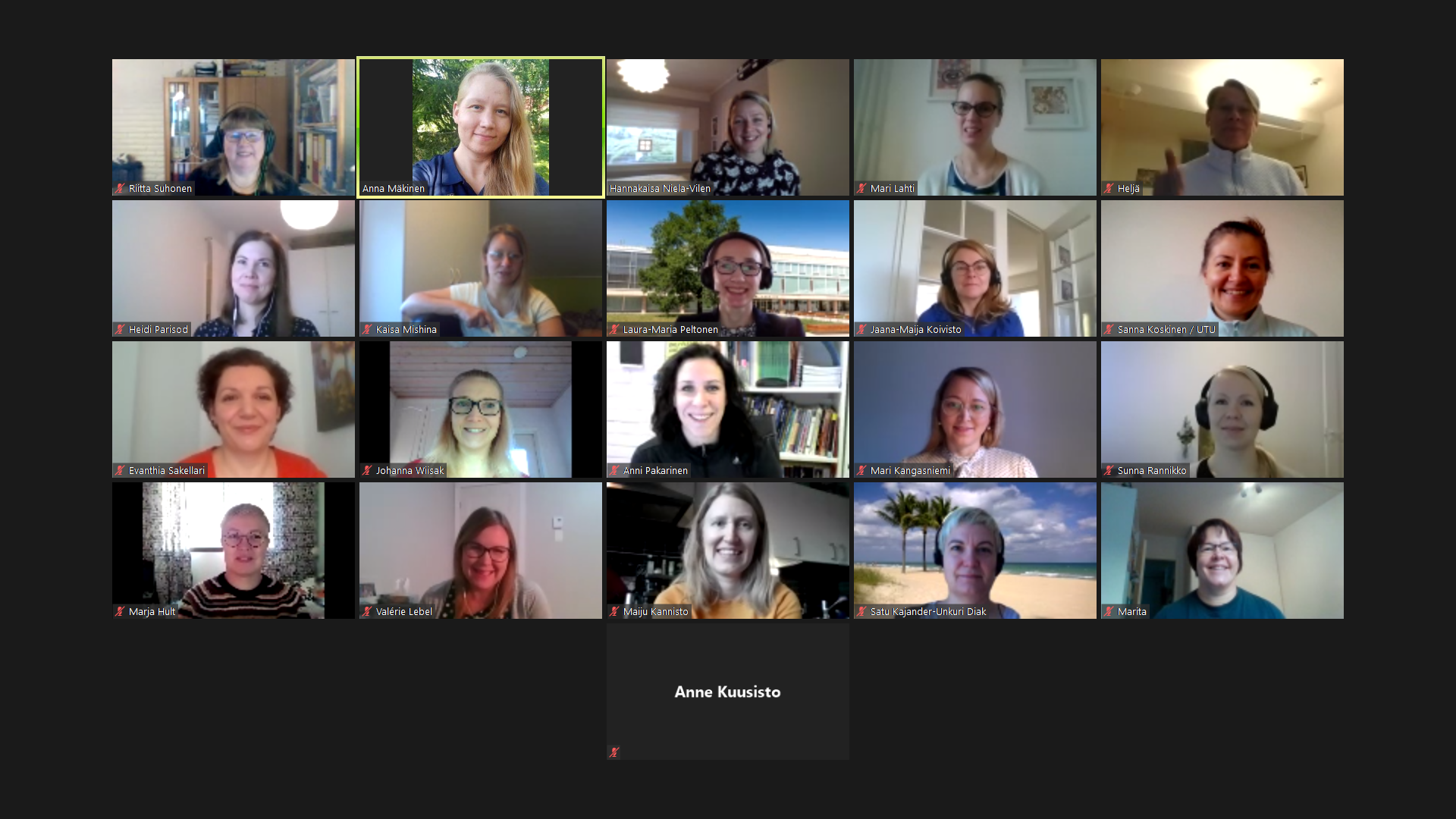
Participants of the seminar
Kohti dosentuuria
Seminar was held in Finnish
Aika: tiistai 10.12.2019 klo 10:00-16:00
Paikka: Turun yliopisto, Dentalia, ls 2.
Ohjelma
| 10:00-10:30 | Tervetulokahvi |
| 10:30-10.45 | Päivän avaus professori Helena Leino-Kilpi |
| 10:45-11:15 | Dosenttitoimikunnan käytännöt Anne Saarenpää, lääk.tdk:n dosenttitoimikunnan sihteeri |
| 11:15-12:15 | Post doc -tutkijasta dosentiksi TtT, dos. Minna Anttila |
| 12:15-13:15 | Lounas Dentalian Koivukabinetissa |
| 13:15-14:15 | Kansainvälinen post doc -tutkija TtT, tutkijatohtori Tella Lantta |
| 14:15-15:45 | Dosenttityöpaja* Iltapäiväkahvit työskentelyn lomassa |
| 15:45-16:00 | Päivän yhteenveto |
*Dosenttityöpajaan voit valmistautua perehtymällä Turun yliopiston lääketieteellisen tiedekunnan dosentuurin hakuohjeeseen. Halutessasi voit valmistella vaadittavia dokumentteja jo etukäteen. Työpajassa saat vinkkejä ja vertaistukea hakemuksesi kehittämiseksi.
Participants of the seminar
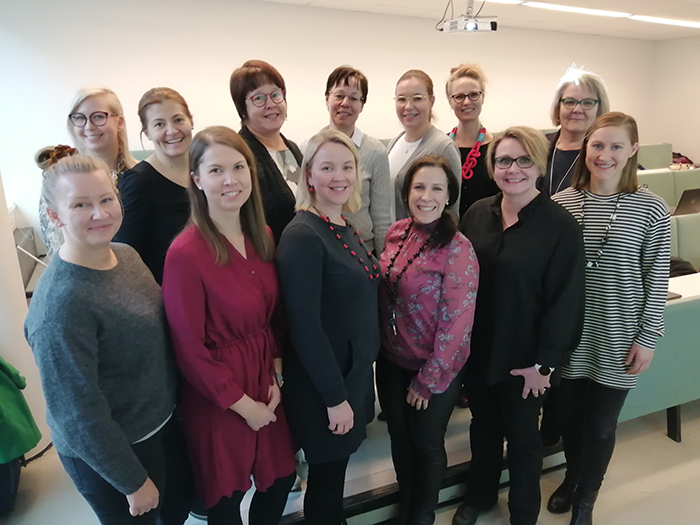
Post doc researchers
Maria Ameel, PhD, postdoctoral researcher in Connected Health UTU, Department of Nursing Science, University of Turku
maria.k.ameel@utu.fi
Digitalization and artificial intelligence in psychiatry – researching the effects of digitalization and AI in experiences by patients and clinicians
Digitalization in health care has several advantages, including more flexible ways of providing care, enhanced quality of care due to the implementation of clinical decision-making support mechanisms, as well as more detailed information and understanding of personal health. Digitalization of health care information makes it possible to gather large amounts of data. With the help of artificial intelligence, the data could be turned into new knowledge that helps both clinicians and patients to better understand health risks and the effects of care interventions. At the same time, many clinicians find that digitalization increases work-related stress.
The aim of this research is to better understand how digitalization in health care changes work and the experience of care. The postdoctoral research project studies digitalization in psychiatric care through three separate studies: the use of video consultations, the integration of an evidence-based violence prevention protocol into the electronic patient health record system, and the use of health data from wearables for patients suffering long-term psychiatric illness.
The founding methodological principle in this research is that conducting research and development of new digital innovations needs to be carried out in co-operation with end users to make the digital processes meaningful and sustainable. In the separate studies, end-users include clinical professionals, patients and their family members, as well as data scientists. Co-design and participatory methods are included in all three studies. Research methods include qualitative methods such as ethnographic studies, interviews, focus groups as well as a large variety of statistical methods.
The findings will be summarized into a user-oriented theory on implementing new digital tools in the health care setting.
The research is planned to take place in 2021-2026 and the main partner in each phase is HUS Psychiatry.
Riitta Askola, PhD, RN, postdoctoral researcher in Mental Health Nursing Science programme, Department of Nursing Science, University of Turku
riittaanneli.askola@utu.fi
Mentor: Docent Tella Lantta
Service system and care pathway of forensic psychiatry patients and their development: Views of patients and treatment providers
Background: The Finnish forensic psychiatric service system lacks the standards and criteria guiding the quality and contents of patient care. Ensuring best recovery-oriented practices in forensic psychiatric services need to be developed at several levels.
Aims: The purpose of this research project is to develop safe, high-quality psychiatric care. The outcome of this project is the production of quality criteria for the forensic psychiatric care and service system.
Methods: The research methods include a literature review, a survey based on validated measurement questionnaires, individual and group interviews as well as the Delphi method. The research will cover the multidisciplinary employees at adult psychiatric wards in Finland’s larger hospital districts, and both employees and patients of forensic psychiatric hospitals.
Expected results: The research results will allow the development of the service system for forensic psychiatric patients in such a way that the identification of so-called risk patients can be improved already at the early stages of treatment, at the general psychiatric level. Moreover, the substance of care and participation during care can be created and the care following inpatient care and the patient’s transfer out of forensic psychiatric care can be developed. The research may promote the effectiveness of treatment by highlighting areas in the care chains that, when reinforced, will allow patients to receive the right kind of treatment at the right time. A proposal of standardized operating methods and quality criteria will be created for the Finnish forensic psychiatric treatment system. The research project will also reveal previously unresearched information that can be utilized in national health policy.
Abigail Kusi Amponsah, PhD, RN, FGCNM
Postdoctoral researcher in Connected Health UTU, Department of Nursing Science, Faculty of Medicine, University of Turku, Finland
abkuam@utu.fi
Lecturer at the Department of Nursing, Faculty of Allied Health Sciences, College of Health Sciences, Kwame Nkrumah University of Science and Technology, Ghana
akamponsah.fahs@knust.edu.gh
Post doc Mentor: Associate Professor Anna Axelin
Implementation and evaluation of a pediatric pain educational program for healthcare providers in a resource-limited setting
Considering the effects of unrelieved children’s pain and the important role of healthcare providers, the proposed project seeks to implement and evaluate a developed pediatric pain educational program in a resource-limited setting (Ghana).
The pilot-feasibility and main trial will be designed as a two-arm cluster, randomized controlled trial with a three-month follow-up. All physicians and nurses working at two specialist children’s hospitals (pilot-feasibility phase) and four teaching hospitals (main trial phase) in Ghana will be randomly allocated into the intervention (flipped classroom) or control (lecture) group.
Outcomes will include pediatric pain knowledge and attitudes, self-efficacy, pain assessment and management competencies, documentation, satisfaction with pain management and evaluation of the educational program. Data on the project outcomes will be collected at baseline, in the immediate post-intervention and three-months after the educational program. Data will be analysed and presented using appropriate descriptive and inferential statistics.
It is hoped that by the end of this 36-month project, there will be improved pediatric pain care which will ultimately improve the bio-psycho-social well-being of hospitalized children and their family caregivers. The workload on healthcare providers and increased consumption of healthcare resources will also be reduced especially in a resource-limited country like Ghana.
Karoliina Nikula, PhD, postdoctoral researcher in Ethical Health Care and Nursing, Department of Nursing Science, University of Turku
More information: https://fi.linkedin.com/in/karoliina-nikula-68223851
The rationale of my postdoctoral research is based on the fact that while there is some research on experts-by-experience (EBEs), there is as yet little on related ethical questions. There is thus a compelling need to study these fundamental ethical and critical questions.
The novelty of this study is to develop the theoretical base of EBE ethics in general and thus increase the possibilities to develop the practical side, e.g. clinical practices in health care where EBEs could be a sustainable part. Clearer understanding of the ethics of EBEs will make it easier to justify and defend their wider use in the health care sector.
The purpose of the study is to examine the ethical issues of experiental expertise/EBEs in the health care sector. This research will help us understand what experiential expertise is, what good it provides, and what are the fundamental (moral) grounds for ethical actions of experiential expertise.
The aim of the research is to provide new perspectives and tools for a diverse range of actors/agents to develop the utilization of expertise/knowledge in the health care sector and to develop clinical practices using shared expertise in a sustainable and responsible way.
As a social ethicist my background is in concept and argumentation analysis. My doctoral thesis was in Social Ethics / in the field of health care ethics.
Outi Tuominen, PhD, postdoctoral researcher in Connected Health UTU, Department of Nursing Science, University of Turku
ouantu@utu.fi
The aim of my study is to study the impact of different staffing models from the perspective of patient safety pediatric and adolescent nursing in a hospital setting. The perspective of my research focuses on the management, experience of nursing staff and competency needs assessment. Patients and families will be involved in the study where appropriate. The overarching concept of the study is patient safety. This study will deepen the knowledge of different staffing models. Staffing models in this context refers to the management of sudden absences, by using float pool nurses, floating nurses and substitute nurses to cover sudden absences of nursing staff. The research will be conducted as a multi-method study.
The overall aim is to develop evidence-based guidelines to guide and support healthcare management and decision-making during day-to-day staffing in the context of patient safety. The research project is part of the Children and Young People's Division's (Turku university hospital) research and Development project for 2021 - 2026 "Patient Safety and Quality in Children and Adolescents in Health Care".
Jaakko Varpula, PhD, Department of Nursing Science, University of Turku
Minna Ylönen, PhD, RN, postdoctoral researcher in Older Individuals' Health, Nursing and Services, Department of Nursing Science, University of Turku
misuyl@utu.fi
Administrative Nurse Director, Social- and Health Care Services, The wellbeing service county of Southwest Finland
Older Individuals Care - Home Best? Assessing prerequisites for living at home of older individuals with comorbidities - evidence for development
The study focuses on supporting evidence-based practices in older individuals’ nursing care. The aim is to model independent living at home, prerequisites for, current and future practices including management and develop uniform practices. The objective is to test Nursing Research Foundation’s Operational Model for Evidence-Based Practices model in the context of home health care in assessing prerequisites for living at home of older individuals with comorbidities.
There will be results in many levels of social - and health care; national, organization, older individuals, informal caregivers, managers, and nurses. This will constitute versatile frame of assessing prerequisites for living at home of older individuals with comorbidities.
Ratna Shila Banstola, PhD, RN, Postdoctoral researcher, Department of Nursing Science, Faculty of Medicine, University of Turku, Finland
ratnashila.banstola@utu.fi
Lecturer at Department of Nursing, Tribhuvan University, Institute of Medicine, Pokhara Nursing Campus, Nepal
ratna.bastola@ponc.tu.edu.np
Mentor: Docent Tella Lantta,
Promoting Health Equity, Mental Health and Adjustment of Adolescents in Urban Slums in Pokhara: The Interplay of Parenting and Social Capital
Background: In a time when global health equity continues to be critical concern, the complex interplay between mental health, urban poverty, and social determinants in low-and-middle-income countries (LMICs) calls for innovative yet context specific and urgent actions. The nurses can play a very significant role by working with children and families in disadvantaged communities globally.
Aims: This study aims to examine how parental factors and social capital influence mental health and adjustment of adolescents living and growing in urban slum communities in Nepal, and introduces and evaluate the preliminary effectiveness of the Nurturing Environments for Teens (NET) intervention- a community based, low-cost nursing intervention on improvement of mental health outcomes among adolescents.
Methodology: The study has two phases: Explorative and Intervention phase. At first, cross-sectional study will be done to examine the association of parents’ substance use, parents’ mental health, social capital, and parenting on their adolescent children’s psychosocial well-being as primary outcome (self-esteem, subjective happiness, and future orientation as primary outcomes) and adolescents’ psychosocial and behavioral outcomes as secondary outcome (school success, aggression, emotional symptoms, conduct problem, peer relationship, substance use, suicidal behavior, and depression). Then, qualitative exploration and co-designing of the NET intervention- a parenting program and a child-peer intervention (intergenerational mentoring/story telling) will be done. In the second phase, quasi-experimental study will be done, a parenting intervention and a child-peer intervention will be piloted into two different communities. Effectiveness of the intervention will be determined through longitudinal follow-up and with statistical tests including mediation analysis (immediate post intervention, at 6 and 12 months). This pilot study helps to decide if the interventions to be revised and which can be applied for a full scale cluster trial.
Expected outcome: This community based nursing intervention is expected to improve positive and supportive parenting; enhance social capital; also improve parental mental health and contribute to promote mental health and healthful transition to adulthood for adolescents growing in urban slums. Additionally, this project offers mutual learning, and sharing of experience and expertise between the researcher and the host which can contribute in global health and nursing.
Yunsuk Jeon, PhD, RN, Postdoctoral Research Programme – Quality of Rehabilitation, Clinical Nursing, and Health Care, Department of Nursing Science, University of Turku
yunsuk.jeon@utu.fi
HUS NRC, Helsinki University Hospital and Helsinki University and Director of Research and Development, Finnish Association of Nurse Anaesthetists
Moral Courage, Anaesthesia Nursing Competence, and Safety Climate in High-Risk Care: A Cross-Context Study in Finland and South Korea
Evaluating and strengthening the quality of clinical nursing is a central focus of the Nursing Science Research Programme Quality of Rehabilitation, Clinical Nursing, and Health Care at the University of Turku. This is particularly important in anaesthesia nursing, where patients depend on healthcare professionals to recognise risks and protect them from harm, often when they are unable to speak for themselves. Building on previous research on anaesthesia nursing competence, this postdoctoral research broadens the evaluation of anaesthesia nursing care by examining moral courage and safety climate alongside anaesthesia nursing competence in Finland and South Korea.
High-quality and safe care depends not only on clinical knowledge and skills, but also on nurses’ willingness to speak up and on an organisational environment that supports safe practice. The research uses three established instruments to assess these dimensions: the Nurses’ Moral Courage Scale, AnestComp, and the Safety Attitudes Questionnaire.
The aim is to examine patterns and interrelationships among moral courage, anaesthesia nursing competence, and safety climate; identify factors associated with them; and investigate cross-context variation across Finnish and South Korean healthcare and cultural contexts.
The findings are expected to contribute to a broader understanding of how individual and organisational factors support safe anaesthesia nursing care. They may provide evidence to inform nursing education, strengthen professional competence, and promote safer working environments, while also supporting international research collaboration between Finland and South Korea.
Tiina Talja PhD, RN, postdoctoral researcher in Mental Health Nursing Science programme, Department of Nursing Science, University of Turku
tiina.talja@utu.fi
Mentor: Docent Tella Lantta
Knowledge-based nurse staffing and unit profiling in psychiatric inpatient care
The shortage of healthcare personnel is a growing problem in Finland. Ensuring sufficient and available nursing staff requires the appropriate allocation of human resources, based on current patient acuity and the competencies needed in each unit. In psychiatric nursing, key factors affecting patient acuity include the risk of violence, self-harm, increased suicide risk, and severe anxiety. Current patient classification tools do not fully recognize the acuity of psychiatric patients, as they do not take into account the specific characteristics of symptoms associated with psychiatric illnesses.
The aim of this research is to produce a tool that enables nurse managers to allocate nursing resources efficiently and appropriately, in real time, based on the current acuity of patients and competencies required in each unit. Knowledge-based nurse staffing is expected to reduce adverse events and improve workplace well-being, which in turn enhances nurse engagement. This is anticipated to support nurse retention and improve staff availability in the future.
Mari Pakkonen, PhD, RN, postdoctoral researcher, Department of Nursing Science, University of Turku
mjpakk@utu.fi
Mentor: Prof. Riitta Suhonen
Further Development and Evaluation of the Person First – Please Intervention to Improve the Quality of Care in Long-Term Care
Postdoctoral research focuses on further developing and evaluating the theory-based Person First – Please (PFP) continuing education intervention to strengthen person-centred care (PCC) competence among nursing staff working in long-term care settings for older people.
The study develops and compares different approaches to continuing education, including face-to-face and web-based education for nursing staff and a manager-specific education module. Using a multi-arm trial and mixed methods, the study examines the effectiveness, cost-efficiency and sustainability of the different approaches, as well as factors influencing their implementation.
The ultimate aim is to identify effective and cost-efficient models for strengthening PCC competence and improving the quality of care for older people. The research will provide evidence for nursing education, leadership development and the sustainable implementation of person-centred care in long-term care settings.
Mentors
Currently available mentors in our research programme:
- Professor emerita Helena Leino-Kilpi
- Professor Sanna Salanterä
- Professor Riitta Suhonen
- Professor Leena Salminen
- Professor Mari Kangasniemi
- Professor Minna Stolt
- Professor Anna Axelin
- Professor Marjorita Sormunen
- Docent Tella Lantta
- Docent Marja Hult
Previous postdoctoral researchers
Lotta Hamari
Satu Kajander-Unkuri
Hanna Kallio
Anne Kuusisto
Mari Lahti
Tanja Moilanen
Heidi Parisod
Marita Ritmala
Evanthia Sakellari
Virpi Sulosaari
Kirsi Talman
Anni Pakarinen
Kaisa Mishina
Emilia Kielo-Viljamaa