
Entrepreneurship studies
Bachelor studies
Our aim at the bachelor level is to provide students with a theoretical and practical knowledge of entrepreneurship. Our bachelor studies focus on the entrepreneurial process and understanding the role of entrepreneurship at an individual and at a societal level. Entrepreneurship studies provide tools for students to work in a constantly changing, innovative business environment after graduation no matter their career choice. During entrepreneurship studies we emphasise active connections to business life e.g. through visiting lecturers and excursions. Currently our focus has been in the planning and development of the new international bachelor’s degree programme “Social and Sustainable Entrepreneurship” that will start in autumn 2025.
We will welcome the first cohort of international BSc students in Autumn 2025. The Bachelor's Degree Programme in Sustainable and Social Entrepreneurship educates the next generation of managers, entrepreneurs, and experts committed to creating both sustainable development and economic well-being. The programme will kick-off at the same time with another new BSc programme in Information and Communication Technology.
The programme combines business understanding with in-depth entrepreneurship studies and versatile multidisciplinary studies in sustainability and social issues. It goes beyond the classroom, offering hands-on experience through our Entrepreneurs-in-Residence programme and active connections with the business community. Students will also be able to take courses in Finnish and other languages.
During 2024 we did focus on the planning of the programme, and did eagerly wait how much interest the programme would gain. We are happy to announce that we received 495 applications for the programme!

In 2024, we challenged ourselves by redesigning our basic entrepreneurship course aimed at all first-year students at the Turku School of Economics. Our goal was and is to transition students’ business and entrepreneurial thinking from traditional linear business thinking to a more holistic regenerative approach. This redefines how business models are understood but also integrates key entrepreneurial elements, such as uncertainty, agency, and opportunities, to aid a new generation of business leaders to understand their role in generating positive impact beyond mere profit making.
The initial idea for incorporating regenerative business concepts into entrepreneurship courses was presented alongside the TrEE -project, led by professor Ulla Hytti. Further inspiration came from a workshop organized by the Entrepreneurship Unit, which featured a presentation by Professor Kim Poldner on "Entrepreneuring of Regenerative Futures."
The core of the renewed course stems from the concept of regenerative business model. Instead of traditional models that often focus on linear growth and profit maximization, regenerative business models emphasize creating positive impact on the environment and society. By focusing on regenerative business, the course emphasizes the importance of positive environmental outcomes and the interconnectedness of humans and ecosystems.
The course aims to lay the foundation of regenerative thinking for first-year bachelor-level students with no prior knowledge of entrepreneurship. By using tools like the Lean Canvas and the newly designed Regenerative Lean Canvas, students learn to analyze existing business models through a regenerative lens. This is induced by developing new business ideas for a case company that not only meet customer needs but also generate positive environmental and societal impacts and extending beyond the traditional timespan of business thinking.
Consequently, the course encourages hope in students by demonstrating that entrepreneurial behavior can address environmental and social issues. To enable this, students are expected to understand the complexities of regenerative business models, entrepreneurial opportunities, agency, and uncertainty. They will grasp the challenges of future-oriented and system thinking, and develop skills in creative thinking, teamwork, and using the new Regenerative Lean Canvas.
Overall, the transformation of our basic entrepreneurship course represents an important step towards integrating non-linear business thinking into business education. By equipping students with the knowledge and tools to create positive change, we hope that this course shows the way for a new generation of business leaders committed to sustainability and regeneration.
Masters studies
Our master studies focus on enhancing research skills through courses related to theoretical perspectives, classics and current issues in entrepreneurship research and research methods. Master studies provide the opportunity to specialise in an interesting research area.
PhD studies
The primary purpose of PhD studies is the preparation of a piece of original entrepreneurship research. Our PhD studies are designed to train doctoral candidates as independent researchers, so that they can claim professional standing as academic staff or in a profession requiring skills in entrepreneurship research. PhD studies consist of a dissertation and PhD courses. The entrepreneurship research seminar series provides our doctoral candidates with excellent learning opportunities and also possibilities to discuss their PhD projects with peers and senior researchers and professors. In 2024, we benefited from the virtual research seminars and invited several guest speakers in addition to our own doctoral researchers. Additionally, international research visits and fellowships are encouraged as a part of the PhD process.
Dissertations in progress at the Entrepreneurship Unit
There are 11 active doctoral researchers in Entrepreneurship. The following doctoral researchers were employed by the Entrepreneurship Unit in 2024:
- Nasim Aryannejad: The Intersection of gender, ethnicity and religion: Network creation of migrant women entrepreneurs in Finland
- Anna Elkina: Entrepreneurial identity formation through entrepreneurial experience: an autoethnographic research (defended in April 2024, read about Anna's defence below)
- Qiujin Yu: Exploring Pivotal Elements and Challenges of Fostering Intrapreneurship in SMEs
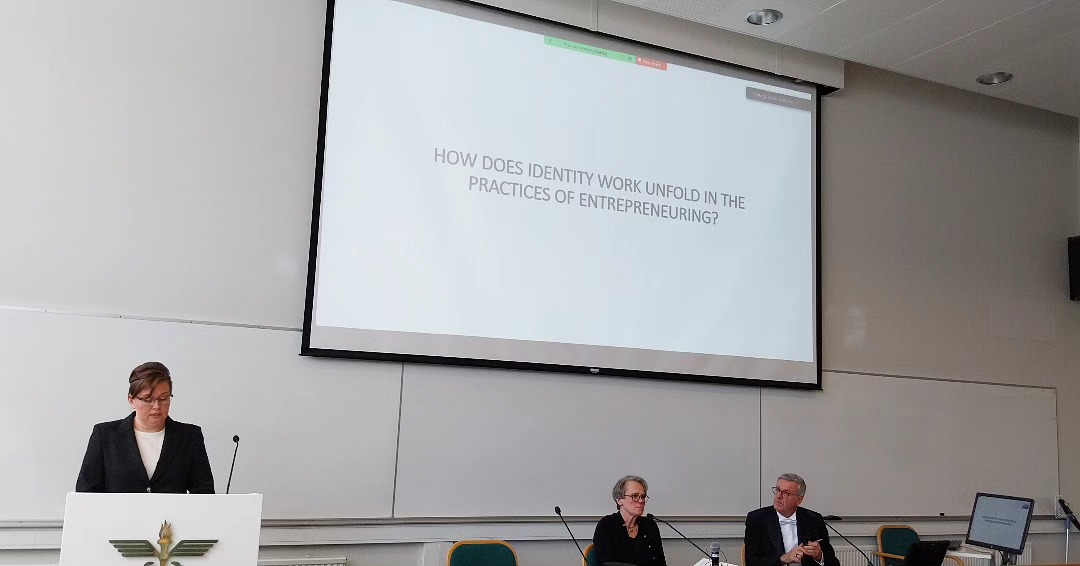
Anna Elkina defended her doctoral dissertation in Entrepreneurship entitled ”Unfolding identity work during an entrepreneurial journey. An autoethnographic study” at the University of Turku on 12.04.2024. Anna’s thesis was supervised by Professor Jarna Heinonen, who acted also as a Custos, and Professor Ulla Hytti. Anna was honoured to have Professor Chris Steyaert (University of St. Gallen, Switzerland) and Professor Kim Poldner (The Hague University of Applied Sciences and University of Groningen, the Netherlands) as the pre-examiners of the thesis. Professor Steyaert acted also as an opponent in the deference.
Entrepreneurship is often considered a remedy for economic, social, and currently even environmental diseases and is discussed within the context of economic growth, employment and overall non-stagnant development of humankind. However, it is also about people, about our relationships, our needs and desires, about becoming rich or poor, about successes and failures, about curiosity and learning, about taking risks and experiencing uncertainty. Thus, entrepreneurship is also about individuals and their journey.
In the autoethnographic study, Anna presents and analyses her own experience of entrepreneuring. This methodological approach allows to reveal how the entrepreneurial becoming is experienced from within a person. Anna focus, for example, on identity conflicts and their resolutions that took place during the entrepreneurial journey.
Anna suggests that in the process of entrepreneuring, identity work unfolds through the experiences of in-betweenness: in-between the gendered roles one plays in society or in-between multiple (and multiplying) constructions of entrepreneurship one absorbs and reproduces. In practice, it might also mean, for example, that some cross-border migrants expose their liminal identity by organizing a business that relies on their national identity (cooking national cuisine, language teaching, organizing cultural events).
On the other hand, the autoethnographic study invites the reader to critically revise practices and discourses that constitute the phenomenon of entrepreneurship. In this study, entrepreneuring is understood as a process of creative organizing that is deeply embedded in other practices of everyday life. Therefore, Anna suggests that affective experiences that often reflect this embeddedness are not mere disturbances or restrictions for entrepreneuring, as they are often seen, but rather sources of creativity that can enhance the finding of new solutions to the existing problems.
The dissertation is available on https://urn.fi/URN:ISBN:978-951-29-9642-1
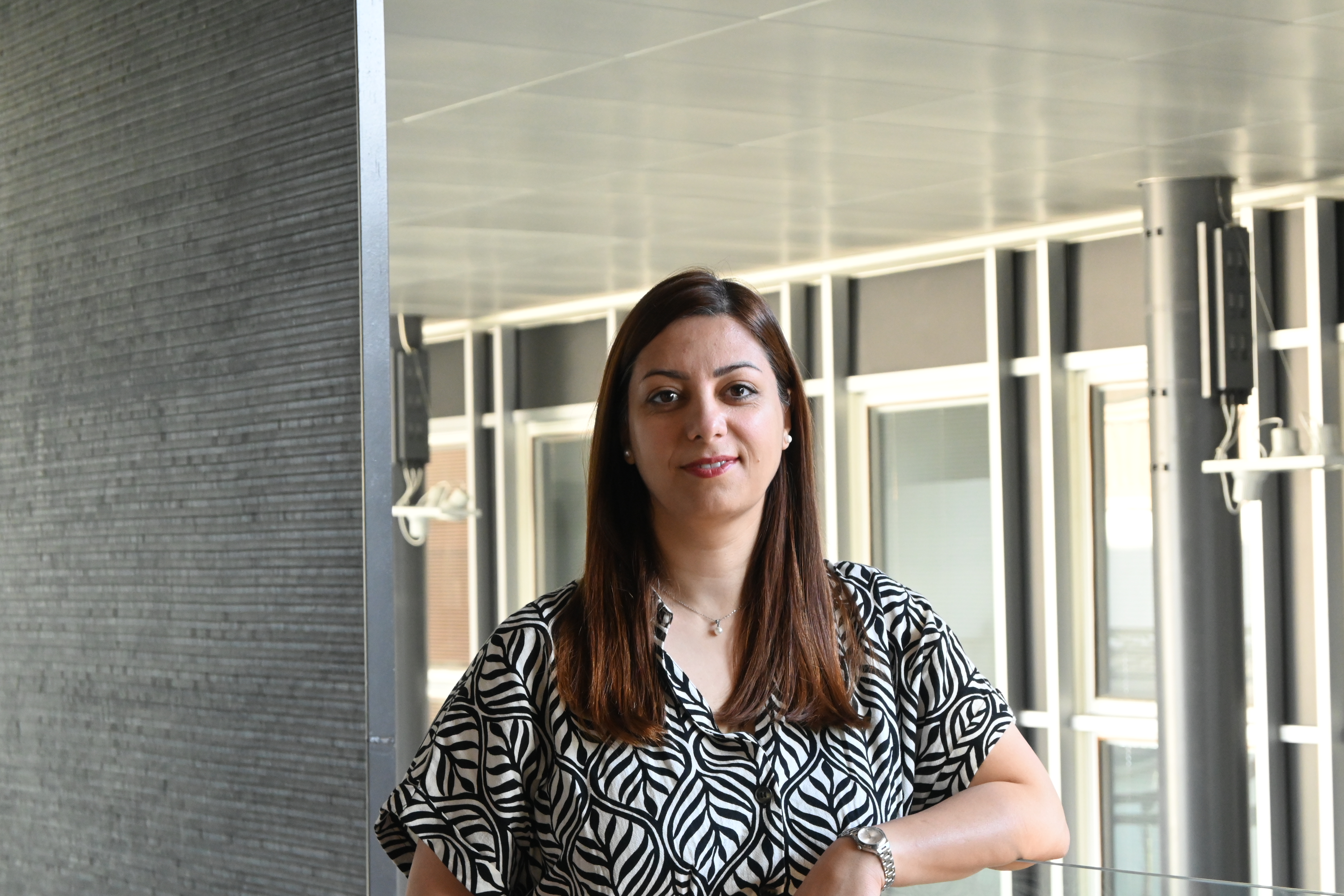
Nasim joined the Entrepreneurship Unit as a PhD student in January 2024. Her research focuses on immigrant female entrepreneurs.
What brought you to Finland?
I came to Finland in 2021 to pursue my second master's degree in Global Innovation Management at the University of Turku. Drawn by Finland’s renowned education system, I was eager to experience its high academic standards firsthand. After extensive research, I applied to UTU and was honoured to receive a scholarship, which made this opportunity even more rewarding.
How did you join the Entrepreneurship Unit at the UTU?
During my master's studies in Global Innovation Management, I was naturally drawn to courses and projects that explored entrepreneurship, innovation, and the challenges and opportunities faced by startups. This growing interest led me to participate in various workshops and programs at Boost Turku, such as Startup Marathon and Startup Journey, where I had the opportunity to apply my academic knowledge in a practical setting. Wanting to further deepen my understanding, I consulted my supervisor about my passion for entrepreneurship. He introduced me to the Entrepreneurship Unit at TSE, highlighting its collaborative environment and excellent research facilities. Inspired by this, I applied and was fortunate to become part of the team.
How have you experienced Finland during the first few months of your stay?
I arrived in Finland on August 2nd, and one of the first things that surprised me was the long daylight hours. As a nature enthusiast, I was captivated by Finland’s breathtaking landscapes—walking in the forests, fishing, and boat riding were truly incredible experiences. Beyond nature, the warm and welcoming attitude of the teachers at TSE, along with the opportunity to connect with both international and Finnish students, made my first few months even more memorable.
What has been your experience of working in the unit so far?
Being part of the Entrepreneurship Unit has been an intellectually enriching and collaborative experience. The supportive environment not only nurtures innovative thinking but also strengthens the sense of community among researchers. My supervisors and colleagues have been incredibly supportive, and engaging with them, along with peers , has deepened my understanding of research. This experience has provided me with valuable insights into both its theoretical foundations and practical applications.
What differences have you noticed between the education systems in Iran and Finland?
There are several key differences between the education systems in Iran and Finland. One of the most noticeable contrasts is the teaching approach—while Iran’s system is more structured and exam-oriented, Finland emphasizes student-centred learning, critical thinking, and practical application. In Finland, there is a strong focus on independent study, collaboration, and problem-solving rather than rote memorization.
Additionally, the relationship between students and professors in Finland is more informal and interactive, fostering open discussions and creativity. The flexibility in course selection and interdisciplinary learning also sets Finland apart, allowing students to tailor their education based on their interests and career goals. Moreover, Finland’s education system places a high value on work-life balance, whereas in Iran, academic pressure can be more intense.
Overall, Finland’s education system promotes innovation, independence, and a more holistic learning experience, which I have found both refreshing and inspiring.
Other entrepreneurship education highlights
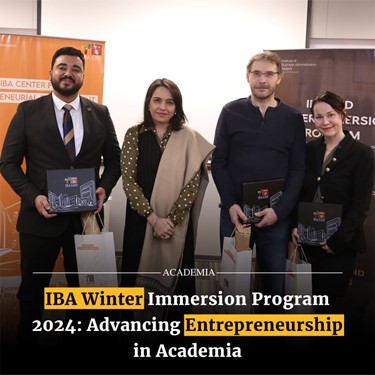
Sanna Ilonen and Joachim Ramström continued their education export efforts in 2024. They took part in IBA-CED Winter Immersion programme by running a workshop on Advancing Entrepreneurship in Academia in December. This was continuity for the workshop organized in 2023 in Karachi.