Gonzalo
Preciado Azanza
Ota yhteyttä
Linkit
Asiantuntijuusalueet
Biografia
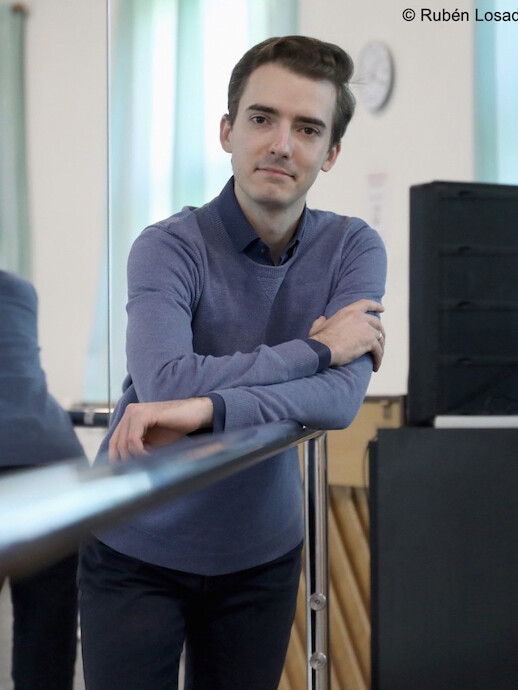
Gonzalo Preciado Azanza is a Marie Skłodowska-Curie Fellow at the Department of Art History and the Turku Institute of Advanced Studies of the University of Turku within the MSCA COFUND programme Turku Intersectoral Excellence Scheme. He was previously a predoctoral and postdoctoral fellow funded by the Government of Aragón at the Department of Art History and the Institute of Heritage and Humanities at the University of Zaragoza in Spain (2022-2025), and a professional dancer with the Latvian National Ballet (2015-2021).
He holds a PhD in Art History from the University of Zaragoza (Outstanding Cum laude and International Mention). He received his BA Hons in Professional Practice in Arts (Dance) from Middlesex University London, an MA in Cultural Management from the Universitat Oberta de Catalunya-Universitat de Girona, and a MA in Advanced Studies in Art History from the University of Zaragoza (Extraordinary Prize and Mention of Excellence). He completed his artistic training at the Conservatorio Municipal Profesional de Danza and the María de Ávila Ballet School, graduating from the English National Ballet School after receiving the UK’s Government Dance and Drama Award.
He has published peer-reviewed papers in top-tier journals (Dance Chronicle, Anales de Historia del Arte, and Letonica), book chapters in prestigious publishers, and he is the author of the book Breve historia de la jota aragonesa en el ballet (Rolde, 2023). He has presented his research at international conferences and advanced schools in the US, the UK, France, Latvia, Lithuania, Greece, Spain, and Finland, including Harvard University, Queen´s University Belfast, and the Spanish National Research Council (CSIC).
His international experience has been reinforced as a visiting researcher at Université Paris 1 Panthéon-Sorbonne, Université Paris 8, the University of Latvia, the Institute of History (CSIC), and Harvard University, where he was a Fellow with the Davis Center for Russian and Eurasian Studies.
He is currently the Principal Investigator (PI) of the project The European diagonal in the Baltic region: Building Resilient and Democratic Values through Spanish-themed ballets (BRIVS) (co-funded by the MSCA, grant agreement no. 101217329). He has also previously been PI of the project Los Pirineos y la jota del Alto Aragón en la danza y el ballet (funded by DPH-IEA, SEFYCU 4565237), as well as other research actions funded by the Banco Sabadell Foundation, the CAI Foundation, the Cátedra Gonzalo Borrás (Aragón Government-UNIZAR), the Institute of Heritage and Humanities (UNIZAR), and the Iberus Campus of International Excellence. He has also been a member of the research group Observatorio Aragonés de Arte en la Esfera Pública and the research project Cuerpo danzante (MCI/AEI/FEDER-UE, PID2021-122286NB-I00).
His leadership has been reinforced as a reviewer for peer-reviewed journals, member of Scientific Committees, and co-organizer of international conferences and seminars. He is a member of the Dance Studies Association, the European Association for Dance History, the Nordic Forum for Dance Research, the Association for the Advancement of Baltic Studies, and the Asociación D+I: Danza más Investigación. He has also been included in the Latvian Encyclopedia of Dance and Ballet.
As part of the bid to have the jota recognized as an Intangible Cultural Heritage of Humanity (UNESCO), he has conducted public outreach activities with public entities in Aragón. His choreographies So far, yet so close (Art Museum Riga Bourse, 2017) and The Essence of Time (Latvian National Library, 2018), both commissioned by the Spanish Embassy in Latvia, contributed to strengthening their bilateral relations. He has also performed extensively in different theatres across Latvia, Lithuania, Estonia, Germany, Italy, Spain, and the UK.
Opetus
He has taught the following courses from the BA in Art History at the University of Zaragoza (Spain): 19th Century Art; Art market, cataloguing and collection management; Conservation and restoration of artistic heritage; Music History; Music in today's society. He has also collaborated in several teaching innovation projects at this university.
He has also collaborated in teaching the course Ballet, Past and Present at Harvard University.
Tutkimus
Throughout his career his research lines has focused on dance and the visual arts through:
1) Artistic exchanges in the Baltic region with a particular interest in the interplay of Latvian-Spanish culture and ballet productions staged by overshadowed female choreographers. He started this pioneer research line during his MA dissertation at the University of Zaragoza and he plan to expand it further during his MSCA project (BRIVS).
2) The transnational impact of Spanish dances with a particular focus on the influence of Aragonese jota in ballet across the nineteenth and twentieth centuries. By doing so, he debunks the mainstream notion that Spanishness merely includes Andalusian archetypes.
3) Choreographic processes in the digital age within the framework of the Movement Lab SPACE+DIGITAL+DANCE, that he co-founded with Dr. Adesola Akinleye (Texas Woman's University).
At the University of Turku, his research will focus on two main areas. First, he will examine the relevance of the Baltic region as a major cultural crossroads through the performing arts in the early twentieth century with a particular focus on the artistic exchanges and transnational networks between Latvia and Spain. Second, he will unravel the meaning of gestures, examining the embodied identities, imaginaries, and ideologies that can be traced using the concept of the “Body as Archive” and Digital Humanities techniques. By doing so, the outcomes of this MSCA project will enable him to develop a new gesture-based approach to analyse socio-political shifts that took place in the Baltic region during the interwar period, using a meaningful acronym for Latvian citizens: BRIVS (which means free).