Sustainability transformation is the imperative of our time, but how can the fundamental shift of societal and economic systems and practices be achieved? What is the role of different actors, themes, and perspectives in building a just and sustainable society?
This summer, Finland Futures Research Centre (FFRC) organises the annual Futures Conference and invites participants to confront the complexities of sustainability and the systemic changes of our future. This year marks the 26th Futures Conference, a collaborative event between FFRC, Finland Futures Academy, and the Sustainability Transformations Doctoral Education Pilot (SusTra).
The multidisciplinary conference features keynote speeches from Inger Birkeland, Per Högselius, and Geci Karuri-Sebina, bridging global geopolitics, equitable future-thinking, and the power of local narratives to provide a comprehensive roadmap for navigating our planetary crisis.
To complement these perspectives, the event facilitates a deeper dive into the research with 110 spoken presentations, as well as 18 dedicated workshops and special sessions. Together, these sessions span the full spectrum of the crisis, from the ethics of AI and regenerative economic models to the deep-time temporalities and ’more-than-human’ agencies required for planetary well-being.
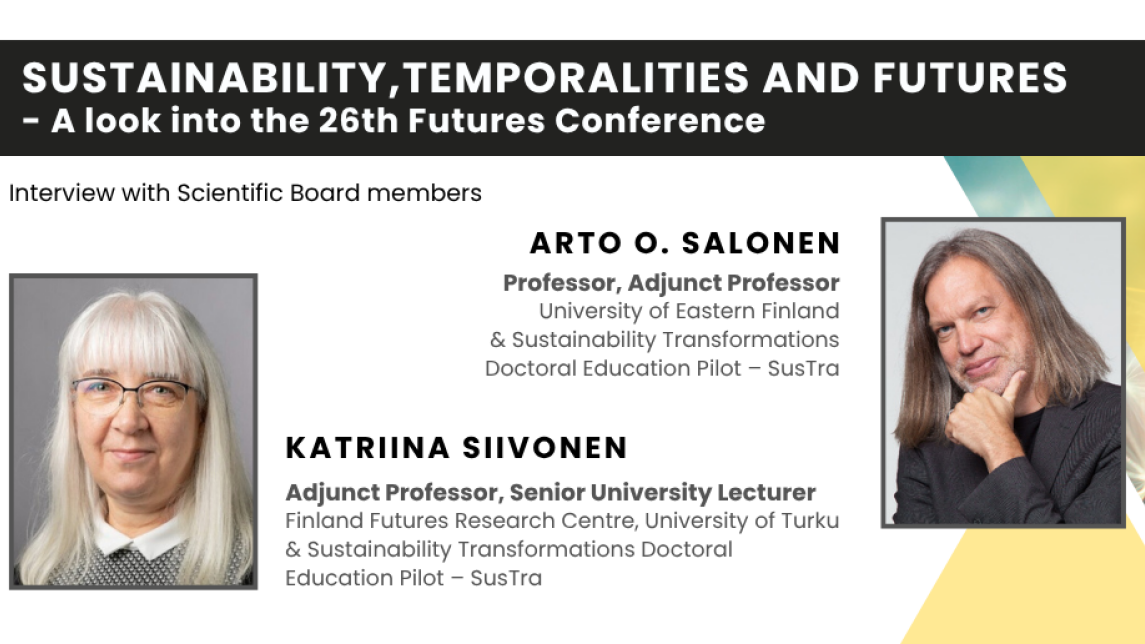
As we move into the final stages of planning the conference, to get a sense of the vision driving this event, we caught up with two members of the scientific board, Arto Salonen and Katriina Siivonen, to hear what they are personally most eager to explore when the doors open.
Arto highlights how a conference is more than just a schedule of talks, it’s a collision of ideas meant to spark real-world change: “I would like to hear value discussions about what we need more of and less of so the future smiles on us. I also hope to participate in a solution-oriented conference. I think it is lazy to recognize a problem without trying to solve it.”
Katriina adds to the idea of conferences being more than a meeting of the mind, stretching our perspective across the scales of time: “Interdisciplinary discussion with different past and future time perspectives from geological time horizon to a fleeting moment connected to current global polycrisis, values, and new understandings needed for anticipatory actions and solutions.” Ultimately, the goal is to move beyond old paradigms and develop a new, shared understanding of what it means to act sustainably in a world of uncertainty.
With sustainability transformation being a generational issue, to truly understand where we are going, we have to look at temporalities, a key theme of the conference. Arto Salonen frames the challenge perfectly:
“Sustainability research inherently combines the past, present, and future. It is also natural to link time-related topics to future research, as represented by the Finland Futures Research Center (FFRC) that facilitates the conference.”
As part of the large concept of temporalities, the conference asks how geological time perspectives, historical understanding, individual and collective memories, and futures thinking can guide individuals, societies, and humankind towards more sustainable outcomes, and how various individual and collective memories and anticipations impact unfolding futures and planetary wellbeing. Though the focus of the conference is naturally on futures, the role of the present is crucial for the building of sustainable futures.
“The present is the only temporal element which we have as tangible thing in our lives. In present, we have evidence and memories of pasts, and we have understanding of different futures. In present, we have also tacit knowledge and emotions, which are related to these. All of these have an impact on our actions towards futures.” emphasizes Katriina Siivonen.
Each year, the Futures Conference gathers researchers, practitioners, decision-makers, and students from around the world in Turku to discuss futures. This year, already 270 people have registered to attend. With sustainability being a key theme for a number of conferences globally, “There is at least really huge interest to the conference and its theme. My understanding is, that it is combining in a new way different disciplinary views and have a potential to serve as a platform for new contacts and co-creation.” Katriina adds.
Across two days we will unpack decades of foresight and research into a powerful blueprint for systemic change. We look forward to you joining us this summer in Finland to help bridge the gap between imagining a sustainable future and actively building one.
The 26th Futures Conference “Sustainability, Temporalities and Futures” takes place at the University of Turku on 9–10 June 2026. Registration is open until the 26th of May.
Tarian Jenkins & Janna Jokela
Doctoral Researchers (SusTra / FFRC)