The Entrepreneurship Unit actively contributes to society by engaging with policymakers, entrepreneurs, students, and the wider public. During 2025, our research informed policy discussions, public debate, and entrepreneurship practice, while our Entrepreneurs in Residence helped strengthen connections between academia and the entrepreneurial ecosystem.
Research contributing to public debate, policy and inclusion
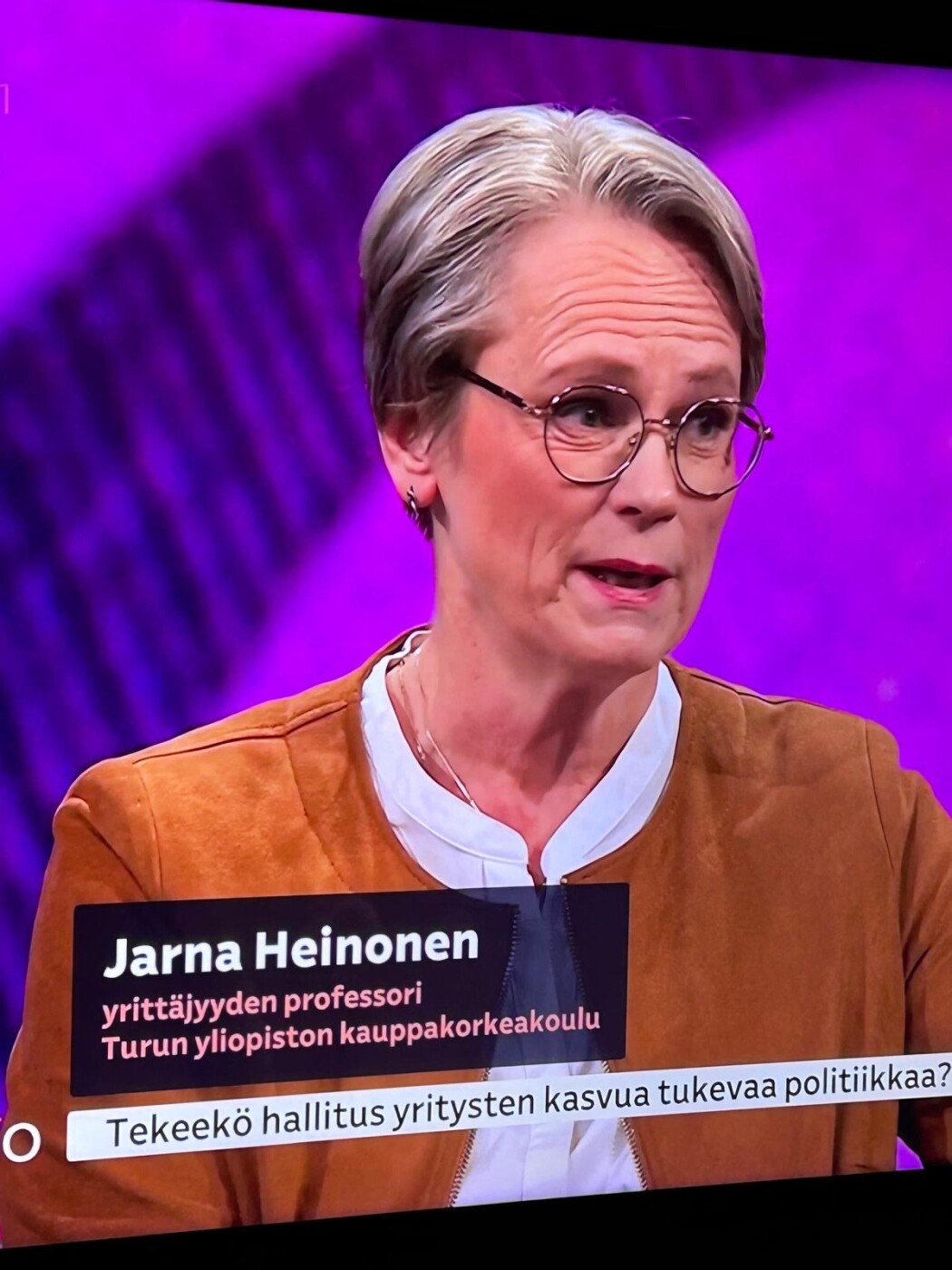
Professor Jarna Heinonen appeared on YLE’s A-Studio as an expert commentator to discuss whether the current government is pursuing policies that genuinely support firm growth. Having studied entrepreneurship policy for more than twenty years, she found it striking how consistently similar results reappear over time – most recently in our study for the Prime Minister’s Office on business formation activity. Finnish entrepreneurship policy has long emphasized the protection and maintenance of existing structures, relying on measures such as removing barriers to entrepreneurship and fostering a predictable operating environment. As a result, Finland scores well on the structural preconditions for entrepreneurship. Nevertheless, relatively few individuals choose to become entrepreneurs, and even fewer pursue growth.
A second research finding sheds light on this question. Entrepreneurship policy in Finland tends to overlook profit-seeking and future-oriented renewal. As a consequence, the incentives for entrepreneurship and growth remain insufficient. The policy instruments for removing barriers and for creating incentives operate in fundamentally different ways. Removing barriers responds to the question, “Why am I unable to start or grow my business?” whereas incentives respond to the question, “Why should I become an entrepreneur or seek to grow my firm?”
Our research provides clear indications that entrepreneurs’ growth aspirations are dampened by weak incentives for entrepreneurship and expansion. In an expert workshop associated with the study, one participant referred to structural features of Finnish society by noting that “we have incentives not to be entrepreneurial.” Such incentives do not foster individual or firm-level dynamism, nor do they support economic growth. On the contrary: fostering growth requires bold – yet often simple – positive incentives.
Heinonen’s strong message to the audience was that Finland needs bold reforms that encourage individuals and firms to be active and growth-oriented. This also requires a shift in mindset: we must seize opportunities with confidence and aspire to ambitious growth. She urged us to avoid pessimism and with open-mindedness build a better and more hopeful future. She was also confident that research can make a difference and impact – together we can!
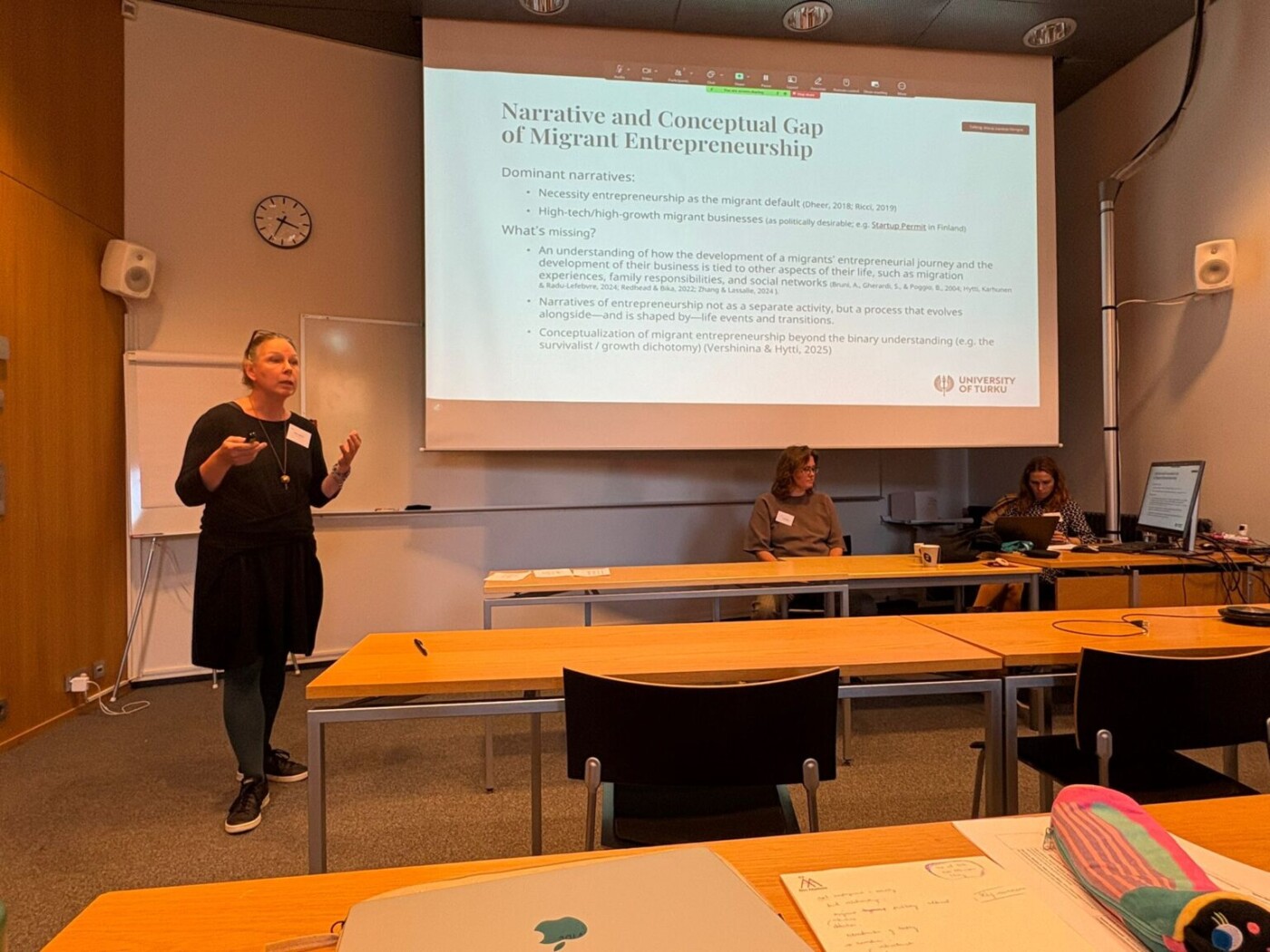
On 9–10 October 2025, researchers from the HI-GEE project took part in the Business and People on the Move conference, held at Åbo Akademi University in Turku. Organized by the Refugee Entrepreneurship Research Group, this year’s conference carried the inspiring theme Breaking Barriers, Building Bridges: The Power of Migrant and Refugee Entrepreneurship.
The event brought together scholars from different continents to discuss the many ways in which migration and entrepreneurship intersect, and how individuals navigate opportunities, challenges, and belonging in their entrepreneurial journeys.
The HI-GEE researchers Satu Aaltonen, Anna Elkina, Tommi Pukkinen, and Ulla Hytti presented the first results from the project, Navigating the Entrepreneurial Journey: Immigrant Entrepreneurs’ Experiences and Future Aspirations across Life and Business Trajectories. The presentation explored migrant entrepreneurship from a life-course perspective, looking at how entrepreneurial experiences intertwine with personal trajectories, social belonging, and community engagement. The team contrasted linear entrepreneurial paths, where entrepreneurship marks the culmination of a career journey, with entrepreneurial episodes, where business ownership appears as one phase within diverse life experiences. The findings highlight how life events and belonging shape entrepreneurial identities and how migrants contribute to both economic and social development of the host countries.
In another session, Natalia Vershinina and Ulla Hytti presented their conceptual paper, Beyond Survival: A Critical Reappraisal of Immigrant Entrepreneurship. They called for a rethinking of migrant entrepreneurship, moving beyond the binary of high-growth versus necessity-based entrepreneurship. Their paper encourages a more nuanced and contextualized understanding of the many entrepreneurial paths that might or might not lead to the growth of the business.
Throughout the conference, discussions centered on themes such as migrants’ resilience, structural barriers, civic and entrepreneurial belonging, and embeddedness in local communities, as well as the broader links between employment, economic participation, and business growth. These topics strongly echo the HI-GEE project’s core aim to understand how the skills, experiences, and entrepreneurial activities of immigrants contribute to Finland’s economic development and how inclusive practices can strengthen both individual opportunities and national growth.
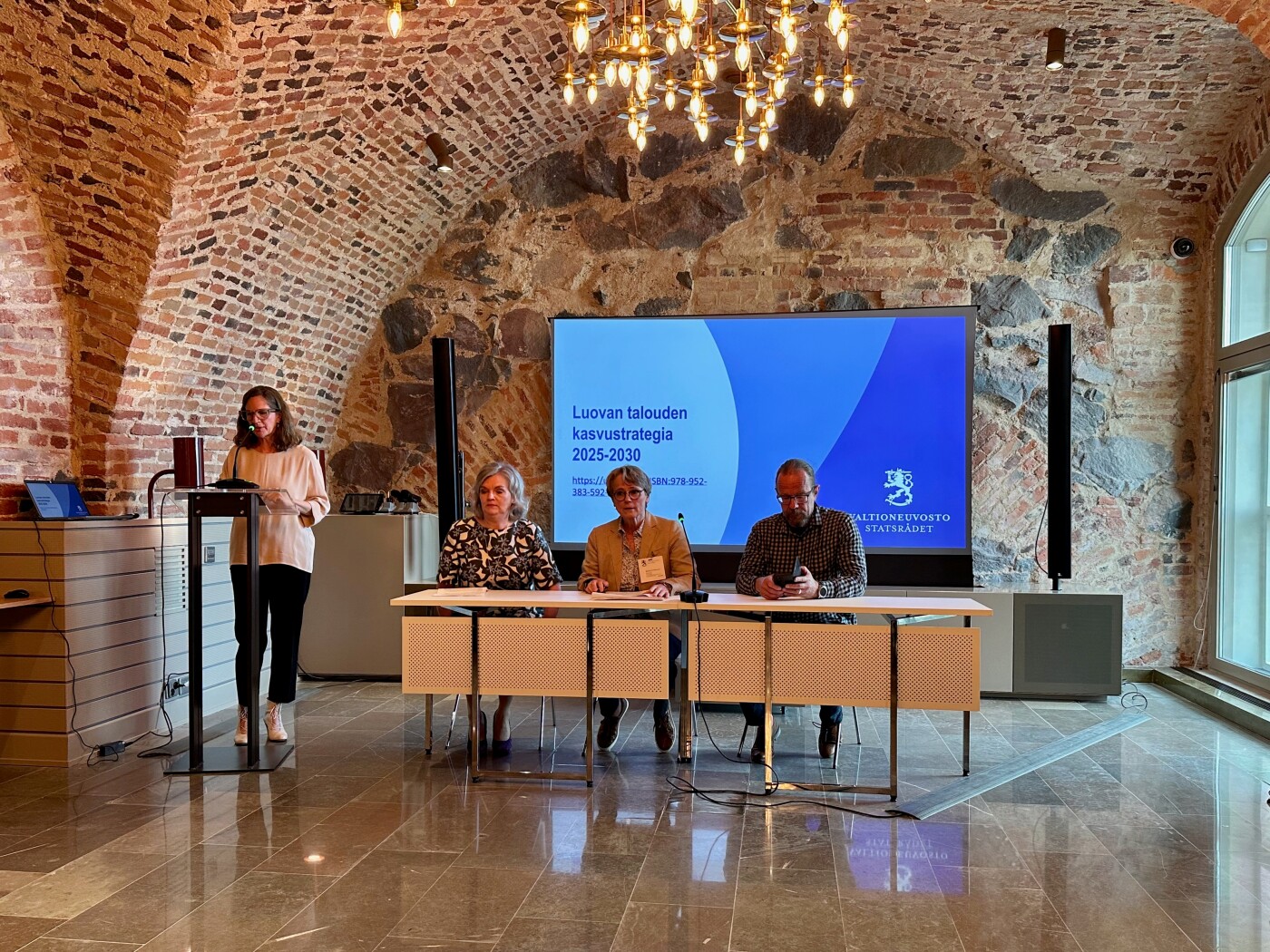
As a part of disseminating ECOCRIN research findings professor Jarna Heinonen participated to several events discussing growth of creative economies. She served as as an invited panelist at the launch event for the Creative Economy Growth Strategy, organized by the Ministry of Economic Affairs and Employment (MEAE) and the Ministry of Education and Culture (MEC) as well as at the Textile & Fashion Forum Helsinki. Furthermore, she gave a keynote speech at the Business and Culture 2025 event organised by the Arts Promotion Centre Finland (Taike). The discussions touched upon the growth potential of creative economies and the ways in which it could be unleashed. The key question remains: how can the latent potential of the creative economy be converted into viable business activity and scalable growth?
Our research within the creative industries has focused on entrepreneurship, innovation, and growth. Our findings suggest that creative-sector actors frequently experience skill gaps, particularly in business and entrepreneurial competences. Many do not fully appreciate that culture and creativity can constitute a livelihood, and that entrepreneurship is a viable form of work. The sector suffers from both limited willingness and limited ability to build economically sustainable creative ventures—an issue that ultimately traces back to skills and to prevailing professional cultures. Furthermore, through culture and the arts, it is possible to generate intangible value for consumers and audiences, and to catalyze growth in other industries—for example by contributing through creative methods to firms’ innovation activities, renewal efforts, or strategic development.
According to our research, the creative industries require integrative policy that brings together multiple forms of value creation: economic value and growth on the one hand, and art, culture, and creativity as intrinsic values on the other. These should not be viewed as opposing forces but rather as mutually reinforcing elements. Integrative policy is cross-administrative, combining perspectives from cultural policy, entrepreneurship policy, and innovation policy. Such cross-pollination and collaboration should also occur within the creative industries themselves and across sectoral boundaries. It is therefore essential that the strategy be implemented boldly and iteratively through cross-administrative collaboration between ministries and in partnership with grassroots actors and intermediary organizations. These models of collaborative practice have been tested and developed in our ECOCRIN* research project and disseminated in various occasions and scholarly writings. Policy-making requires entrepreneurial experimentation and creativity. In the growth of the creative economy, experimentation and creativity have a particularly important role—just as research plays a crucial role in informing policies.
* ECOCRIN (Sustainable and Innovative Creative Ecosystems) is a Business Finland funded research project examining creative economy ecosystems and the innovation and cultural policies that support their growth.
Entrepreneurs in Residence bridge academia and practice
The Turku School of Economics Entrepreneurs in Residence (EiR) programme strengthens connections between the University and the entrepreneurial community by bringing experienced entrepreneurs and business leaders into teaching, mentoring, networking, and student activities. In 2025, the programme featured five Entrepreneurs in Residence:
- Hannu Aaltonen, CM-trader
- Petri Hollmén, Founder and CEO of Lyyti Oy
- Jussi Karttila, Founder and CEO of Zefort Oy
- Noora Keskievari, Co-Founder and CEO of OneMind Dogs Oy
- Sari-Anne Poikkijoki, Founder and CEO of Åma Oy.
Together, they enriched entrepreneurship education and research by providing practical perspectives, supporting students, and fostering links with the regional entrepreneurial ecosystem.
Among the programme's highlights in 2025 was Entrepreneur in Residence Noora Keskievari's speech at the Turku School of Economics' 75th Anniversary Gala, where she reflected on her journey from student entrepreneur to investor and discussed the importance of courage, experimentation, and community in fostering entrepreneurship.
As an alumn, and today an Entrepreneur in Residence (EiR) and the Chair of Monttu Ventures, I feel grateful and proud to be part of this community. I began my studies here over 20 years ago, in the early 2000s. I still remember walking into the school as a young student - full of curiosity, ambition, and perhaps a bit of youthful impatience to do something real. From a very young age, I had been a doer, someone who loves to get things done. So it’s no surprise that I took the leap into entrepreneurship at the very beginning of my studies. In those early years, combining studies with running a company was the perfect way to test everything I learned in lectures, and I was applying them immediately in real business.
In the early 2000s, the culture around student entrepreneurship was very different from today. There were only a few student start-ups and almost no support systems. Being a student entrepreneur felt a bit unusual, not fully understood or encouraged at that time. But even with limited support for entrepreneurship, the education I received here gave me a strong foundation: practical tools from balance sheets to strategy, that I could use immediately in my own company. Most importantly, they taught me to think critically and see problems from different angles, which is valuable for any entrepreneur.
I have witnessed how Turku School of Economics has evolved, especially over the last decade, into a hub that actively fosters entrepreneurship and innovation. Our School has taken a huge leap forward in embracing the entrepreneurial spirit. There are courses, programs, and societies dedicated to startups and innovation. Guest speakers, seasoned entrepreneurs and innovators, regularly share their experiences with students. The attitude has shifted to encourage students to experiment with their own business ideas and research commercialization.
As a Chair of Monttu Ventures, the student-led venture company, I get to work closely with the next generation of entrepreneurs and see firsthand how strongly the entrepreneurial spirit lives at our School. In Monttu Ventures our alumni and students come together to bridge academia and the startup world proving that entrepreneurship in Turku is thriving.
Celebration is not only about looking back – it’s about looking forward
When I think about the next 75 years, I keep coming back to one thing: the courage to build something new! For me, courage has always meant taking a step before everything feels ready. The first step is often the hardest; staying where things are familiar is always easier. But nothing new grows there. Growth happens when you take a risk, when you don’t yet know the outcome, and when you choose to move forward. That’s why this community matters so much. When you feel supported by your School, by mentors, by peers, the leap into the unknown becomes easier.
We are fortunate to have a highly passionate generation rising, eager to build companies and solve big problems. I see this passion every day in our students and young entrepreneurs. Our job – as a university, as educators, as alumni – is to nurture that passion. We must give them the skills, the confidence, and the permission to follow that path.
Let me address a question that might be on the minds of potential students or entrepreneurs: “Why come to Turku to study and to build a company?” Here’s my short pitch - from the perspective of someone who studied here, built businesses here, and continues to invest in Turku’s future. Turku gives you three things that really matter: great education, a supportive ecosystem, and a community where people genuinely help each other. Turku is smaller than Helsinki, yes, but honestly, that’s our superpower. You find the right people faster, things move quicker, and you don’t get stuck in traffic. It takes about 15 minutes to get anywhere. If you’re still thinking where to study or start a company, Turku is the place. Trust me.
75 years is a long journey. Through all the changes in business, technology, and the world around us, this School has kept moving forward and giving its students what they need to succeed. Looking forward, the next decades will bring challenges we can’t yet see, and opportunities we shouldn’t miss.