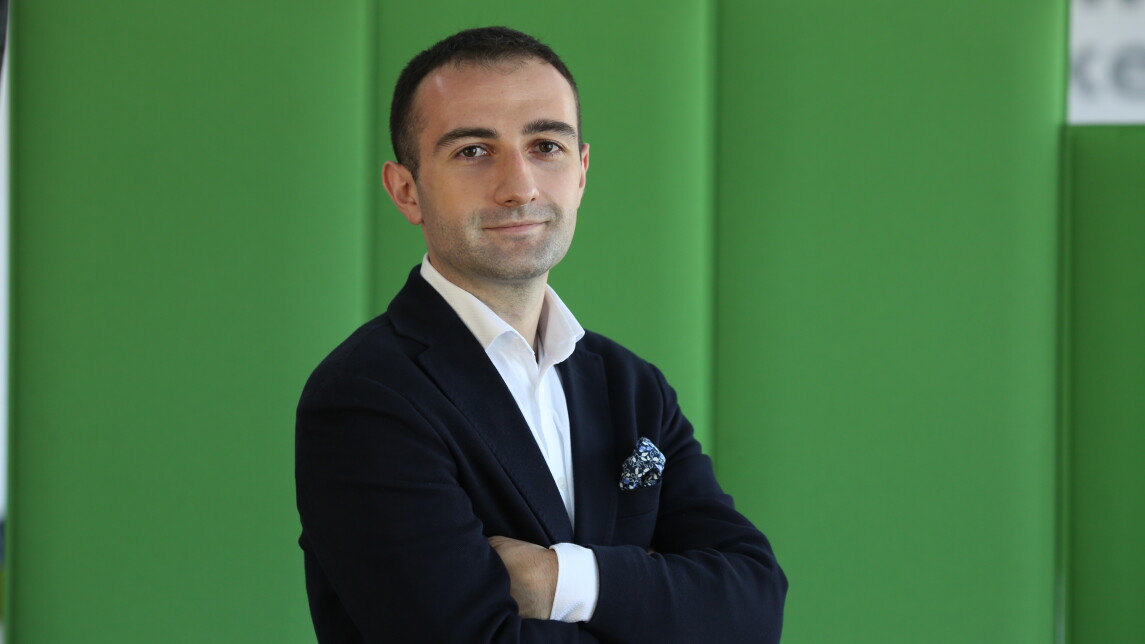
Doctoral Researcher Levan Maisuradze is the next featured guest in the Faculty of Law’s 'Researcher in the Spotlight' series.
Name: Levan Maisuradze
Position in the faculty: Doctoral Researcher
Degrees: Master of Law
Fields of interest: Online Platforms, AI Regulation, IT Law, Media Law, Telecommunications Law, EU Law, Constitutional Law
Describe your career path. What led you to your current position?
My academic and professional path has taken me from Georgia to Finland, where I began doctoral research at the University of Turku in 2025. I hold Master’s degrees in Private Law from Tbilisi State University and in European Business Law from Lund University.
Before joining Calonia, I worked as head of the legal support group at the National Communications Commission of Georgia, the media and telecommunications regulatory authority, also served as an elected member of the Council of Europe’s Committee of Experts on Online Safety and Empowerment of Content Creators and Users, and held various positions at the legal provision and research department of the Constitutional Court of Georgia.
This diverse experience shaped my interest in how law responds to complex social and technological challenges. As a practicing lawyer and public servant, I often dealt with questions concerning regulation, fundamental rights, general principles, and institutional decision-making at both national and international levels. Over time, I became interested in exploring these questions from an academic perspective. Doctoral research provides me with the opportunity to examine issues I previously encountered in practice, but now with more theoretical depth.
What projects are you currently working on?
I am currently pursuing my doctoral research within the EU co-funded project HAIF - Human-Centric Artificial Intelligence for a Sustainable Future. My research focuses on AI-based content moderation practices of online platforms and their implications for fundamental rights.
In particular, I examine how EU law addresses the challenges created by AI-based content moderation. These include risks of over-moderation - where lawful or legitimate expression is restricted, under-moderation - where harmful or unlawful content remains available, algorithmic bias and the lack of transparency in automated decision-making. I find these questions especially pressing, as online platforms increasingly influence the public discourse, the exercise of fundamental rights and access to essential services.
Have your interests evolved since you finished your studies?
I have long been interested in methods of legal interpretation, the application of legal principles, and the relationship between legal rules and constitutional values. I have applied these methods in different legal contexts. At the outset of my career which is linked with the Constitutional Court, I worked mainly with constitutional law and human rights. During my Master’s studies and thesis work, I engaged European Business Law and tax law. At the later stage, my focus has shifted toward media and telecommunications law, online safety and digital regulation while working at the National Communications Commission and serving at the Council of Europe expert committee.
Currently, I am applying the same methodologies to the regulation of artificial intelligence and online platform governance. In that sense, my interests have not been entirely changed. On the contrary, they proved to be agile to meet themes of contemporary legal research. They have moved across different legal fields as new societal and technological questions have emerged and attracted my attention.
If you were not a researcher, what would your profession be?
If I were not a researcher, I would probably be a lawyer, as it gives me an utmost pleasure to perform as a practicing lawyer and to deal with the challenges of applying law to real-life problems. Another possibility would be linguistics. I have always been interested in languages and in observing how they operate, as systems of communication and as ways of understanding the world and cultures.
What inspires you?
I am inspired by stories of strong will and determination. I believe that when someone has strong will – or sisu as they call it here in Finland - very few things are impossible. Such stories remind me that progress often depends not only on knowledge or talent, but also on persistence, patience, and the ability to continue even when the path seems difficult or uncertain.
If you'd like, feel free to share how you've adapted to life in Turku and Finland, and the Calonia community.
Adapting to life in Finland has been both challenging and exciting experience. As I come from a sunny southern country, the Finnish climate has tested my weather-resistance. I have survived my first freezing season in Turku, which already feels like an achievement. I am still getting used to the long summer days and the lack of sunshine during winter.
At the same time, I have found Turku to be a very pleasant place to live and work. The Calonia community has been very welcoming, helpful, and collaborative. I especially appreciate the opportunity to exchange ideas with Finnish and international researchers. These conversations bring new perspectives to my own work and make the academic environment intellectually stimulating and enjoyable.